AI Opportunity Assessment for Small Business: Rank Your Top 3
An AI opportunity assessment for a small business scores every repeatable process and ranks the top three by payback before any budget is committed.
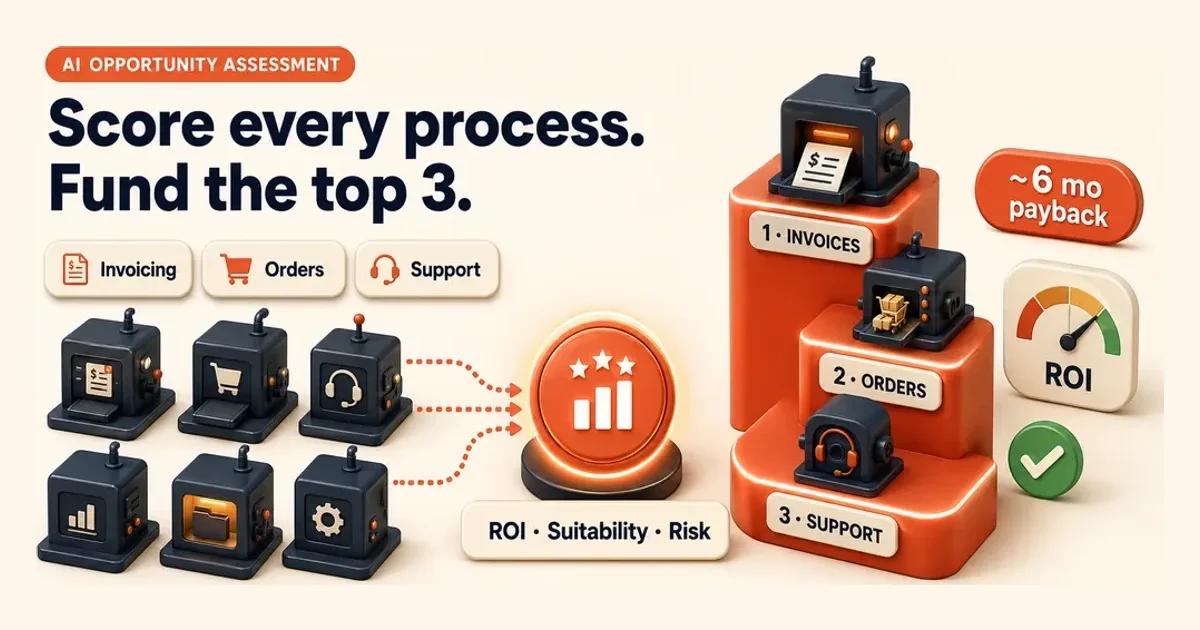
Most SMBs choose their first AI project the same way they choose a lunch spot. Whatever is closest, loudest, or recommended by the person in the room with the strongest opinion. The CV-screening tool a competitor mentioned. The chatbot a vendor demoed well. Six months and a five-figure invoice later, the payback is vague. The second project is harder to fund because the first one never proved itself. The problem was never the technology. It was that nobody ran an AI opportunity assessment before committing budget. Nobody scored the processes and ranked them.
Quick Answer. An AI opportunity assessment for small business scores every repeatable process for ROI, suitability and risk, then ranks the top three by payback before you commit budget. For an SMB it replaces gut-feel project selection with a defensible shortlist, so the first AI spend lands on the process with the fastest measurable return.
Why gut-feel project selection is the real cost
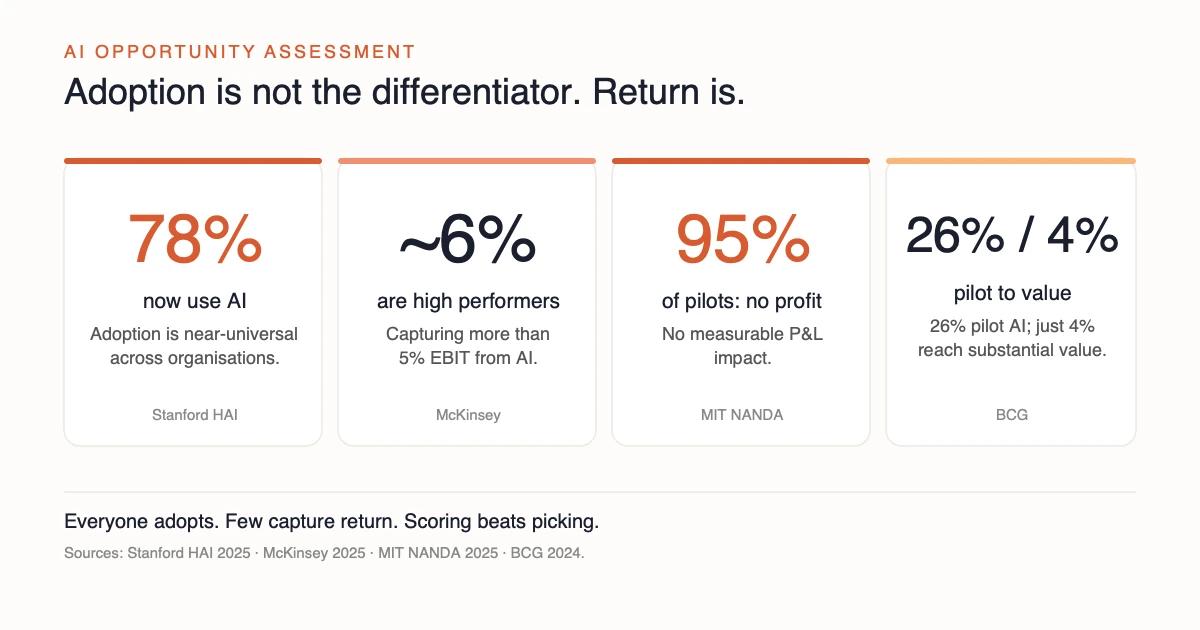
The headline AI-adoption numbers look like a gold rush. Stanford HAI's 2025 AI Index records that 78% of organisations reported using AI in 2024, up from 55% a year earlier 1. The share using generative AI in at least one business function more than doubled, to 71%. McKinsey's 2025 survey puts regular generative-AI use at roughly 80% of organisations, with two-thirds using it in more than one function 2. Adoption is no longer the differentiator. Almost everyone is using something.
Return is the differentiator, and it is scarce. McKinsey's same survey found that only about 6% of firms qualify as AI high performers attributing more than 5% of EBIT to AI 2. BCG's 2024 study of 1,000 executives across 59 countries was blunter. Only 26% of companies had built the capabilities to move beyond proofs of concept and generate tangible value, and just 4% were generating substantial value across functions 4. MIT's 2025 Project NANDA study drew on 150 interviews and 300 public deployments. It found that roughly 95% of enterprise generative-AI pilots delivered no measurable profit impact, and explicitly attributed the failure to organisational choices, not model quality 3.
Read those three findings together and a pattern emerges. The bottleneck is not whether AI works. It is which work you point it at. MIT noted that more than half of generative-AI budgets went to sales and marketing, while the cleanest returns sat in unglamorous back-office automation 3. That is a selection failure, and it is exactly the failure an opportunity assessment exists to prevent.
For SMBs the stakes are sharper than for enterprises. A 200-person distributor cannot afford four failed pilots to find one winner. UK DSIT's 2025 Technology Adoption Review found AI use concentrated in larger firms 6. 68% of large accountancy and consulting firms used AI, versus just 15% of small ones. OECD data tells the same story across member economies. AI use among businesses with 10 or more employees rose from 5.6% in 2020 to 14% in 2024, still far behind mature tools like cloud 5. Skills and knowledge gaps hold it back, not appetite. Smaller firms have less margin for a misfire. That makes choosing the right first project not a nicety but the whole game.
What an AI opportunity assessment actually is
An AI opportunity assessment answers one question for an operations, finance or IT manager: of all the things we do, which two or three should we automate first, and why those? It is a business exercise, not a modelling exercise. No model is trained, no data pipeline is built. You are ranking candidates, not delivering them.
The method has three moves.
1. Inventory the processes. List the repeatable work the business does: invoice processing, order entry, ticket triage, quote preparation, document classification, data re-keying between systems, supplier onboarding. The unit is a process, not a tool or a department. A useful inventory for an SMB runs to a few dozen entries, not hundreds.
2. Score each process on three axes. For every candidate you ask: how big is the prize (ROI), how well does the work fit what AI can reliably do today (Suitability), and what does an error cost (Risk)? These map cleanly onto the structure of the NIST AI Risk Management Framework. It organises AI governance around mapping context, measuring impact and managing risk 8. The opportunity assessment is the front door to that discipline, applied at the level of a single process rather than the whole organisation.
3. Rank and cut to a top three. Combine the three scores into one comparable number and sort. The processes that score high on ROI and Suitability and low on Risk float to the top. Everything below the line waits. The output is not a strategy deck; it is a ranked shortlist with the arithmetic shown.
The reason the ranking matters more than any single score is that SMBs almost never lack ideas. They lack a defensible way to choose between them. When every idea is argued in isolation, the most confident advocate wins. When every idea is scored on the same three axes, the numbers decide. The second-best project stops crowding out the best one.
For the strategic context that sits above this exercise, meaning why you are adopting AI at all and what good looks like a year out, the AI strategy framework for SMBs is the companion read. The opportunity assessment is where that strategy becomes a list of processes in priority order.
The Agent Opportunity Score: ROI + Suitability − Risk
The scoring axis AI Priority Map uses is the Agent Opportunity Score. It is a single number per process, defined as ROI plus Suitability minus Risk. It exists so that a long, messy list of "things we could automate" collapses into a ranked table where the top entries are self-evidently the ones to fund.
- ROI captures the size of the prize. That is annual hours on the process, loaded labour cost, and a realistic automation rate (rarely 100%, often 40–70%), netted against build, licence and oversight cost. This is the number a finance director will check.
- Suitability captures fit. It asks how rules-bounded and repeatable the work is, how clean the inputs are, and whether the task is the kind of text-or-data work current models handle reliably. A high-volume, well-structured process scores high; a one-off judgement call scores low.
- Risk captures the cost of error: regulatory exposure, customer-facing blast radius, and how expensive human oversight will be. Risk is subtracted, which is what keeps a high-ROI but high-stakes process, say an automated credit decision, from ranking above a boring, safe, high-volume one.
A worked example
Take a 200-person distributor weighing four candidates. Invoice processing runs about 160 hours a month at a £28 loaded hourly cost. At a conservative 60% automation rate that is roughly £32,000 of gross annual saving. After run and oversight costs it nets near £24,000, with payback under six months. Run the same arithmetic on every candidate on the same basis and the list sorts itself:
| Process | ROI | Suitability | Risk | Agent Opportunity Score | Rank |
|---|---|---|---|---|---|
| Invoice processing | high | high | low | High | 1 |
| Order entry & confirmation | high | high | low–med | Strong | 2 |
| Customer ticket triage | med–high | high | medium | Moderate | 3 |
| Automated credit / pricing decision | very high | medium | very high | Low | — |
Illustrative dimension reads; the combined Agent Opportunity Score and its exact weighting live in the Agent Opportunity Score guide.
The credit-decision row is the one to watch. It carries the highest ROI of the four, and it still misses the top three. Its Risk (an automated pricing or credit error is expensive and customer-facing) is subtracted out. That is precisely what a ranked score enforces and a gut-feel shortlist misses. The most lucrative-looking process is often not the one to automate first.
The mechanics of how each component is computed, weighted and combined are set out in full in how the Agent Opportunity Score is calculated. The point worth holding here is structural. By forcing ROI, Suitability and Risk onto the same scale for every process, the score makes processes comparable. That comparability is the entire value of the exercise. Without it, "which should we do first" is a debate. With it, it is a sort.
Start with the evidence, not the enthusiasm. Before committing budget, see what a scored, ranked assessment looks like for a business like yours. Read a sample report to see the top-three ranking and roadmap in full, or start your AI Foundation Audit: a 40–90 minute wizard, delivered within 24 hours, with a 100% money-back guarantee if no process with measurable savings is found. (An interactive ROI calculator and self-serve scorecard are planned as a future enhancement and are not live yet; today the assessment is the guided audit.)
The evidence: scoring beats picking
The case for scoring-before-picking is not an opinion; it is what the adoption data shows when you read it for return rather than uptake.
The MIT NANDA finding, 95% of pilots with no measurable profit impact, is the strongest single data point. The researchers traced the failure to organisational and selection factors rather than to the models themselves 3. When the technology works but the projects fail, the lever is the choice of project. BCG's four-tier distribution makes the same point from the value side. 49% of firms were still stuck on proofs of concept, and only the top 4% ran what they called value engines 4. Proof-of-concept purgatory is what happens when projects are chosen for how impressive they look in a demo rather than for where they rank on payback.
The U.S. Census Bureau's Business Trends and Outlook Survey adds a useful corrective for SMBs specifically. AI use among firms rose steadily through 2024, and smaller firms led larger ones in nearly half of the tracked use cases, with marketing automation especially common among small businesses 7,9. That is double-edged. It shows small firms can adopt, but it also shows them clustering in the same visible, marketing-led use cases that MIT found delivered the weakest returns. The back-office processes with the cleanest payback, the ones an opportunity assessment surfaces, are systematically under-chosen.
Every numeric claim above is doing one job. It establishes that the gap between AI adoption and AI return is real, large, and driven by which processes get chosen. Scoring every process and ranking the top three is the cheapest available insurance against landing in the 95%.
Breaking it down: from ranked list to running system
A finished assessment hands you a ranked table. Turning that into working automation is a sequence, and each step has its own depth. The cluster of supporting guides comes in here.
Prioritising the use cases. The assessment produces the ranking, but applying a scoring framework by hand, choosing weights and handling ties and deciding where the cut line sits, deserves its own walkthrough. How to prioritise AI use cases covers the scoring framework step by step for a manager doing it themselves.
Choosing the first process. "Top 3" still leaves a sequencing decision: which of the three goes first? Usually it is the one with the highest Suitability and lowest Risk, even if its ROI is not the largest. You want an early, clean win that builds internal confidence. Which processes to automate first is the decision framework for that call.
Sequencing the rollout. Once the first automation lands, the rest of the ranked list becomes a roadmap. The AI implementation roadmap for SMBs covers phasing from first automation to broader rollout, including where to slot governance and oversight.
Understanding what you are deploying. Increasingly the thing being deployed is an agent: software that takes multi-step actions rather than only generating text. What that means, what it costs, and where it is safe to start for a smaller firm is covered in AI agents for SMBs.
Before any of this, it is worth running the pre-flight check in 50 questions to ask before implementing AI, and many of its questions feed directly into the Suitability and Risk scores, so the diligence and the assessment reinforce each other.
When an opportunity assessment is the wrong tool
Honesty requires naming the cases where scoring processes is not what you need, because recommending it universally would be the same gut-feel error in a different coat.
If you have no repeatable processes to score, there is nothing to rank. A pre-revenue startup or a project-based firm where every engagement is bespoke will not have the high-volume, rules-bounded work that scores well. The assessment will return thin results because the input is thin. Fix the process map first.
If the real blocker is data or systems, not selection. Some SMBs already know their top process but cannot automate it because the data lives in a system nobody can integrate with. Then the binding constraint is integration debt, not prioritisation, and a scoring exercise will only confirm a process you already suspected. That is a different problem with a different first move.
If the goal is growth, not cost-out. Opportunity assessments are strongest at surfacing efficiency wins: hours saved, errors reduced. If the strategic question is "how do we serve more customers with the team we have," the framing in scale, don't cut matters more than a savings-ranked table. The assessment still helps, but it should be read through a capacity lens rather than a headcount-reduction one.
If you are being sold a readiness or maturity verdict. A readiness assessment, the term the big consultancies own, answers whether your organisation is mature enough for AI in the abstract. It is a useful enterprise-governance exercise and a poor substitute for a ranked process list. If a vendor offers a maturity score where you needed a prioritised shortlist, you have been handed the wrong deliverable. Know which question you are actually asking.
In all four cases the discipline is the same one the assessment teaches: name the real constraint before spending against it.
What to do next
If you have AI projects competing for the same budget and no agreed way to rank them, the next move is not another vendor demo. It is to score the processes.
You can run a lightweight version yourself: list your repeatable processes, score each on ROI, Suitability and Risk, combine into a single number, and cut to a top three. The supporting guides above give you the framework for each step, and how the Agent Opportunity Score is calculated gives you the exact arithmetic.
You might rather have it done rigorously and defensibly, with the full process inventory, the scoring, the ranked top three, a phased implementation roadmap and an IT brief your team or integrator can act on. That is precisely what AI Priority Map's AI Foundation Audit delivers. It runs as a 40–90 minute guided wizard, the package arrives within 24 hours, and it carries a 100% money-back guarantee if no process with measurable savings is identified. The point of either route is the same. Spend the first AI pound on the process that the numbers, not the loudest voice, put at the top.
One ranked shortlist beats ten competing pitches. See a sample report to read a full top-three ranking and roadmap, or start your AI Foundation Audit and get your processes scored within 24 hours, money-back guaranteed if nothing with measurable savings is found.
Frequently asked questions
What is an AI opportunity assessment for a small business?
An AI opportunity assessment is a structured exercise that inventories every repeatable process in a business, scores each one for return, suitability and risk, and ranks the few that justify automation first. For a small business it replaces gut-feel project selection with a defensible shortlist — typically a top three — so the first AI budget goes to the process with the fastest, most measurable payback rather than the one that happened to be top of mind.
How is an AI opportunity assessment different from an AI readiness assessment or AI audit?
A readiness assessment asks whether your organisation is mature enough for AI — data, governance, skills. An opportunity assessment asks a sharper question: which specific processes will pay back if you automate them, and in what order. Readiness is a maturity verdict; opportunity is a ranked action list. The two are complementary, but only the opportunity assessment tells a 40-person operations team what to build next quarter.
Which processes should a small business automate with AI first?
Start with high-volume, rules-bounded, text-or-data-heavy processes that a person repeats many times a week: invoice and order processing, ticket triage, document classification, quote preparation, data entry between systems. These score high on suitability and ROI and low on risk, which is exactly what an opportunity assessment is built to surface. Avoid starting with judgement-heavy or customer-facing decisions where an error is expensive and oversight is costly. 8
How do you calculate the ROI of an AI automation project?
Estimate annual hours spent on the process, multiply by loaded labour cost, and apply a realistic automation rate — rarely 100%, often 40–70%. Net out the build, licence and oversight cost, plus an error-handling overhead. The result is annual net benefit and a payback period. The discipline that matters is doing this for every candidate process on the same basis, so you compare like with like rather than championing one project in isolation.
Why do so many small business AI projects fail to deliver a return?
The dominant failure mode is selection, not technology. MIT's 2025 study found roughly 95% of enterprise generative-AI pilots delivered no measurable profit impact, with the barrier described as organisational rather than technical. small businesses that pick a project by gut feel tend to choose visible, sales-and-marketing use cases while the back-office processes with the cleanest payback go unranked. Scoring every process first is the cheapest defence against that pattern. 3
What is an Agent Opportunity Score?
The Agent Opportunity Score is the metric AI Priority Map uses to rank candidate processes. It combines three components — ROI (the size of the prize), Suitability (how well the work fits current AI capability) and Risk (the cost of getting it wrong) — into a single comparable number, expressed as ROI plus Suitability minus Risk. Ranking by that score, rather than by enthusiasm, is what turns a long list of ideas into a defensible top three.
How long does an AI opportunity assessment take, and what do you get?
AI Priority Map's AI Foundation Audit runs as a 40–90 minute guided wizard, with the assessment package delivered within 24 hours. The output ranks your processes by Agent Opportunity Score, names the top three, and ships a phased implementation roadmap plus an IT brief your team or integrator can act on. It carries a 100% money-back guarantee if no process with measurable savings is identified, so the downside of running it is bounded.
Can a small business run an AI opportunity assessment without a data science team?
Yes. An opportunity assessment is a business exercise, not a modelling one — it asks how often a process runs, how rules-bounded it is, and what an error costs, all of which operations, finance and IT managers already know. No model is trained during the assessment; that comes later, only for the processes that rank. The point of scoring first is precisely to avoid hiring or building before you know which two or three processes justify it. 8
Summary
AI opportunity assessment — rank before you spend
│
├─ The real failure
│   ├─ Adoption is everywhere — ~78% use AI, but return is rare
│   └─ It's selection, not tech — 95% of pilots show no profit
│
├─ Score every process
│   ├─ ROI — hours x loaded cost x realistic automation rate
│   ├─ Suitability — rules-bounded, high-volume, clean inputs
│   └─ Risk — error cost & oversight, subtracted from the score
│
└─ Rank to a top 3
    ├─ One comparable number — ROI + Suitability − Risk, then sort
    └─ Watch the trap — highest-ROI row often loses on risk
Related insights
- How to Prioritise AI Use Cases — the scoring framework applied step by step by a manager doing it themselves.
- Which Processes to Automate First — the decision framework for sequencing the top three.
- AI Implementation Roadmap for SMBs — phasing from first automation to full rollout.
- AI Agents for SMBs — what agents are, what they cost, and where to start safely.
- How the Agent Opportunity Score Is Calculated — the exact ROI + Suitability − Risk arithmetic behind the ranking.
- AI Strategy Framework for SMBs — the strategy layer the assessment turns into a ranked list.
- 50 Questions to Ask Before Implementing AI — the pre-flight diligence that feeds the Suitability and Risk scores.
- Scale, Don't Cut — the growth framing for reading the assessment through a capacity lens.
Last updated: June 2026. Version 1.0.
Frequently Asked Questions
What is an AI opportunity assessment for a small business?
How is an AI opportunity assessment different from an AI readiness assessment or AI audit?
Which processes should a small business automate with AI first?
How do you calculate the ROI of an AI automation project?
Why do so many small business AI projects fail to deliver a return?
What is an Agent Opportunity Score?
How long does an AI opportunity assessment take, and what do you get?
Can a small business run an AI opportunity assessment without a data science team?
Sources
- 1.The 2025 AI Index Report — Economy chapter — Stanford Institute for Human-Centered AI (HAI) · 2025
- 2.The State of AI in 2025: Agents, innovation, and transformation — McKinsey & Company (QuantumBlack) · 2025
- 3.The GenAI Divide: State of AI in Business 2025 (Project NANDA) — Massachusetts Institute of Technology (MIT) · 2025
- 4.Where's the Value in AI? — AI adoption in 2024 — Boston Consulting Group (BCG) · 2024
- 5.AI adoption by small and medium-sized enterprises — OECD · 2025
- 6.Technology Adoption Review 2025 — UK Department for Science, Innovation and Technology (DSIT) · 2025
- 7.Tracking Firm Use of AI in Real Time: A Snapshot from the Business Trends and Outlook Survey (CES-WP-24-16) — U.S. Census Bureau (Center for Economic Studies) · 2024
- 8.Artificial Intelligence Risk Management Framework (AI RMF 1.0) — NIST · 2023
- 9.AI Use at U.S. Businesses — U.S. Census Bureau · 2026
Want this run on your business?
AI Foundation Audit — a structured assessment of your AI footprint: integration risks, governance gaps, ROI opportunities. Delivered as a comprehensive report you can act on.
You receive your AI Opportunity Report and Implementation Brief — tailored to your business and delivered immediately.