Scale, Don't Cut: The Business Case for AI Without Layoffs
The case for AI without layoffs: scale output with the team you have. The enterprise cutting playbook targets work a smaller firm does not have enough of.
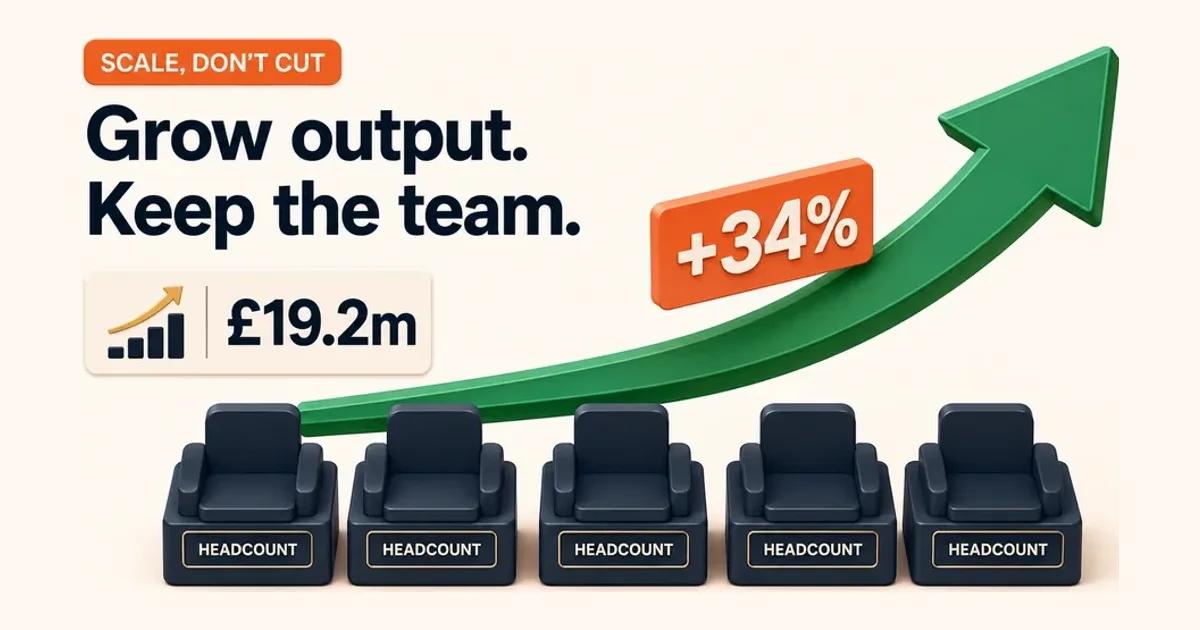
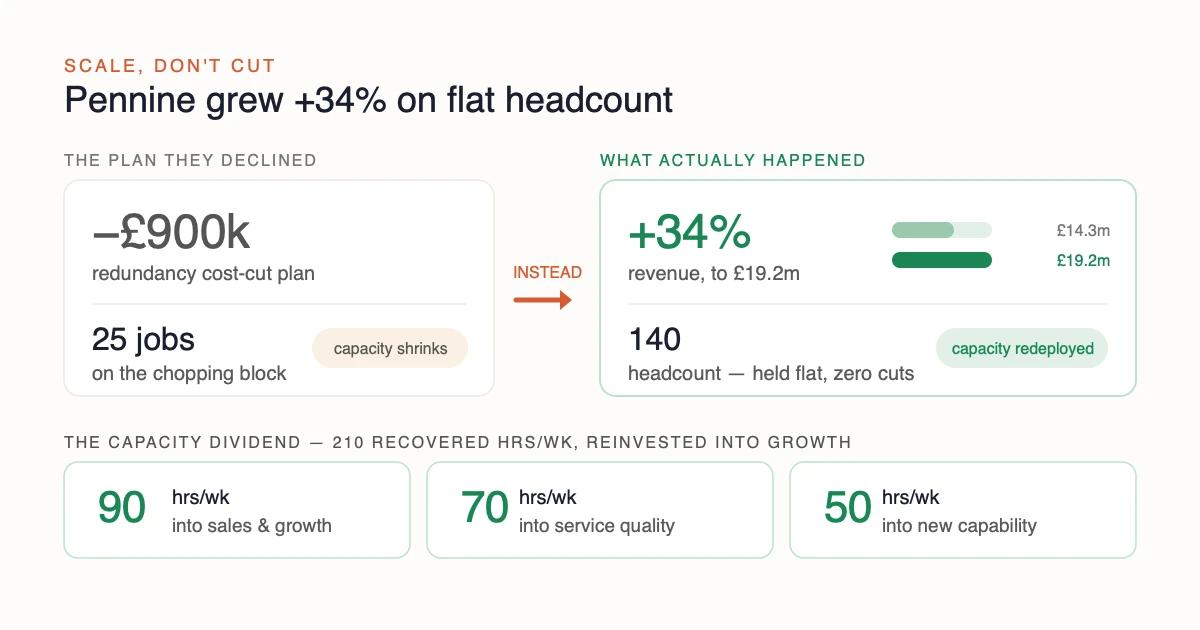
Rachel Okafor's board sat across the table with a £900,000 redundancy plan. That was 25 jobs, 210 hours of weekly capacity, a clean P&L line by Q2. Two of Pennine's Leeds-area competitors had already announced layoffs that quarter. The logic was airtight. Pennine Logistics & Fulfilment had just deployed an AI-powered warehouse management system and a customer-service copilot, and the savings were sitting right there on a spreadsheet. Cut the 25 roles, pocket the £900k, close the year ahead of plan. Rachel, MD of the 140-person 3PL, said no. Her bet was that the same AI deployment that looked like a redundancy generator was actually a growth engine, if she could redeploy those recovered hours before the board ran out of patience. Twelve months later, revenue had grown 34% to £19.2m on flat headcount. The competitors who took the layoff route were quietly rehiring on premium contract terms.
Illustrative case. Pennine Logistics & Fulfilment, Rachel Okafor and the company-specific figures are illustrative; they do not identify a real business or a published customer result. The cited sources support the wider workforce and productivity argument, not this individual company history.
Quick Answer. The strategic case for AI without layoffs is scaling output with the team you have rather than cutting headcount. The enterprise layoff playbook targeted narrow, high-volume work a smaller firm rarely runs at that scale, and copying it destroys the institutional knowledge it competes on. Redeploy the freed hours into new revenue instead.
The Layoff Playbook Smaller Firms Are Being Sold (And Why It Was Never Designed for Them)
The headlines wrote the strategy. And the strategy was never meant for you.
The headlines that shaped the playbook
Three announcements landed in quick succession and rewired how boards think about AI:
- Salesforce: Marc Benioff stated the company cut support headcount from 9,000 to 5,000 using AI agents
- Block: Jack Dorsey cited AI when cutting 4,000 roles across the company
- Klarna: The payments firm shrank from 7,000 to roughly 3,000 employees, then, after 11 months, began quietly rehiring humans
That last detail rarely made the follow-up coverage. The reversal did not trend.
Why it doesn't transfer down-market
Enterprise cuts landed in narrow, high-volume, low-judgement functions: refund processing, tier-one support queues, ticket triage. SMBs rarely operate work at that scale or in that shape. Their competitive advantage is the opposite: institutional knowledge, customer intimacy, and the operational judgement concentrated across small teams. Copying an enterprise layoff playbook into a 50–200 person firm doesn't capture enterprise savings. It destroys the very moat the SMB was competing on.
The WEF's Future of Jobs Report 2025 frames this directly 1: the primary barrier to AI transformation isn't excess headcount. 63% of employers cite the skills gap. The constraint is capability, not cost.
What the Data Actually Says About AI and Headcount
The headlines and the data tell different stories.
The Stanford HAI AI Index 2026 found that while one-third of organisations expect AI to reduce their workforce, almost half expect little to no change in headcount 2. Large-scale job losses have not yet materialised in overall employment data. Early movers who over-cut are now quietly rehiring, often under different job titles. The net effect, across the cohort that moved fastest, trends back toward baseline headcount within two years.
Goldman Sachs is frequently cited for alarming job-loss projections. The same research simultaneously notes that only 9.3% of US companies had used generative AI in production in the prior two weeks. It finds no significant statistical correlation between AI exposure and unemployment rates or layoff rates at the macro level.
OECD research on AI and Work reaches a different conclusion than the coverage suggests. Both workers and employers are generally positive about AI's impact when training and consultation are built into the deployment 3. The outcomes diverge sharply depending on whether organisations invest in their people alongside the technology.
Key data points
- Stanford HAI 2026: almost half of all organisations expect little to no change in headcount 2
- Goldman Sachs: no significant statistical correlation between AI exposure and unemployment at the macro level
- OECD: worker and employer sentiment turns positive when training accompanies deployment 3
The dominant framing, that AI deploys and jobs disappear, is empirically thin and constructed entirely from enterprise-scale data. Rachel Okafor's board was reacting to a story, not a pattern.
The Automation Arms Race: Why These Layoffs Backfire at the Market Level
Individual layoff decisions look rational. The aggregate is self-defeating.
A March 2026 academic paper from the University of Pennsylvania and Boston University is titled The AI Layoff Trap. It models the collective dynamic SMB owners rarely see priced into their decisions. When firms across an economy automate to cut headcount, they each capture 100% of their own savings. They feel only a fraction of the resulting demand destruction. The paper names the endpoint plainly: "boundless productivity and zero demand."
To see the absorption gap in concrete terms, take a 60-person UK distributor. It automates order-processing, cuts the five staff who ran it, and saves roughly £200k annually. Those five wage earners represented approximately £150k in annual discretionary spending within the local supply chain. Multiply across 50 similar SMBs in the same sector and the demand destruction compounds well beyond any single firm's savings line. The OECD frames AI as a General-Purpose Technology whose value accrues to firms that use it to do more, not to firms that use it to do the same with fewer people 4.
Pennine's two layoff-route competitors are now seeing softening order books. The e-commerce merchants they serve are themselves customers of laid-off-staff firms downstream. Defecting from the arms race is the rational move.
The endpoint of the cost-cutting frame
- UPenn/BU: firms automate their way to "boundless productivity and zero demand"
- Pennine's competitors chose the layoff route; softening order books followed within months
- Retained-team scaling captures AI's productivity gains whilst preserving the wage base that keeps your market alive
Why Don't 85% of AI Projects Hit the P&L?
The cost-cutting case for AI assumes fast, clean savings. The evidence says otherwise.
Roughly 78% of companies now report using generative AI, yet the majority report no significant bottom-line impact. Up to 85% of AI projects fail to reach production value. They live in pilot, stall at integration, or quietly get abandoned. A study of 40,000 developers found they felt 24% faster with AI assistance. Measured on complex tasks, they were actually 19% slower. OECD experimental studies confirm that firms integrating AI with retained teams gain stronger competitive advantages than those treating the technology as a headcount substitute 5.
Vendor-claimed productivity gains of 50–100% routinely compress to 5–15% in large-scale organisational studies. The gap lives in costs most boards never see. Change management, data cleaning, infrastructure upgrades, prompt engineering and model maintenance swell total cost of ownership to 300–400% of the initial figure.
If you cut headcount before the deployment proves out, you carry the full cost with none of the savings. The people you let go were the ones who understood the data, knew the edge cases, and could have closed the gap between demo and production. Retained, trained teams are not a cost drag on AI deployment. They are the prerequisite for it.
The Capacity Dividend: Treating AI Time Savings as Growth Capital
When AI saves a team five hours per person per week, most advice stops there. The strategic question of what to do with those hours is left unanswered.
Reframe recovered hours as growth capital and the maths inverts. A 12-person UK agency that recovers 30 hours per week and reinvests them into a new service line worth £180k ARR earns four times what it would by firing one person to save £45k. The OECD frames AI as a General-Purpose Technology whose value comes from diffusion across new activities, not substitution of existing ones 4. The WEF Future of Jobs Report 2025 projects 78 million net new jobs globally by 2030 1. They are concentrated in firms that use the technology to do new things, not firms that shrink.
Pennine's 210 recovered hours per week funded 18 new merchant accounts and a full returns-management service line. That is the capacity dividend. Time freed by automation, reinvested as the capital for growth.
The Wrong Question and the Right One
- Wrong: "How many people can we cut?"
- Right: "What can we now do that we couldn't before?"
The first question treats AI as a cost lever. The second treats it as the OECD intended. It is a productivity multiplier that opens new activities rather than only cheapening existing ones 4.
What to Copy (and Ignore) from Klarna, Salesforce, and Block
| Enterprise move | Does it scale down to an SMB |
|---|---|
| Pairing AI to narrow, repetitive, high-volume task pockets inside existing roles | Yes, this is the transferable part |
| Documenting prompts, retrieval rules and the oversight routine | Yes |
| Headcount substitution as the strategy | No: Klarna spent 11 months tuning before a partial reversal, quietly rehiring where automation underperformed |
| Automating away scarce talent | No: the WEF names human-AI collaboration as the preferred outcome 6, and the OECD finds AI shifts skill demand rather than eliminating roles 7 |
Not every enterprise AI move scales down. The transferable lessons are narrower than the headlines suggest.
Klarna spent 11 months tuning its AI deployment before a partial reversal, quietly rehiring in functions where automation had underperformed. Most SMB boards only saw part one of that story.
The WEF's "Co-Pilot Economy" scenario names human-AI collaboration, not headcount substitution, as the preferred strategic outcome 6. Scenarios built purely on automating away scarce talent produce patchy productivity and concentrated, fragile gains. The OECD frames this similarly: AI shifts skill demand rather than eliminating roles 7.
What translates to smaller scale
- Identifying narrow, repetitive, high-volume task pockets within existing roles and pairing AI tools to them
- Documenting prompts, retrieval rules, and workflows as durable company IP: institutional knowledge encoded, not discarded
- Treating the first 6–12 months as a tuning period, not a savings event
What doesn't transfer
- Mass cuts in the human work that's hardest to absorb (complex customer relationships, exception handling, contextual decisions) before AI is proven in production
- Replacing institutional knowledge with vendor-managed agents who hold no context about your specific operations
How Pennine Made the Capacity Dividend Real
Rachel Okafor's counter-proposal to her board was simple. Give her 90 days to redeploy the AI-recovered capacity before authorising any redundancies.
The recovered hours split three ways. Roughly 90 hours funded new merchant onboarding capacity, bringing 18 new e-commerce SMBs onto the Pennine platform. About 70 hours stood up a returns-management service line, a margin-rich product Pennine couldn't previously staff. The remaining 50 hours funded structured training, moving existing warehouse-admin and customer-service staff into account-management and merchant-success roles. Twelve months later, revenue had reached the growth trajectory noted in the opening, with headcount unchanged at 140 and revenue per employee materially higher. Two competitors who took the layoff route are now rehiring on contract terms.
OECD research on AI and work finds that training and worker consultation are consistently associated with better outcomes than headcount reduction 3. Rachel's board got a business case. The data gives it a structural explanation.
Where the recovered hours went
- 90 hours: onboarding capacity for 18 new merchant accounts
- 70 hours: standing up the returns-management service line
- 50 hours: structured training moving existing staff into account-management roles
The hours did not become savings. They became a service line, a client base, and a team with new skills. That sequencing, capacity first and revenue second and profit third, is the pattern most AI deployment plans skip entirely.
A 12-Week Retention-First AI Adoption Playbook
A retention-first playbook sequences workforce decisions ahead of tooling decisions. The order matters more than the tools.
Weeks 1–4: Run a capability audit at the task level, not the job level, and consult staff openly. OECD research finds worker consultation correlates with better AI outcomes 3. Make a public no-redundancy commitment for the audit window. It costs nothing and draws out honest input. Map tasks, not jobs. A role that is 60% automatable still has 40% that is not.
Weeks 5–8: Pair AI tools to your highest-judgement workers first, not your lowest. Senior staff write better prompts, spot bad outputs faster, and convert recovered hours into IP. That IP is documented prompts, retrieval rules, and workflows that compound. Fund the time using UK routes such as the Apprenticeship Levy or tax-deductible training.
Weeks 9–12: Measure hours recovered per role and allocate the capacity dividend explicitly to new revenue, retention work, or quality uplift. Set kill criteria before deployment. Any tool that has not recovered its cost in cycle one gets cut. WEF reports 85% of employers plan to prioritise upskilling and 63% cite the skills gap, not excess headcount, as the primary barrier to transformation 1.
Rachel Okafor ran this sequence without naming it. The 12-week structure is what the pattern looks like written down.
How Do You Defend a No-Layoffs AI Strategy in the Boardroom?
Boards and PE backers have absorbed the "AI = cuts" narrative from financial media. Defending a retention-led strategy needs an argument bank, not earnestness.
Lead with WEF's finding that 85% of employers globally are prioritising upskilling rather than headcount reduction, and that the skills gap is the primary barrier to transformation, not excess people 1. Layer in the early-mover evidence. Klarna's documented reversal came after eleven months, and Stanford HAI's 2026 finding is that large-scale job losses have not materialised 2. Firms that cut aggressively are already backfilling roles, typically at premium contract rates. Add the UPenn/BU AI Layoff Trap research. It shows aggregate SMB cuts erode the consumer base those same businesses depend on. The OECD classifies AI as a General-Purpose Technology whose primary economic contribution is productivity acceleration, not cost extraction 4. The Stanford Digital Economy Lab distinguishes AI automation from AI augmentation: employment declines concentrate in occupations where AI automates work, not in those where it augments — giving MDs empirical grounding for the retention argument 8.
These are not soft arguments. They are the mainstream institutional consensus, not the MD's personal preference.
Counter-questions to ask cost-cutting advocates
The argument bank sets the table. Counter-questions close the room. Ask each in sequence:
- "What's our plan when 50% of these roles need rehiring at premium contract rates in 18 months?"
- "Which parts of our customer-intimacy moat survive the cut, and how do we price that loss?"
- "What's the demand-side risk in our customer segment if two or three peers do the same simultaneously?"
These questions reposition the MD as the sophisticated operator who has read the evidence, not the laggard avoiding hard decisions. Rachel Okafor did not walk into her board meeting with earnestness. She walked in with a revenue line that did not exist twelve months prior.
Leading Indicators: How to Tell Retention-First AI Is Working
| Layer | What to track | Why it belongs on the scoreboard |
|---|---|---|
| Capacity | Hours recovered per role per week, and the share redeployed into named growth bets | Hours absorbed silently prove nothing |
| People | Voluntary attrition, internal mobility into roles the capacity dividend created, engagement | OECD evidence links worker consultation to better AI outcomes 3, so engagement leads rather than lags |
| Commercial | Revenue per employee, new revenue lines launched, customer churn | Revenue per employee is the headline KPI a board can argue with |
Retention-first AI needs its own scoreboard, or it loses the boardroom argument by default.
Track three layers. Capacity: hours recovered per role per week, and the percentage of those hours redeployed into named growth bets rather than absorbed silently. People: voluntary attrition, internal mobility into new roles created by the capacity dividend, and engagement scores. OECD evidence links worker consultation to better AI outcomes 3, so engagement is a leading indicator, not a soft one. Commercial: revenue per employee as the headline KPI, new revenue lines launched in the period, and customer churn.
Pennine's twelve-month picture is what this scoreboard looks like when it's working: revenue up materially on flat headcount, two new merchant cohorts, a new service line, zero redundancies. The UK labour market data reinforces the case. Demand for AI-capable talent rose 2% in 2024, with firms investing in upskilling rather than net cuts 9.
Capacity Metrics
- Hours recovered per role per week
- Percentage of recovered hours redeployed to named growth bets
People Metrics
- Voluntary attrition rate
- Internal mobility into roles that did not exist pre-deployment
- Engagement scores (leading indicator, not a courtesy measure)
Commercial Metrics
- Revenue per employee (headline KPI)
- New revenue lines launched in the period
- Customer churn rate
When internal mobility stalls and nobody moves into the new roles the capacity dividend created, the hours have been absorbed into the background and the growth bet has stalled. The scoreboard tells you fast when the strategy isn't working — which is precisely when cost-cutting advocates assume retention strategies fail silently.
The Strategic Choice: Cut to the Floor, or Scale from It
The strategic case for AI in an SMB is not cost reduction. It is scale with a retained team.
Path A: cuts → arms race → demand erosion → rehire on contract
- Short-term margin uplift, applauded in Q1
- Contribution to the automation arms race across your customer segment
- Rehiring — as Klarna's reversal and Stanford HAI's 2026 labour data confirm 2 — at premium contract rates
Path B: capacity dividend → growth → moat compounds
- AI-recovered hours redeployed into new revenue and new services
- Customer intimacy deepens as the team upskills rather than shrinks
- The moat widens with every retained operator who learns to run the new stack
Pennine took Path B. Two layoff-route competitors started rehiring on contract terms before year-end.
The choice Rachel Okafor made was not moral. It was strategic. The OECD frames AI as a general-purpose technology — a growth enabler, not a cost lever 4. The WEF identifies the skills gap, not excess headcount, as the binding constraint 1. Stanford HAI's 2024 AI Index found AI enables workers to complete tasks more quickly and bridges the gap between low- and high-skilled staff — augmentation at the team level, not substitution 10. SMBs that frame AI as a scaling engine, not a severance accelerant, are the ones that will still be growing in 2027.
Summary
Scale, don't cut — AI as growth, not severance
│
├─ Path A · cut to the floor
│   ├─ Borrowed playbook — enterprise cuts don't scale down
│   ├─ Arms race — peers cut, demand erodes, order books soften
│   └─ Rehire — Klarna reversed at 11 months, premium contracts
│
├─ Path B · scale from it
│   ├─ Capacity dividend — freed hours = growth capital
│   └─ Moat compounds — team upskills, intimacy deepens
│
└─ Pennine · the proof
    ├─ Declined £900k cut — redeployed 210 hrs/week instead
    └─ Result — revenue +34% to £19.2m, headcount flat at 140
Related insights
- Your SMB Doesn't Need More AI Tools. It Needs an AI Strategy. — the audit-first phased sequence that puts the capacity dividend to work instead of the severance line.
- AI Is Not a Tool You Buy. It's an IT Integration Project (2026). — why the infrastructure work behind retained-team scaling is the real bottleneck, not the AI tool.
- 50 Questions to Ask Before Implementing AI: SMB Buyer's Guide — buyer-stage diagnostics across five decision-maker personas, including the scale-vs-cut framing for boards.
Last updated: 5 May 2026.
Frequently Asked Questions
Should a UK small business use AI to cut staff or redeploy them?
Why don't enterprise AI layoffs at Salesforce, Klarna, or Block translate to small business scale?
What is the "capacity dividend" and how should a small business spend AI-recovered hours?
How can a small business MD defend a no-layoffs AI strategy in a board meeting?
What metrics show whether a retention-first AI strategy is actually working?
Why do employees resist AI — fear of job loss, mistrust, or skill gaps — and how do I address each?
What's a realistic year-1 adoption rate I should plan for — 60% or 100%?
Sources
- 1.Future of Jobs Report 2025 — World Economic Forum · 2025
- 2.AI Index Report 2026 — Stanford HAI · 2026
- 3.AI and Work — OECD · 2025
- 4.The Impact of Artificial Intelligence on Productivity, Distribution and Growth — OECD · 2025
- 5.Unlocking Productivity with Generative AI: Evidence from Experimental Studies — OECD · 2025
- 6.Four Futures for Jobs in the New Economy: AI and Talent in 2030 — World Economic Forum · 2025
- 7.Future of Work — OECD · 2025
- 8.Canaries in the Coal Mine — Stanford Digital Economy Lab · 2025
- 9.AI Index 2025 — Labour Market Data — Stanford HAI — via Lightcast · 2025
- 10.AI Index Report 2024 — Stanford HAI · 2024
Want this run on your business?
AI Foundation Audit — a structured assessment of your AI footprint: integration risks, governance gaps, ROI opportunities. Delivered as a comprehensive report you can act on.
You receive your AI Opportunity Report and Implementation Brief — tailored to your business and delivered immediately.