You Don't Need More AI Tools. You Need an AI Strategy Framework
An AI strategy framework replaces ad-hoc per-seat subscriptions with one accountable plan: audit the footprint, consolidate it, then implement in phases.
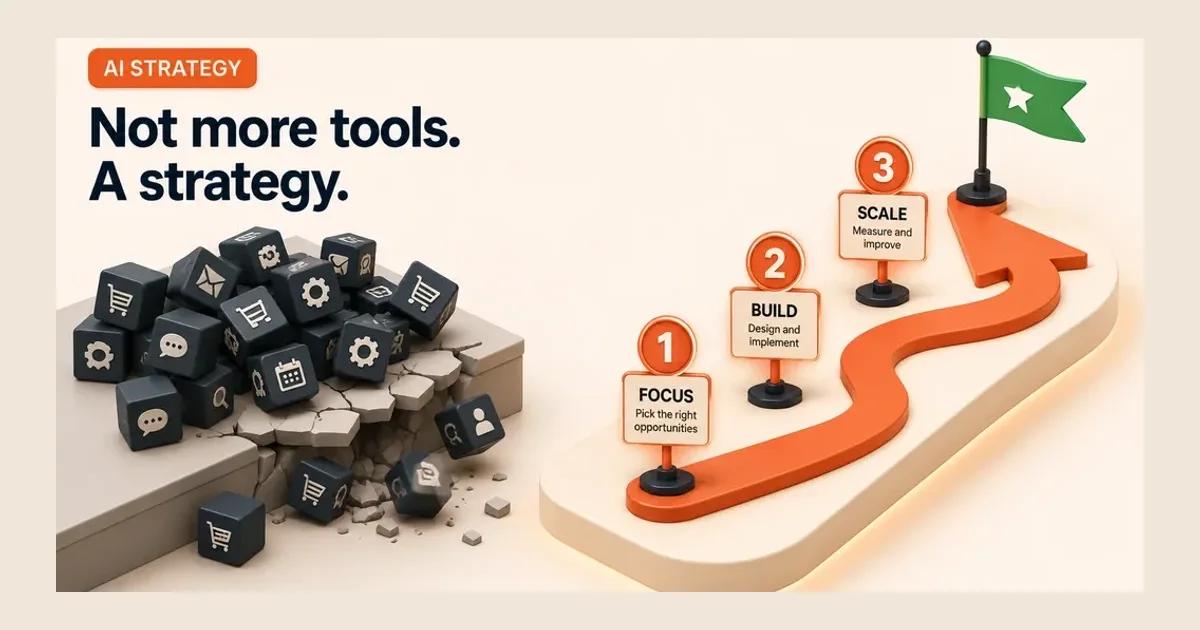
Mark Hadley, MD of Anvil Acoustic Engineering, opened a quarterly expense review and found £1,400 a month leaking out in AI subscriptions he had never approved. Fifty-three of his 140 staff, across six departments, were each expensing personal seats: ChatGPT Plus, Claude Pro, Perplexity, Gamma, Otter. No shared prompt library. No audit trail. No MD sign-off. Three engineers admitted, when asked plainly, that they had pasted confidential client tender pricing and acoustic drawings into off-the-shelf chatbots to speed up proposals. (Composite anonymised case based on patterns observed across UK SMB AI adoption research; Anvil Acoustic Engineering is illustrative, not a real firm.) Anvil is a Reading-based acoustic engineering and consultancy firm serving construction and rail clients. For two quarters Mark had been telling his board AI adoption was going well, because his people were using AI. The expense review showed he had confused use with strategy. Annualised, the sprawl ran close to £17,000, with unquantified UK GDPR exposure on three live engagements and zero productivity uplift to show. The methodical version of AI strategy looks nothing like another subscription. It looks like an audit, a policy, one owner and one measured workflow.
Quick Answer. More tools do not raise productivity: management discipline does, and DSIT found over three-quarters of UK adopters saw no revenue change. An AI strategy framework fixes that: audit the footprint, consolidate onto a sanctioned stack, give one owner five hours a week, and prove value on cycle time or margin, not hours saved.
The 47-subscription pattern is the modal UK picture, not an exception
Mark's first reaction was that Anvil had a discipline problem unique to his firm. The data says otherwise. Across the OECD's D4SME 2026 survey of small and medium employers, the headline finding was that most businesses are using off-the-shelf AI products, while strategic, targeted and secure integration within business operations remains uneven 4. The picture inside Anvil, in other words, is the picture across thousands of European SMEs.
The UK number sharpens it. DSIT's AI Adoption Research, drawing on 3,500 interviews conducted by IFF Research and Technopolis, found that around one in six UK businesses (16%) currently use any AI technology, and 80% have neither adopted nor planned to 5. Among the firms that had adopted, more than three-quarters reported no change in revenue. That is the productivity puzzle in one sentence: tools are present, value is not.
What "off-the-shelf, uneven integration" looks like inside the firm
Inside Anvil, "uneven integration" was visible the moment Mark mapped it. The acoustics team used Claude Pro for technical literature reviews. Bid-writers used ChatGPT Plus for proposal first drafts. Two account leads ran Perplexity for client research. The marketing assistant used Gamma for slide decks. Nobody had compared notes. Nobody owned the question of which workflow each tool was actually best for. A single internal use-case registry would have collapsed half the seat count overnight, but no such registry existed. The same firm that ran tightly governed acoustic-modelling workflows for rail tunnels was running its AI footprint like a personal hobby budget.
The OECD G7 Discussion Paper on SME AI adoption frames the same gap at policy level: SME AI adoption remains relatively low compared with other digital technologies and to larger firms, and the gap is best understood through a taxonomy of digital maturity, complexity of use, and scope of application 3. Anvil sits in the broad middle of that taxonomy. It is not behind on access. It is behind on coordination.
Why does 'plug-and-play AI' fail to deliver the outcome?
The dominant story being sold to MDs like Mark is that AI for SMBs is plug-and-play. Sign up, log in, get value, no strategy required. Vendor blogs, MSP newsletters and the long tail of "10 AI tools you can start with today" articles repeat the framing until it sounds like common sense. It is not common sense. It is marketing.
The OECD G7 Discussion Paper is unusually direct about why the framing breaks: SMEs report struggling to define use cases, assess returns, or move beyond pilots 3. The login screen is frictionless; the integration is not. The reason most ad-hoc AI projects stall before they reach production is not the tool. It is the absence of a structured connection between the tool, the business task, and a measurable outcome.
Look at the architecture vendors actually sell when asked to design for organisations rather than individuals. ChatGPT Business, OpenAI's enterprise-grade plan, requires a minimum of two seats and centralised admin controls. The product itself implies, by its own design, that ungoverned individual subscriptions are not the intended organisational model. The £20-per-seat consumer plan is for consumers. When dozens of employees expense the consumer plan and call it a strategy, the firm has not adopted ChatGPT Business; it has adopted dozens of disconnected experiments.
Why the narrative persists
The story persists because the cost of experimentation looks trivially low. Twenty pounds a seat reads as a rounding error in a mid-sized firm. Scale that across a third of the staff, as Anvil did, and the rounding error becomes the £17,000 run-rate Mark found in his expense report. Add the unquantified cost of pasted client data, duplicated prompt work and zero institutional learning, and the rounding error has eaten the firm's discretionary AI budget for the year, with nothing to show the board.
The G7 Ministerial Statement on SME AI adoption put the alternative plainly: structured plans that connect AI tools with business tasks, functions, goals and outcomes appropriate to each business's size and sector are the key to extracting value from AI 2. Plug-and-play is the lid. Strategy is the lever.
The discipline differential: why management quality predicts ROI more than tool count
The single strongest UK statistic in this debate is not about AI at all. It is about management. The ONS Management and Expectations Survey, drawing on management practice scores across UK firms in 2023, found that 88% of firms in the top decile of management practice scores adopted at least one advanced technology, against 51% of firms in the bottom decile 6. The variable that predicts technology follow-through is management discipline, not budget, not headcount, and not subscription count.
Peer-reviewed work points the same way. A 2025 MDPI study on SME AI adoption, using the TOE-DOI framework on a fresh survey, found that SMEs with high digital capability scores had up to a 52% higher likelihood of successful AI adoption 10. Among the ten critical challenges identified by the same paper were fragmented data architectures and weak governance practices, both of which are the direct downstream effects of un-managed sprawl.
What "management discipline" looks like at this scale
Discipline at Anvil's scale is not enterprise process. It is four small habits, run weekly, by one accountable person.
Someone owns the sanctioned tool list, and updates it. Someone owns the use-case registry, and reviews new entries. Someone owns the data-handling rules, and answers questions when staff are unsure. Someone owns the one number the board sees each quarter. The four roles can sit on one person's desk for five hours a week. They do not require a chief technology officer. They require ownership.
Mark already had operational discipline. Anvil is a UK acoustic engineering firm; if his project managers ran rail-tunnel jobs the way his teams were running AI subscriptions, the firm would not be in business. The miscalculation was not capability. It was assuming AI did not need the same discipline he applied to everything else.
How do you run an AI audit before strategy in six weeks?
| Weeks | The work | The output |
|---|---|---|
| 1–2 | Pull six months of expense reports for AI SaaS lines, cross-check the corporate card, run a five-question staff survey on tools, tasks, data, payer and approval | A list of tools, a list of tasks and a list of data flows on one page |
| 3–4 | Draft an acceptable-use policy that fits one side of A4: sanctioned tools, permitted data classes, what must never be pasted into a public model, who to ask | The document that closes the UK GDPR exposure ad-hoc seats produce |
| 5–6 | Pick the smallest sanctioned stack covering validated use cases, move billing to one corporate account, deactivate shadow seats | One billing line, one admin console, one accountable owner |
Before Anvil could write an AI strategy, it had to know what it was already running. The audit-first sequence below is what one accountable owner can complete in six weeks at five hours a week. The temptation, at every stage, is to skip to a new tool. Resist it.
Week 1–2: discover the footprint
Pull the last six months of expense reports and search for AI SaaS line items. ChatGPT, Claude, Perplexity, Gamma, Otter, Notion AI, Copilot, Jasper, Synthesia, ElevenLabs, Midjourney. Cross-check against the corporate card statement. Then run a five-question employee survey: which AI tools do you use, for what tasks, with what data, paid by whom, with what approval. Map the answers onto a single page. The output is a list of tools, a list of tasks, and a list of data flows. Most MDs find double the SaaS sprawl they expected and a third of the use cases they assumed.
Don't buy a new tool first. The audit consumes the existing surface area before adding any. Until you know what you have, you cannot decide what is missing.
Week 3–4: write the rules
Draft an acceptable-use policy that fits on one side of A4. The policy names which tools are sanctioned, which data classes are permitted, which client-related content must never be pasted into a public model, and who to ask when in doubt. This is the document that closes the UK GDPR exposure that ad-hoc seats produce. Publish it, train against it, sign it.
Week 5–6: consolidate
Pick the smallest sanctioned stack that covers the validated use cases, move billing to a single corporate account, deactivate shadow seats, and reclaim the spend. The DSIT/DBT SME Digital Adoption Taskforce describes the destination: AI-powered digital adoption support integrated into the Business Growth Service, with diagnostic tools to help SMEs consider AI as they refine their businesses 7. The board version is simpler. One billing line, one admin console, one accountable owner. The WEF Board Playbook for Governing Agentic AI calls this the shadow agent audit, and frames it as the first governance act a board can demand: identify the informal automation built within the organisation 9.
Don't run a six-month consultant-led strategy review. The MD with five hours a week needs the audit done in six weeks, not six months. Six months from now, the sprawl bill is double and the data exposure is older.
UK GDPR is the load-bearing reason centralisation is non-optional
When three Anvil engineers admitted to pasting confidential tender pricing and acoustic drawings into consumer chatbots, they were not merely embarrassing. They were performing a UK GDPR processing event with no lawful basis, no Data Protection Impact Assessment and no audit trail. The Information Commissioner's Office treats this kind of un-governed processing of client and employee data as a compliance failure regardless of intent. Goodwill is not a defence; documented governance is.
The exposure compounds in two directions. Internally, the firm cannot demonstrate, on request, what data left the building, when, to which model, under whose contract. Externally, in any UK SMB serving EU customers, the EU AI Act lands a second layer of obligation: general-purpose model obligations are live, and high-risk system obligations follow. Construction and rail clients, who increasingly write AI-handling clauses into framework contracts, can disqualify a tender on missing governance alone.
The same WEF playbook is unambiguous on where the risk actually sits: the primary risk is not vendor AI; it is unsupervised shadow internal deployment 9. Governance, the playbook argues, begins where explainability fails. In practical terms, that means the moment a Anvil engineer pastes an acoustic drawing into a consumer chatbot, the firm has lost the ability to explain to a client what happened to their data. Centralisation is not an enterprise-overhead concern. It is the condition under which the firm can answer a contractual question.
The audit-and-consolidate sequence in the previous section is also the GDPR sequence. The acceptable-use policy is the lawful-basis document. The sanctioned tool list is the processor list. The single billing line is the audit trail. None of these are extras. They are the minimum a UK SMB can show when a regulator, an insurer or a client procurement team asks the obvious question.
Anvil's three-engineer disclosure was not a disciplinary problem. It was a policy gap. The engineers had been told to win more tenders. Nobody had told them which tools they could use, which data they could paste, or who to ask. Once the policy existed and the sanctioned stack arrived, the same engineers stopped pasting acoustic drawings anywhere they should not, because the legitimate path was now faster than the workaround. Compliance, in this scale of firm, is rarely a willingness problem. It is almost always an instruction problem.
A centre of excellence on a shoestring: the hybrid governance model
The dominant SERP framing splits SMB AI advice into two camps. Camp one says top-down strategy is essential and proceeds to describe an enterprise programme office. Camp two says just start somewhere, and proceeds to glorify ad-hoc grassroots tooling. Neither matches the reality of a mid-sized SMB with no CTO and an MD who can give five hours a week.
The DSIT/DBT SME Digital Adoption Taskforce points at the missing model. The taskforce recommends an AI-powered "CTO as a service" for SMEs and a single accountable structure to coordinate AI adoption across the small-business economy 7. The firm-level translation is a centre of excellence on a shoestring: one accountable owner, a sanctioned tool list, a shared use-case registry, and a lightweight intake process for new ideas. The function exists. The headcount does not.
One owner, four small habits
| Habit | Cadence |
|---|---|
| Use-case review | Monthly |
| Tool re-evaluation | Quarterly |
| Pulse on the acceptable-use policy | Weekly |
| Open inbox for staff ideas | Continuous |
The accountable owner can be the MD, the operations lead, or a senior engineer with the right disposition. The role is not technical; it is editorial. The owner curates what the firm uses, why, and to what end. Five hours a week buys a monthly use-case review, a quarterly tool re-evaluation, a quick weekly pulse on the acceptable-use policy, and an open inbox for staff ideas. The OECD G7 Blueprint frames the same role at policy level: SMEs that adopt sound internal strategies aligned with their business models and organisational capacities can gain a distinct advantage 1. Inside the firm, "sound internal strategy" is the four habits, not the policy document.
Capture grassroots momentum without surrendering governance
Most SMB AI energy comes from staff. Bid writers find a faster way to draft. Engineers find a better way to summarise standards. Marketing finds a way to brief decks in minutes instead of hours. The mistake is to treat that energy as either the strategy itself or as something to be policed away. The hybrid model captures it. The use-case registry is the front door. Anyone in the firm can submit a workflow. The owner reviews monthly, sanctions the ones with measurable upside, and folds the tooling under the central account. Grassroots becomes an input. Governance remains the operating system.
This sits upstream of the workforce-redeployment question covered in our cornerstone on scaling without layoffs, and upstream of the system-by-system risk frame covered in our governance cornerstone, both of which assume the firm has already cleared the audit step. The order matters. A firm that tries to redeploy hours before it knows which workflows are sanctioned will redeploy hours into shadow workflows. A firm that tries to govern the risk of one model before it has consolidated billing will buy a control plane for a problem it has not yet defined.
The number that matters by week twelve
After six weeks of audit and consolidation, the firm has stopped the bleeding. The next six weeks are about choosing the one use case that makes the strategy real. The vendor stat shelf is full of "91% revenue growth" and "87% efficiency uplift" claims that correlate with discipline rather than tools. The honest year-one goal is movement on a single named use case, measured before and after, owned by one team.
Why hours saved is the wrong headline
Hours saved is an input, not an outcome. It is vendor-friendly because it grows with seat count. It is board-irrelevant because it does not link to revenue, margin, or retention. The right output metric is the one the board already asks about: revenue per employee, gross margin on a sanctioned process, win rate on tendered work, or retention on a target customer segment. The DSIT AI Opportunities Action Plan: One Year On frames the national ambition in similar terms: a coordinated, economy-wide approach to private sector adoption, with sector leadership in place and SMEs backed to use AI to boost productivity 8. At firm level, "boost productivity" must reduce to a number a finance director can audit.
Don't measure by hours saved. Hours saved is an input metric. The board is buying outcomes, and so is the customer.
Pick one process, one team, one baseline
In month two, pick a single workflow with a measurable baseline. For Anvil, the obvious candidate was tender response. The bid-writing function had a clear cycle time, a clear win-rate denominator, and a clear pipeline value. The team agreed three numbers before any AI work started: average hours per tender, win rate on the trailing 31 tenders, pipeline value at the start of the experiment. Without those numbers, no later result is interpretable.
Don't roll out across all departments month one. One team, one process, one metric. Iterate, then scale. A firm that runs eight pilots simultaneously runs eight unmeasurable pilots.
Month three: measure honestly
In month three, run the same workflow with the sanctioned stack and the new prompt patterns, against the same baseline. Compare. Report. Decide. If the use case shifts the metric, register it as a sanctioned workflow and start the next experiment. If it does not, kill it cleanly and pick another. The point of the phased sequence is not to prove AI works; the point is to learn, on real data, where it works inside this firm. Coordinated, sector-led adoption, the language the UK government now uses 8, is exactly what individual SMBs do at firm level when they sequence their experiments instead of crowdsourcing them.
The honest counter-question to ask, before any board meeting, is whether the chosen number can be defended cold. Cycle time is auditable. Win rate is auditable. Pipeline value is auditable. "Productivity" is not. The discipline of picking a metric the finance director already trusts forces the rest of the strategy to behave. It also makes the second use case easier to commission, because the precedent for measurement now exists inside the firm.
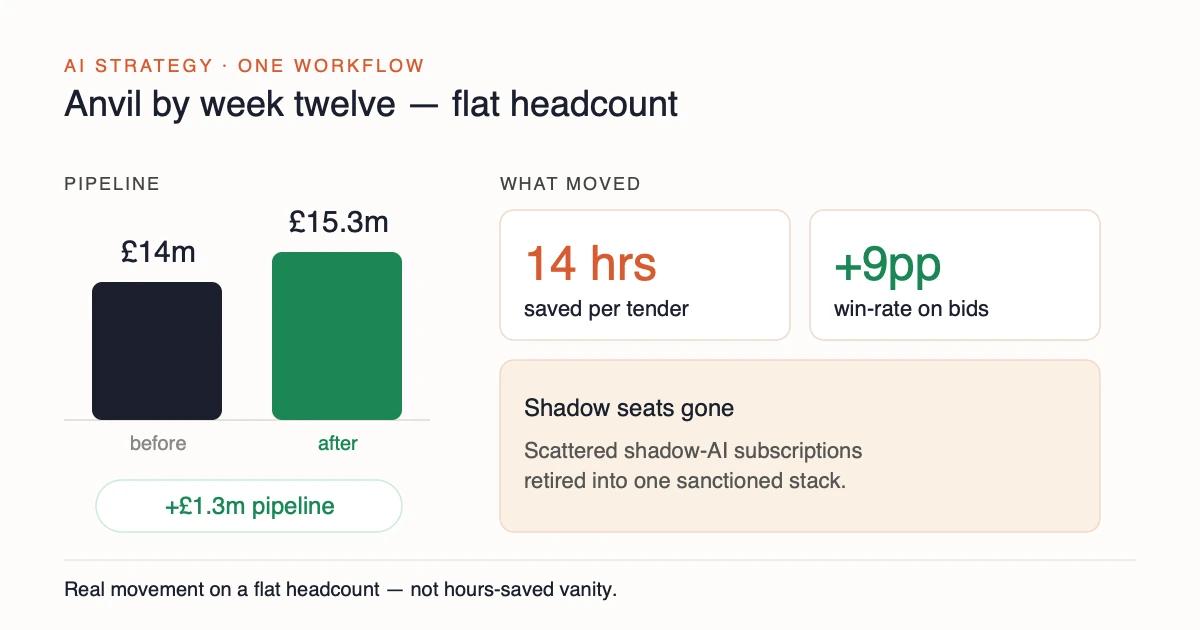
Twelve weeks after the audit started, Mark sat in front of his board with a different story. The shadow seats were gone. One sanctioned stack ran the firm: Microsoft Copilot for productivity inside Office, and a single Claude Team workspace for engineering analysis. Six workflows sat in the use-case registry. The acceptable-use policy was signed by every member of staff. The first measured workflow, automated tender-response drafting in the engineering team, had shaved 14 hours per tender and produced a nine-percentage-point improvement in win rate against the trailing baseline of 31 tenders. Annualised against pipeline, that was the difference between £14m and £15.3m of qualified work entering the funnel.
The board did not ask how many AI subscriptions Anvil had. It asked which workflow Mark wanted to measure next.
aiprioritymap.com's AI Foundation Audit framework is built around the same audit-first sequence; the methodology page documents what one accountable owner can complete in the first six weeks.
Summary
AI strategy, not more tools — the SMB sequence
│
├─ Sprawl isn't strategy
│   ├─ The symptom — dozens of shadow per-seat subscriptions
│   ├─ The predictor — management discipline, not tool count
│   └─ The risk — confidential data pasted into consumer chatbots
│
├─ Audit before adding
│   ├─ Discover — map every tool, task & data flow on one page
│   ├─ Write rules — one-page acceptable-use policy, then sign it
│   └─ Consolidate — one sanctioned stack, one billing line, one owner
│
└─ Prove it in 90 days
    ├─ One workflow — one team, one baseline, measured before/after
    └─ Right metric — cycle time or win rate, never hours saved
Related insights
- 50 Questions to Ask Before Implementing AI: SMB Buyer's Guide — the buyer-side diagnostic that surfaces the 47-subscription symptom before the strategy work starts.
- Scale, Don't Cut: The SMB Case for AI Without Layoffs — what the phased sequence is in service of: capacity dividend, not headcount reduction.
- AI Talent Trap: Why Your Best AI Engineer Isn't on the Market — the single-accountable-owner question the strategy framework keeps deferring to.
Last updated: 9 May 2026.
Frequently Asked Questions
How fast can a UK small business go from AI sprawl to a coherent AI strategy without hiring a CTO?
Why doesn't buying more AI tools improve productivity at small business scale?
What is the biggest UK GDPR risk when staff use consumer AI tools like ChatGPT or Claude?
Who should own AI strategy in a UK small business that has no CTO?
What is the right metric to prove AI is working in a small business after 90 days?
How long until our AI investment pays back for a UK small business of 50-500 employees?
70% of AI efforts fail to deliver value — what are the three issues that kill them, and how do I avoid them?
Sources
- 1.SME AI Adoption Blueprint — OECD/G7 — Canada G7 Presidency · 2025
- 2.G7 Ministerial Statement on SME AI Adoption — G7 · 2025
- 3.AI Adoption by Small and Medium-Sized Enterprises — OECD — G7 Discussion Paper · 2025
- 4.Empowering SMEs in the Age of AI — OECD — D4SME 2026 Survey · 2026
- 5.AI Adoption Research — DSIT — IFF Research / Technopolis · 2026
- 6.Management Practices and the Adoption of Technology and AI in UK Firms 2023 — ONS · 2025
- 7.SME Digital Adoption Taskforce Final Report — DSIT / DBT · 2025
- 8.AI Opportunities Action Plan: One Year On — DSIT · 2026
- 9.Board Playbook for Governing Agentic AI — World Economic Forum · 2026
- 10.Artificial Intelligence Adoption in SMEs: TOE-DOI Framework — MDPI Applied Sciences · 2025
Want this run on your business?
AI Foundation Audit — a structured assessment of your AI footprint: integration risks, governance gaps, ROI opportunities. Delivered as a comprehensive report you can act on.
You receive your AI Opportunity Report and Implementation Brief — tailored to your business and delivered immediately.