Hiring an AI Engineer? Your Best One Is Already on the Payroll
Hiring an AI engineer rarely fixes the problem. The bottleneck is operational judgement, and below 500 staff the better AI lead is already on your payroll.
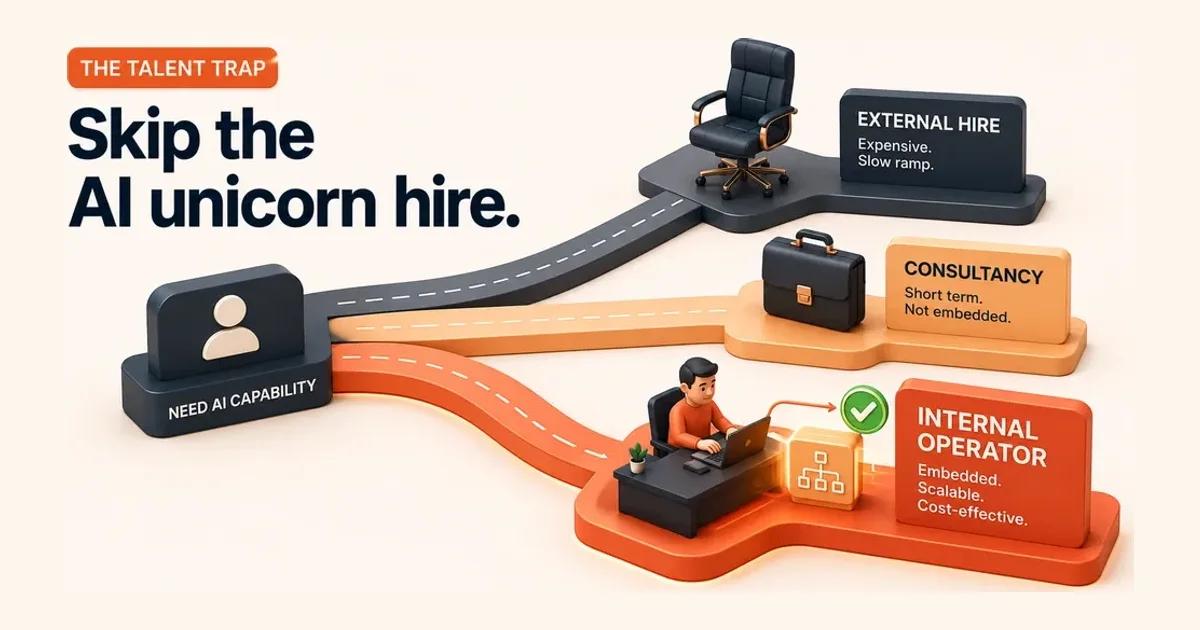
Six months ago, the MD at a 140-person UK precision manufacturer posted an AI Engineer requisition at £95-130k, and has nothing to show for it 1. The candidates wanted equity, full remote, or a team to lead. None of which the firm could offer. This is the AI Talent Trap: the hire is not on the market because the role is wrongly defined. The bottleneck is operational judgement and protected internal time, not Python.
Quick Answer. Hiring an AI engineer from outside rarely fixes the problem: the bottleneck is operational judgement and protected time, not Python. Below 500 staff, promote a senior operator into an AI Lead role with 30% protected time, an apprenticeship and a P&L owned by Operations, at 35–50% of an external hire's cost.
The senior-band AI Engineer requisition that didn't close
Calderdale Toolworks, November 2025
Calderdale Toolworks is a 140-person precision-manufacturing SMB in West Yorkshire: CNC sub-contract components, £20-30m turnover. The board had signed off an AI initiative with real ambition. Managing Director James Holloway authorised an AI Engineer requisition at the senior-band rate. The problem looked clear; disparate MES, ERP and quality-log data needed integrating.
Calderdale Toolworks is a composite drawn from interviews with several UK precision-manufacturing SMBs in the 50–500 headcount band. Firm name, persona names, and specific figures have been altered. The operational arc — posting an AI Engineer role at £95-130k for six months, then promoting an internal operations manager into an AI Lead role with vendor scaffolding — reflects a pattern observed across multiple engagements.
Six months later the role was still open. Three credible candidates had materialised. All three wanted equity, full remote, or an existing engineering team to lead. Lorien's UK 2026 guide places the senior AI Engineer band at £100-150k 13; IT Jobs Watch puts the median at £87,500 for the six months to May 2026 14. Calderdale Toolworks had not lost a negotiation; it had entered the wrong auction. DSIT's 2025 AI Labour Market Survey 1 finds 35% of UK organisations cannot fill AI roles, 97% report at least one AI skills gap, and 28% say technical shortages have blocked business goals. The UK SMB posting an AI Engineer requisition is competing against London hyperscalers and US-remote employers where senior posts are the hardest to fill. The open requisition is not a pricing signal. It is a strategy signal.
The reframe
Holloway identified Sarah Bennett: eight years in the firm, owner of MES configuration, ERP data flows and the quote-to-cash process. No formal AI background. An eight-year archive of institutional knowledge no external hire could import in under two years. "I refuse to keep paying agency retainers for a role that won't fill," Holloway said.
Why has your AI Engineer requisition been open for six months?
Structural, not cyclical
An AI Engineer requisition open for six months is not a cyclical recruitment problem. It is structural. The UK's share of AI-skill job postings sits at 1.9%, against 4.7% in Singapore 8. The UK SMB competes inside a thin national pool against London hyperscalers and US-remote employers who pay materially more. Recruitment and Employment Confederation data puts senior-technical AI roles at four-to-six months time-to-hire in normal conditions. SMBs without employer brand, equity, or remote-first culture land at the long tail of that distribution.
Why the role specification is obsolete before it lands
Stanford HAI's 2025 AI Index 8 records mentions of the 'agentic AI' skill cluster growing at triple-digit pace in a single year. A JD signed off by the board in March no longer fully describes what the firm needs in December. The hire is a snapshot. The work is a moving target. The requisition cannot keep pace with either the labour market or the technology, and that gap widens precisely because the firm mistakes a capability problem for a procurement problem.
The bottleneck is judgement, not Python
| What the requisition asks for | What the work actually needs |
|---|---|
| Model and framework depth | Judgement about which process is worth automating at all |
| A specialist hired from outside | Domain context and internal credibility already earned |
| Technical seniority | Protected time and an executive sponsor |
What AI-exposed roles actually demand
The bottleneck on AI capability inside a UK SMB is not Python. OECD's April 2024 analysis of online vacancies across ten OECD countries 5 finds 72% of vacancies in AI-exposed occupations demand management skills and 67% demand business skills; narrow technical specialisms come second. The skill stack is management-first, business-context-second, technical-third.
Judgement under uncertainty as the durable edge
Kalluri, writing in MIT Sloan Management Review in October 2025 10, argues the durable AI-era differentiator is meta-expertise: judgement under uncertainty, asking better questions, and contextual understanding of "the white spaces that don't yet exist in any AI model's training data." The external AI Engineer arrives without those white spaces, and they take years to earn. Sarah Bennett's eight-year tenure — her knowledge of which ERP integrations break at month-end, which customer drawings carry ambiguous tolerances, which supplier onboarding steps are undocumented friction — is exactly that white-space data. What firms diagnose as an AI-skills gap is most often a judgement gap wearing a technical costume.
The 95% who get nothing back
The headline failure number
MIT Media Lab's Project NANDA, reported in Harvard Business Review by Furr and Shipilov in August 2025 12, finds 95% of generative-AI investments have produced zero returns. That figure is not a technology indictment; it is a scaffolding indictment. OECD's 5,000-SME survey 3 finds firm-provided training delivers substantially greater benefit than ad-hoc adoption. The 5% who get returns are firms with a named internal operator who prioritises use cases, maintains models, and escalates failures.
Why it is a scaffolding problem, not a tools problem
Premature commitment to immature tooling destroys capital. The steelman for 'wait-for-agents' is real. But the frame confuses tool maturity with capability maturity. Waiting eighteen months does not solve the scaffolding problem. It postpones it. Every internal candidate has aged, been promoted, or left by the time the firm decides to act.
What UK firms actually do — and why the requisition is the outlier
The 8:1 ratio in the official data
The ONS Business Insights and Conditions Survey for 2 October 2025 7 reports 33% of UK AI-using firms are training or retraining existing staff to integrate AI, while only 4% are recruiting new staff with AI-related skills: an 8:1 internal-train-to-external-hire ratio in official data. UK AI usage has reached 23% of businesses, up from 9% in 2023. The requisition strategy is the outlier.
The same pattern at macro level
The WEF Future of Jobs 2025 6 finds 85% of employers plan to upskill by 2030 and half plan to transition staff from declining to growing roles internally. What looks like a brave choice for the SMB is statistical conformity with what other employers do.
Why both external routes fail once they start
The hire and the consultancy fail differently, and both failures arrive after the decision looks settled. That is what makes them expensive.
Post-hire reality: the external AI Engineer inside a smaller firm
What breaks at month four
Yokoi and Wade (MIT Sloan Management Review, December 2025) 11 identify organisational knowledge — fragmented, inaccessible and underused — as the primary GenAI bottleneck. The external engineer cannot rewire knowledge they do not have. By month four, use-case prioritisation drifts toward technically interesting problems rather than commercially impactful ones. No executive sponsor, no P&L line, no operational protected time. The role is structurally orphaned.
What breaks at month nine
By month nine, model drift, prompt regression and integration breakage have no internal owner. Stanford HAI documents agentic-AI skill demands evolving faster than any annual recruitment cycle can track 8. OECD 3 shows generative AI compensates for skill gaps only where training is firm-provided. Bennett already knew where the institutional knowledge lived, already held a P&L line, and already had Holloway's sponsorship.
Post-engagement reality: the consultancy bridge at month seven
The kernel of truth and where it ends
The consultancy engagement does not fail during the engagement. It fails at month seven. External pattern recognition is high-ROI in weeks one to six; a good consultant compresses weeks of debate into a single workshop. But Helium42's UK 2026 pricing data is clear: hidden costs for data preparation, cloud infrastructure, staff training and change management routinely add 40–60% to the budget, and the consultancy does not absorb them.
What collapses at month seven
OECD 3 is clear: training anchored inside a firm's own operations outperforms ad-hoc external delivery. The hand-back deck assumes an internal owner who was never named. Model drift goes unnoticed until a customer complaint surfaces it. The NANDA zero-return cohort 12 is heavily populated by post-engagement firms in exactly this position. Use external consultancy for time-boxed diagnostic and knowledge transfer with a hand-back milestone in the contract — never as a substitute for the promoted internal operator.
The two substitutes, and why neither closes the gap
Before committing to a role, most firms try one of two cheaper things first. Both help. Neither is sufficient on its own, and the reasons differ.
Why off-the-shelf training cannot solve it on its own
What the external training market actually looks like
Sending three operations managers on a 12-week Skills Bootcamp at £1-3k each does not produce AI capability. It produces three certificates. OECD's Bridging the AI Skills Gap (April 2025) 4 finds only 0.3–5.5% of training-course supply features AI content, most mis-targeted at advanced technical skills only around 1% of roles actually need.
Skills England's October 2025 research names the gap: "poor employer understanding, particularly among small and medium-sized enterprises, of what is meant by AI skills."
Training inside a role, not instead of one
OECD 3 is decisive: training anchored inside a defined role with mandate and protected time outperforms ad-hoc external delivery. The frame dismantles on one question: what does the person do on the Monday after the course ends? Without a defined role, a P&L line, and a vendor partner, the answer is exactly what they did before.
Buying a copilot is not a strategy
Where the copilot purchase IS the strategy
Microsoft 365 Copilot Chat is bundled with eligible M365 SMB tiers; Gemini in Workspace is bundled into Google base tiers. For drafting, meeting summaries and email triage, these tools work without specialist involvement. Every SMB employee should be using a copilot; this layer is genuinely solved and requires no AI Engineer to deploy.
Where the copilot purchase ends
Calderdale Toolworks' actual ambition is order-validation automation, ERP-integrated quote-to-cash, document intelligence on customer drawings, and supplier-onboarding flows. None of those workflows are delivered by Copilot out of the box. OECD 3 finds generative AI raises rather than reduces demand for highly-skilled workers within SMEs, precisely because value moves from generic productivity to integrated operational workflows requiring domain context and process redesign 8. The copilot answers a question the Operations Director is not asking.
The AI Lead role, and what has to sit behind it
A specification without funded support is a job description nobody can actually do. Both halves are below.
The AI Lead role specification
Who the candidate is
The internal AI lead at a UK SMB is an existing senior operator: typically an Operations Manager or process lead with five to eight or more years inside the firm, deep ERP, MES or customer-process knowledge, and ownership of at least one core operational dataset. Not a former software engineer. Not an external hire.
OECD AI Papers No. 14 5 validates the profile: 72% of AI-exposed vacancies demand management skills, 67% demand business skills — narrow technical specialisms rank third. Bennett's profile — eight years at Calderdale Toolworks, MES configuration and quote-to-cash ownership — is not the edge case. It is the archetype.
The role specification (paste-into-HR)
Title: AI Lead. Reports to: Operations Director or MD. Mandate: own the firm's applied-AI portfolio, covering use-case prioritisation, vendor partner management, evaluation design, and production system custody. Time: 30% protected capacity ring-fenced from operational duties; the remaining 70% preserves operational responsibilities deliberately, keeping domain context alive. P&L line: AI Lead role and vendor partner cost owned by Operations, not IT, anchoring every AI decision to operational outcomes.
The funded upskilling spine
The Level 5 AI Leader apprenticeship (Skills England AU0009) runs 12–18 months, fully funded through the apprenticeship levy or levy transfer from a tier-1 customer. For SMBs in aerospace or automotive supply chains, large employers can transfer up to 50% of their annual levy pot to SMB suppliers. Cambridge Spark and Multiverse deliver L5 cohorts covering the management and business skills OECD 5 identifies as the binding requirement.
The vendor partner pattern
The implementation partner is hired on a knowledge-transfer scope, not long-term delivery. Helium42's UK 2026 data anchors the day-rate band at £580-£1,500 with scoped SMB packages below the full-service diagnostic fee. The contract runs four to six months. The final payment tranche releases only when the promoted operator runs the production system unaided. The vendor is paid to make themselves redundant. Data preparation and change management are absorbed by the AI Lead's protected capacity, closing the hidden-cost gap Helium42 flags.
The funded scaffolding behind the internal-lead model
What GOV.UK already pays for
The promoted-operator model is not contrarian speculation. It is the funded UK national strategy. The DSIT AI Opportunities Action Plan: One Year On 2 reports more than one million AI courses already delivered toward a 10m-worker target by 2030, with significant TechFirst funding and SMEs explicitly in scope.
Apprenticeship-levy mechanics
The Level 5 AI Leader (AU0009) is fully levy-funded for SMBs paying the levy; government co-investment covers nearly all costs for those below the threshold. For tier-1 supply-chain SMBs, levy transfer is the practical route. The scaffolding is paid for. The only decision is: who is the candidate, and when does the conversation happen?
How do internal lead, external hire, and consultancy compare over 9 months?
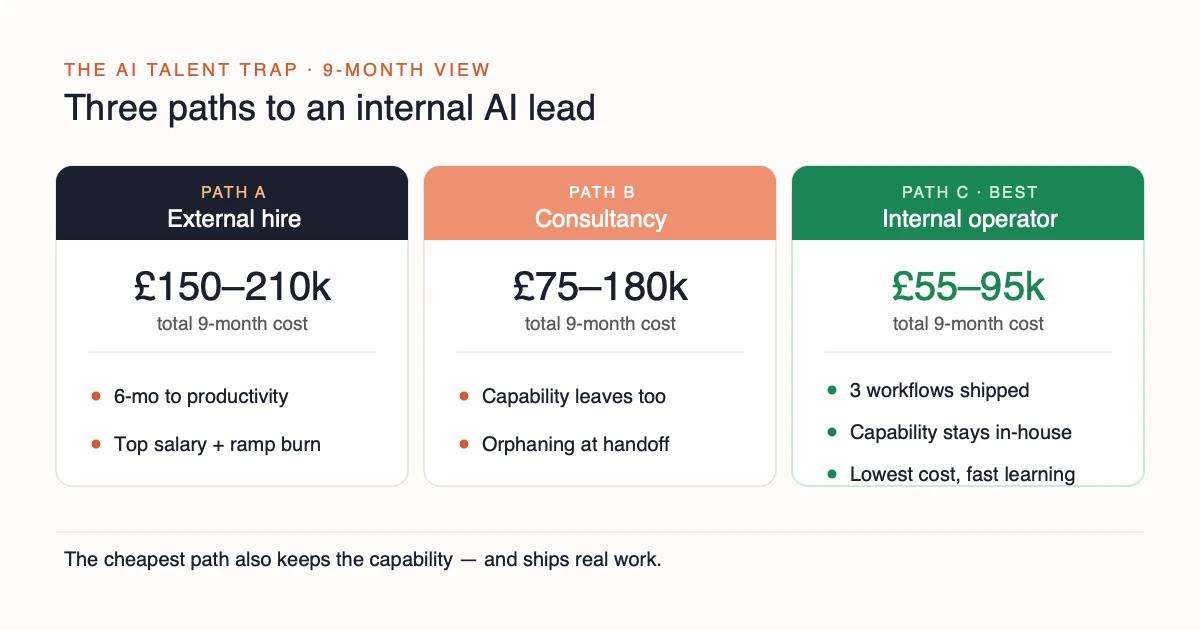
| Over nine months | A: external AI Engineer | B: consultancy bridge | C: promoted internal operator |
|---|---|---|---|
| Cost | £150-210k risk-adjusted, including a 20–25% agency fee of £19-32k | £75-180k, plus overrun the consultancy does not absorb | £55-95k fully loaded |
| Time to productivity | Six months, given the orphaned-role failure mode | Immediate, but bounded by the engagement | Immediate, the person is already in post |
| What remains afterwards | Partial output, no domain context, no P&L line | Post-engagement orphaning risk | Three production workflows and full system custody |
| Funding route | Salary, fully loaded at 1.3–1.4x 13,14 | Fee, £40-85k diagnostic plus £2-6k a month fractional | £8-15k uplift plus a levy-funded Level 5 apprenticeship 2 |
Path A — external AI Engineer hire
Salary: the senior band (Lorien 13, IT Jobs Watch 14), fully-loaded at 1.3–1.4x for employer NI, pension and equipment: £125-180k year-one. Add a 20–25% agency fee: £19-32k. Time-to-productivity given the orphaned-role failure mode: six months. Risk-adjusted year-one cost: £150-210k for partial output. The NANDA zero-return finding 12 applies disproportionately here: no executive sponsor, no domain context, and no operational P&L line are structural features of the pattern.
Path B — consultancy bridge
Diagnostic and roadmap: £40-85k from a full-service provider, or a scoped SMB package at the lower end. Fractional CAIO at £2-6k per month: £18-54k across nine months. Plus the hidden-cost overrun (data preparation, infrastructure, change management) the consultancy does not absorb — a premium routinely running to more than half the headline fee. Total nine-month spend: £75-180k with post-engagement orphaning risk.
Path C — internal operator promoted into AI Lead role with vendor partner
Salary uplift on existing operations manager package: eight to fifteen thousand pounds. Level 5 AI Leader apprenticeship, levy-funded 2. Vendor implementation partner on time-boxed knowledge-transfer contract: £30-60k. Total fully-loaded nine-month spend: £55-95k. Three production workflows shipped. The operator stays in post and retains full system custody.
Path A risk-adjusted (£150-210k) versus Path C (£55-95k): the promoted-operator path runs at roughly 35–50% of the fully-loaded external-hire cost and leaves a compounding internal capability. At the extremes the difference exceeds £50k in favour of promotion — and the firm retains an asset rather than a vacancy.
Nine months later: what shipped
What Calderdale Toolworks shipped
Nine months after Holloway closed the AI Engineer requisition, three production workflows were live, all owned by Bennett: AI-assisted RFQ-to-quote (£1.2m quoted volume at three times previous throughput), ERP-integrated supplier-onboarding document intelligence, and customer-drawing parsing with automated engineering review handoff. The vendor exited at month five per the hand-back milestone. IPPR's analysis 9 frames the outcome: the augmentation path delivers the £92bn GDP upside scenario, not the job-loss scenario. WEF 6 confirms the macro direction.
Pre-rebuttal of the wait-for-agents frame
Tools mature on a vendor timeline. Capability matures on a firm timeline. Stanford HAI 8 documents agentic-AI skill demand growing faster than any hire-based strategy. The operator promoted today against free tooling is the asset that survives vendor consolidation. The firm that waits until 2027 faces the same scaffolding deficit with a narrower window and a thinner candidate pool.
Day 1 to Day 15: the three-step plan
Day 1: close the requisition
Close the AI Engineer requisition and reallocate the recruitment-fee budget toward L5 AI Leader apprenticeship funding. Less than two hours of internal effort. The ONS data 7 confirms this is the median UK move — an 8:1 internal-train-to-external-hire ratio; the requisition route is the statistical outlier, not the safe default.
Days 2–5: name the operator
Identify the operator inside the firm who owns a core operational dataset: the MES, the ERP, the customer-process flow. Book a 60-minute conversation about the AI Lead role and the L5 funding route. This is the single highest-leverage hour the Operations Director spends on AI this year.
Days 5–15: bring in the vendor
Request quotes from two implementation partners on a time-boxed knowledge-transfer scope with a hand-back milestone — not long-term delivery. The right contract pays the vendor to make themselves redundant once the AI Lead holds sole system custody.
- Anti-pattern 1 — DO NOT post a backup AI Engineer requisition in parallel. It re-creates the orphaning failure.
- Anti-pattern 2 — DO NOT delegate the AI Lead remit to IT or to a junior without operational P&L exposure. It re-creates the no-executive-sponsor failure mode.
The right AI hire was inside the building the whole time. What was missing was the operating model. Bennett's promotion required a defined role, a ring-fenced time structure, funded upskilling, and a vendor partner on the right contractual terms. aiprioritymap.com works alongside Operations Directors making this exact transition. If you want a 90-minute working session to map your candidate operator, first three use cases, and L5 funding route, we can usually book one within the week.
FAQ — the AI Talent Trap and the AI Lead model
How much should a UK SMB pay for an AI Engineer in 2026?
Lorien's UK 2026 insight 13 anchors senior pay at £100-150k; IT Jobs Watch reports an £87,500 median 14. DSIT 1 shows a third of UK organisations cannot fill AI roles, and the promoted-operator path delivers the same scope for less.
What is an AI Lead and how is it different from an AI Engineer?
An AI Lead is an existing senior operator promoted into a defined role with ring-fenced time, an L5 AI Leader apprenticeship spine (AU0009), a time-boxed vendor partner, and a P&L line owned by Operations. OECD confirms AI-exposed roles demand management and business skills above specialist technical ones 5.
Should I hire an AI consultancy if I cannot find an AI Engineer?
Yes — for the diagnostic phase (weeks one to six), with hand-back terms written into the SOW. Not as a substitute for the promoted operator. OECD 3 shows internally-anchored training outperforms ad-hoc external delivery. Without an internal owner, the bridge collapses at month seven.
Is a Skills Bootcamp enough to give us AI capability?
No. OECD 4 finds AI content is 0.3–5.5% of training supply, mis-targeted at advanced technical skills most SMBs do not need. Credentials without mandate, protected time, and a P&L line produce a certificate, not a capability.
Can Microsoft 365 Copilot or Google Gemini replace an AI specialist for an SMB?
For drafting, summaries and email triage, yes. For integrated operational workflows — order validation, ERP integration, document intelligence — no. OECD 3 finds generative AI raises demand for skilled workers as value shifts to domain-specific work.
Should we wait 12–18 months for AI tooling to mature before hiring or training?
No. Vendor and firm-capability timelines are different curves. Stanford HAI 8 shows agentic-AI skill demand accelerating faster than any hire-based catch-up. The operator promoted today outlasts any tool consolidation.
What does the funded UK scaffolding behind the internal-lead model actually cover?
DSIT 2 reports over one million AI courses delivered toward a ten-million-worker target by 2030, with two million SME employees in scope and £187m of TechFirst funding. The L5 AI Leader apprenticeship (AU0009) is levy-funded for SMBs above the threshold, or government co-funded below it.
Summary
The AI Talent Trap — your best hire is already inside
│
├─ The wrong auction
│   ├─ Open 6 months — competing with hyperscalers, thin pool
│   ├─ Spec ages fast — JD obsolete before the hire lands
│   └─ Strategy signal — not a pricing problem to outbid
│
├─ The real bottleneck
│   ├─ Judgement, not Python — 72% of roles want management
│   └─ White-space data — 8 years of context can't be hired in
│
└─ Promote an internal AI Lead
    ├─ Who — senior operator owning a core dataset
    ├─ Scaffolding — 30% time, L5 levy funding, time-boxed vendor
    └─ Payoff — ~35-50% of hire cost, capability that compounds
Related insights
- Your SMB Doesn't Need More AI Tools. It Needs an AI Strategy. — the strategy framework the promoted AI Lead is hired to put into practice; without it, the role has nothing to own.
- 50 Questions to Ask Before Implementing AI: SMB Buyer's Guide — buyer-stage diagnostics that surface the role design question for boards before the hire is posted.
- AI Governance From Day One: SMB Cost of Retrofitting Compliance — the EU AI Act Article 26 oversight duty that defines what the internal AI Lead is actually accountable for.
- In-House AI Lead vs Consultancy vs Audit: Which Delivery Model? — the wider decision this hire sits inside: when to own the capability, borrow it, or score the opportunity first before committing to any route.
Last updated: 10 May 2026.
Frequently Asked Questions
What is an AI Lead and how is it different from an AI Engineer?
How much should a UK small business pay for an AI Engineer in 2026, and is the requisition the right instrument?
If I can't find an AI Engineer, should I just hire an AI consultancy instead?
Are Skills Bootcamps or Microsoft Copilot enough — or do we need a dedicated AI Lead?
What UK government funding can cover the AI Lead role and reduce the budget exposure?
Who owns AI in our organisation — do I need a Chief AI Officer, an AI Lead reporting to the CIO, or distributed ownership across functions?
Do I need to hire a dedicated AI Engineer, or can my existing engineering team cover AI integration with structured upskilling?
Sources
- 1.AI Labour Market Survey 2025 — Executive Summary — UK Department for Science, Innovation and Technology (DSIT) · 2026
- 2.AI Opportunities Action Plan: One Year On — UK Department for Science, Innovation and Technology (DSIT) · 2026
- 3.Generative AI and the SME Workforce — New Survey Evidence — OECD · 2025
- 4.Bridging the AI Skills Gap: Is Training Keeping Up? — OECD · 2025
- 5.Artificial Intelligence and the Changing Demand for Skills in the Labour Market (OECD AI Papers No. 14) — OECD · 2024
- 6.Future of Jobs Report 2025 — World Economic Forum · 2025
- 7.Business insights and impact on the UK economy: 2 October 2025 — Office for National Statistics · 2025
- 8.2025 AI Index Report — Chapter 4: Economy — Stanford Institute for Human-Centered AI (HAI) · 2025
- 9.Transformed by AI: How generative artificial intelligence could affect work in the UK — Institute for Public Policy Research (IPPR) · 2024
- 10.What's Your Edge? Rethinking Expertise in the Age of AI (Kalluri) — MIT Sloan Management Review · 2025
- 11.Rewire Organizational Knowledge With GenAI (Yokoi & Wade) — MIT Sloan Management Review · 2025
- 12.Beware the AI Experimentation Trap (Furr & Shipilov) — Harvard Business Review · 2025
- 13.What salary can an AI Engineer expect in 2026? UK Insights — Lorien · 2026
- 14.Artificial Intelligence Engineer Job Trends, Salaries and Skill Sets (UK) — IT Jobs Watch · 2026
Want this run on your business?
AI Foundation Audit — a structured assessment of your AI footprint: integration risks, governance gaps, ROI opportunities. Delivered as a comprehensive report you can act on.
You receive your AI Opportunity Report and Implementation Brief — tailored to your business and delivered immediately.