AI Implementation Framework: It's an IT Integration Project
An AI implementation framework has to budget the integration: identity, data and monitoring work is 60–70% of real cost, and no vendor quotes it.
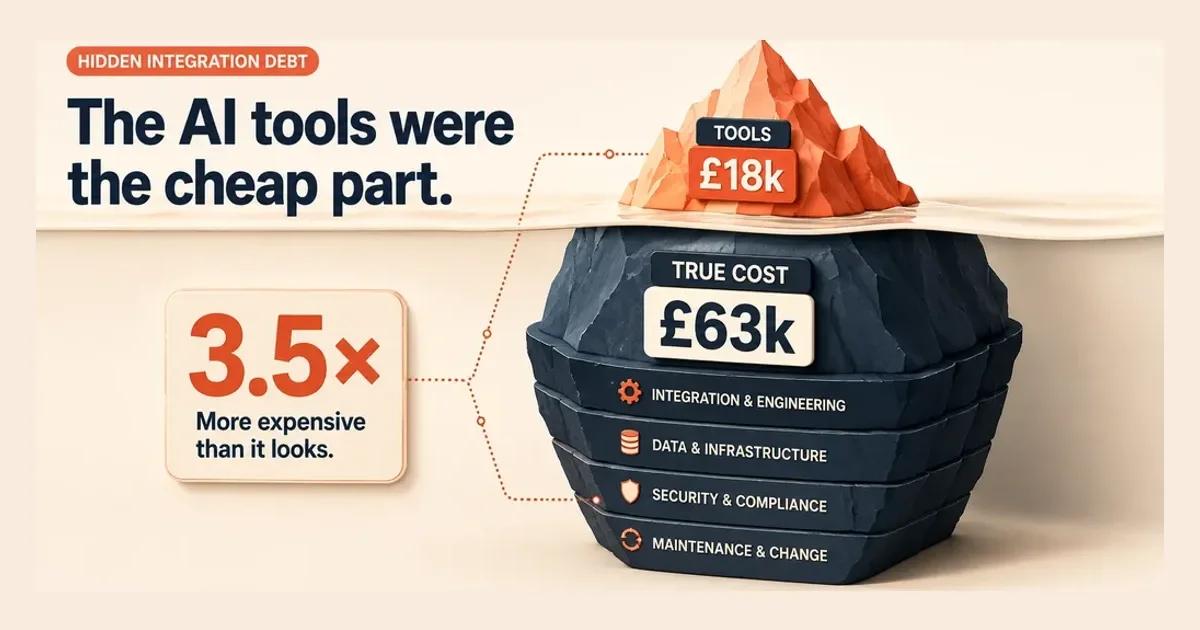
Pavel runs a 75-person manufacturer outside Birmingham. Last year he spent £18,000 on AI tools: a copilot for sales, a document parser for procurement, a chatbot for customer service. None of it stuck. When we audited his stack, we found £45,000 of integration debt his vendors never mentioned: a legacy ERP without an API, no single sign-on, customer data split across three systems and a shared inbox. His AI programme didn't cost £18,000. It cost £63,000. Nobody told him until the money was gone.
Illustrative case. Pavel, his company and the company-specific figures are illustrative; they do not identify a real named business or a published customer result. The cited sources support the wider integration-debt pattern, not this individual company history.
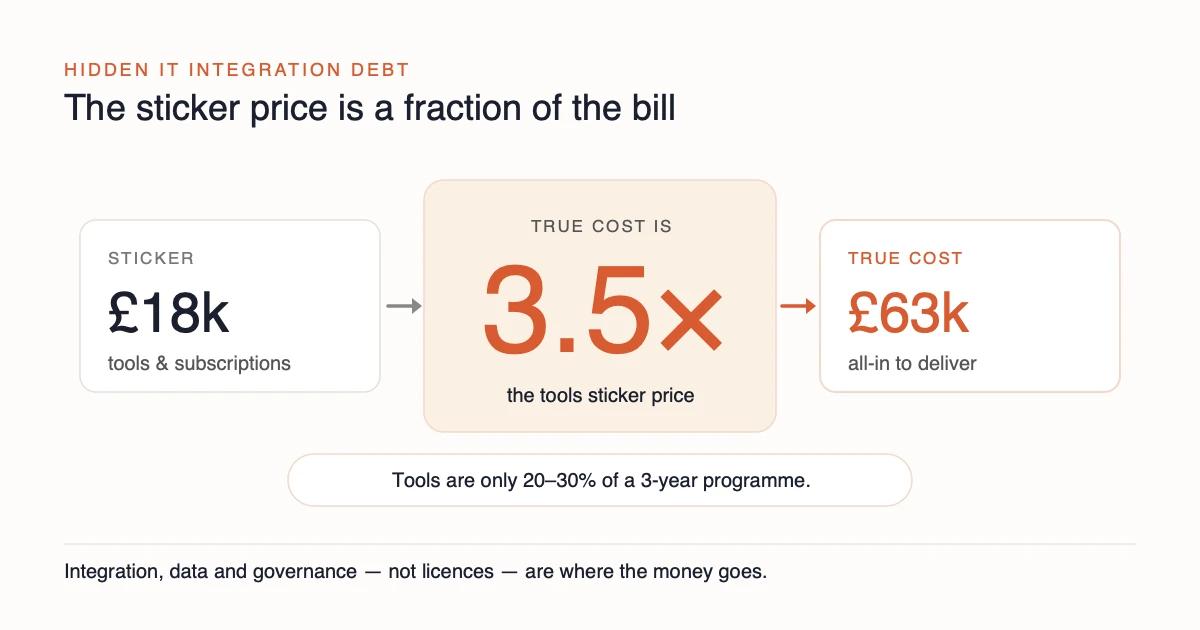
Quick Answer. AI is not a tool you buy, it is an IT integration project. Subscriptions are 20 to 30 per cent of three-year cost; identity, data, integration and governance account for the rest, and they surprise you unless scoped upfront. Run a Stage Zero audit before signing — step one of any AI implementation framework.
Why did £18,000 of AI Tools Deliver Nothing?
He wasn't naive. He wasn't cutting corners. He made the same miscalculation most SMB leaders make: he treated AI as a SaaS purchase rather than a system integration.
What Pavel actually bought
Three AI subscriptions, each purchased by a department head on a credit card. IT was never consulted.
- A sales copilot for the commercial team
- An invoice parser for procurement
- A customer service chatbot for the support desk
Each demoed in under an hour. Each was sold as plug-and-play.
What broke when reality hit
Pavel's £18,000 spend bought three AI subscriptions: a sales copilot, an invoice parser, a customer service chatbot. Each was sold as plug-and-play. Each demoed in under an hour. Twelve months later, none had moved a single business process. The sales copilot couldn't read the legacy CRM because no API existed. The invoice parser misread 1 in 4 documents because procurement data was inconsistent across three systems. The chatbot answered customer questions with hallucinated product specs because no governed knowledge base fed it.
Pavel's miscalculation wasn't choosing bad tools. He bought subscriptions without scoping the APIs, governed data and system connections each one needed. The vendors had every commercial incentive to encourage that framing. Nobody told him that AI tools don't sit beside existing systems the way Slack does. They reach into them, reason across them, and act upon them. That requires plumbing he didn't have.
The UK National Audit Office reached the same conclusion at national scale: achieving real AI benefits requires tackling data quality and ageing IT infrastructure first 1. Pavel's situation wasn't unusual. It was the rule.
The Counter-Narrative: Plug-and-Play AI and Why It Misleads Buyers
Vendor marketing has a consistent message. It is specific, confident, and wrong at the level that matters most.
What vendors say
- "Launch AI workflows in days, not months."
- "Reduce IT dependency."
- "No specialised technical expertise required."
These claims are true for one thing: getting a demo to run. They are not true for deploying that demo into a live business.
What's actually true
The plug-and-play story is the most expensive metaphor in enterprise software. It is borrowed from consumer electronics, where you plug a USB drive into a laptop and it works. AI tools do not behave like USB drives. They behave like new employees with system-wide access: they need credentials, role definitions, supervised onboarding, and clear boundaries on what they may read and write.
SaaS marketplaces collapse this complexity into a credit card transaction, which is excellent for vendors and dangerous for buyers. The truth is narrower. Plug-and-play exists at the feature level (a chatbot answers questions, a copilot drafts text), but disappears at the system level (the chatbot answering authenticated customer questions about live order status across three integrated platforms). UK SMBs lose money in the gap between those two scopes, a gap that vendors are commercially incentivised to leave undefined.
The UK Government's own AI Playbook frames deployment as a multi-stage project lifecycle requiring user research, data protection due diligence, and ethical review at every stage 2. That is not a product purchase motion. It is an IT project.
AIaaS does not bypass IT. It defers IT. The bill arrives after the contract is signed, as Pavel discovered when £18,000 of tools surfaced £45,000 of integration debt he had never budgeted for.
Why AI Implementation Frameworks Keep Failing
The frameworks exist. They are documented, polished, and widely shared. They still fail SMBs at the first step.
The frameworks already on the internet
Search for AI implementation guidance and you find the same structures: crawl-walk-run methodologies from AWS and its partners, Securafy's five-stage adoption model, Framework IT's readiness assessments. Each one is competent. Each one shares a critical assumption: that your IT estate is already fit for purpose.
They begin at pilot selection. They ask which process to automate first. They do not ask what sits underneath it.
The Stage Zero they all skip
Most AI implementation frameworks for SMBs share the same flaw: they assume the underlying IT estate is ready. Crawl-walk-run methodologies, five-stage adoption models, AI readiness assessments all start at pilot selection and skip what the UK National Audit Office calls the prerequisite work.
The NAO has been explicit since March 2024: government must tackle longstanding issues including data quality and ageing IT infrastructure before effective AI use is possible 3. The Public Accounts Committee found that 28% of central government systems are classified as legacy, and approximately a third of the 72 highest-risk systems still lack remediation funding 4. The same pattern holds in SMBs. ERPs from 2009. Customer data spread across spreadsheets, CRM, and email. No single sign-on. No API gateway. A framework that begins at pilot selection rather than legacy audit delivers Pavel's outcome: £18,000 spent, zero processes moved.
Stage Zero has three components every SMB framework skips:
- Legacy system audit: which systems exist, how old, what connectivity they expose
- Data quality assessment: where your operational data actually lives and whether it is clean enough to feed a model
- Identity and access architecture review: whether your systems can authenticate an AI agent at all
No crawl-walk-run model will save you if Stage Zero is unresolved. The PAC was direct: there are no quick fixes 5. That applies equally at 75 employees and 75,000.
The Hidden Integration Debt: What an AI Audit Actually Surfaces
When Pavel's audit concluded, the headline figure wasn't £18,000. It was £63,000. The tools were the smallest line item.
Across our own audit sample of UK SMBs in 2025-26, every case surfaced these five debt categories. The proportions varied. The categories did not.
The five categories of integration debt
Every SMB AI audit we conduct surfaces the same five categories of unbudgeted work. The names change. The costs shift. The categories do not.
- Legacy system access: APIs, connectors, middleware to expose data that AI tools can actually read
- Data quality and lineage: deduplication, standardisation, reconciling multiple sources of truth
- Identity, SSO, and role-based access control: defining what AI agents can read, write, and never touch
- Audit logging and observability: trails, monitoring, alerting that vendor compliance certifications do not provide
- Security review and compliance documentation: a review that lives outside the vendor's responsibility
The PAC reached the same conclusion at government scale: poor data quality and out-of-date legacy IT are actively putting AI adoption at risk 4. The NAO was equally direct. Updating legacy systems and improving data quality is fundamental to exploiting AI, and organisations must consider the dependencies between AI plans and wider digital transformation before committing 1. Those dependencies don't disappear at 75 employees.
Pavel's £45,000 breakdown
Pavel's £45,000 of hidden integration debt fell into five categories that every SMB AI audit eventually exposes. Legacy system access: £15,000 to expose his 2011 ERP through a middleware layer so AI tools could read order data. Data quality remediation: £12,000 to deduplicate customer records, standardise product codes, and reconcile three sources of inventory truth. Identity and access: £8,000 to roll out single sign-on and define role-based access for AI agents that needed read-only access to some systems and write access to others.
Logging and security: £6,000 for audit trails, monitoring, and a security review that the AI tools' compliance certifications did not eliminate. Process redesign: £4,000 to rewrite the standard operating procedures the AI was meant to support. None of this appeared in any vendor proposal. All of it was non-negotiable. The £18,000 of subscriptions sat dormant until the £45,000 of plumbing was built.
| Category | Amount | What It Covered |
|---|---|---|
| Legacy system access | £15,000 | Middleware to expose 2011 ERP via API |
| Data quality remediation | £12,000 | Customer dedup, product code standardisation, inventory reconciliation |
| Identity & access | £8,000 | SSO rollout, RBAC for AI agents |
| Logging & security | £6,000 | Audit trails, monitoring, security review |
| Process redesign | £4,000 | SOP rewrites for AI-assisted workflows |
| Total | £45,000 | Hidden integration debt |
That is the true cost of an AI deployment: not the licence, but the infrastructure it requires to function.
The 5-Layer AI Integration Framework
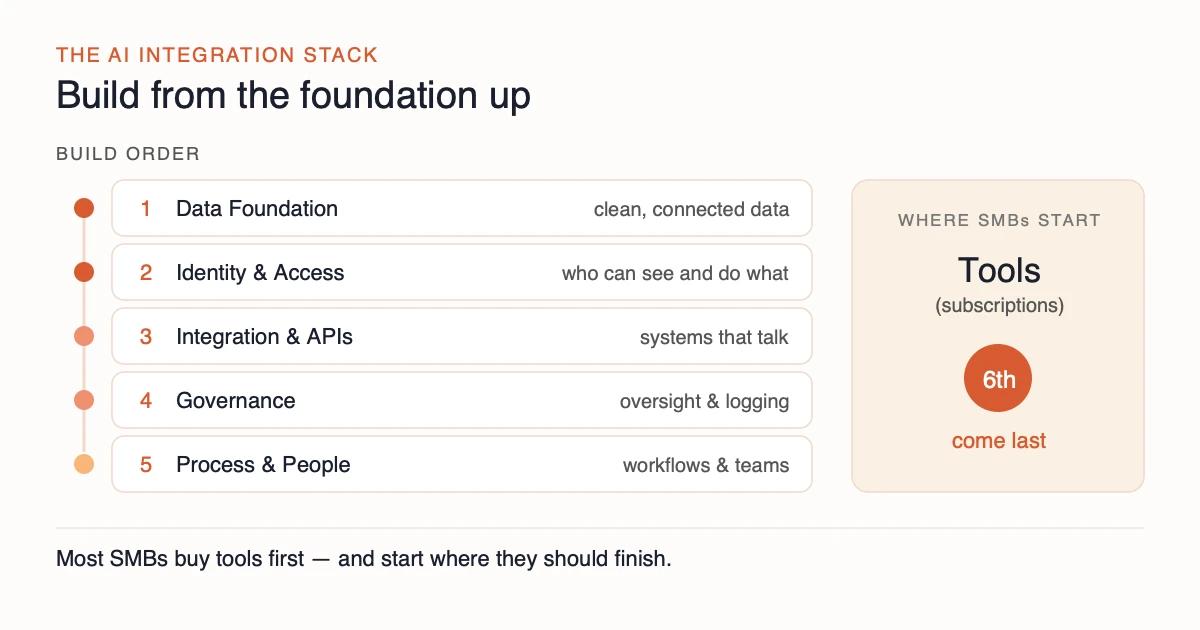
Most SMB AI projects fail because they start at Layer 5 and work backwards. The framework below reverses that. It sequences the work correctly, and puts tool selection last.
The UK Government AI Playbook is explicit on this point: "AI solutions, like other technology deployments, have a full product life cycle that you need to understand" — Planning, Building, Testing, Deployment, Maintenance and Retirement 2. This framework applies that lifecycle logic at SMB scale, with budget guidance drawn from our audits.
Layer 1: Data Foundation (25–35% of programme budget)
Audit your data sources, quality, and lineage before anything else. Define a single source of truth per domain: customers, inventory, orders, finance. You cannot reason over data you do not trust. This layer consistently consumes the largest share of budget. It is also the layer most SMBs skip entirely.
Layer 2: Identity & Access (10–15% of programme budget)
SSO across every system the AI will touch. Role-based access defined for AI agents as carefully as for human users. If an AI agent can write to your ERP without an access policy, you have a control failure, not a productivity tool.
Layer 3: Integration & APIs (20–30% of programme budget)
Expose legacy systems through APIs or middleware. Define explicitly which systems are read-only and which are write-enabled for AI. Pavel's £45,000 of integration debt lived here: undocumented systems with no API surface, no middleware, and no agreed data contracts.
Layer 4: Governance & Observability (10–15% of programme budget)
Audit logging of every AI action. Model monitoring and drift evaluation. Without this layer, you cannot distinguish an AI performing correctly from one silently producing wrong outputs. This is not compliance theatre. It is operational hygiene.
Layer 5: Process & Workforce (15–20% of programme budget)
Rewrite SOPs to incorporate AI checkpoints. Define human-in-the-loop boundaries explicitly. Role redefinition belongs in engineering scope, not in a half-day training session bolted on at go-live.
| Layer | Focus | % of Programme Budget |
|---|---|---|
| Layer 1 | Data Foundation | 25–35% |
| Layer 2 | Identity & Access | 10–15% |
| Layer 3 | Integration & APIs | 20–30% |
| Layer 4 | Governance & Observability | 10–15% |
| Layer 5 | Process & Workforce | 15–20% |
| Tools | AI subscriptions | 15–25% (residual) |
The 5-Layer AI Integration Framework reorders the SMB AI conversation. Layer 1 is Data Foundation: you cannot reason over data you do not trust, so 25–35% of programme budget goes to data quality, lineage, and master data management. Layer 2 is Identity & Access: SSO across every system the AI touches, with role-based access defined for AI agents as carefully as for humans (10–15%). Layer 3 is Integration & APIs: expose legacy systems through APIs or middleware, with explicit read-only versus write boundaries (20–30%). Layer 4 is Governance & Observability: audit logging of every AI action, model evaluation, and drift monitoring (10–15%). Layer 5 is Process & Workforce: SOP rewrites, human-in-the-loop checkpoints, and role redefinition treated as engineering scope, not a training afterthought (15–20%).
Tool selection happens after these five layers are scoped, not before. It is the lifecycle the UK Government AI Playbook lays out, applied at SMB scale 2. It is the framework UK SMBs actually need.
Add the layers together and a pattern emerges: roughly 60–75% of a real AI programme budget is infrastructure, governance, and process work. The AI tool itself is the remaining slice. Vendors invoice for the slice. The rest arrives as a surprise.
Costing AI as an Integration Programme: A TCO Worksheet
Most AI budgets are built around the wrong number. The tool subscription is not the cost of the programme. It is one line item in a list of ten.
A serious AI TCO model treats the tool subscription as one line item amongst ten, not the headline figure. Across the audits we have run, the tool subscription typically represents 20–30% of the true three-year cost of ownership. Integration engineering, data remediation, identity work, security review, monitoring tooling, training, and process redesign make up the remaining 70–80%. Pavel's case is illustrative: £18,000 sticker price, £63,000 true cost, a 3.5x multiplier that would have been visible in any honest scoping exercise.
This framework scopes the integration project itself. Ongoing running costs (model inference, hosting, API spend) depend heavily on model selection and deployment architecture. With current open-source options and the right local-versus-cloud mix, they are often a minor line item against the operational savings AI delivers. We treat them as a separate analysis, not because they don't matter, but because they deserve their own scoped review.
The UK Parliament's Digital Centre evidence explicitly rejects transactional procurement models for technology, arguing for outcome-based funding that addresses risks and enables joined-up action 6. SMBs that copy the SaaS procurement playbook for AI inherit the SaaS budget, not the integration budget. The result is a tool that runs but a programme that doesn't.
Line items most vendors omit
- Integration engineering hours
- Data quality remediation
- Identity and access work
- Security review and compliance documentation
- Training and change management
- Monitoring tooling
- Decommissioning costs of replaced systems
These are not edge cases. The NAO has identified skills shortages, data quality issues and ageing IT systems as barriers to realising AI's benefits in government 3.
Rule of thumb for a 3-year TCO
- Tool subscription: 20–30% of true cost
- Integration engineering: 40–50%
- Operations and governance: 20–30%
Build the budget in this order. If the tool subscription is the largest line item, the scoping is incomplete, and the hidden debt will surface after go-live, exactly as it did for Pavel.
How Do You Evaluate an AI Vendor From Demo to Production?
Most AI vendors lead with a demo. The demo works. The question is whether your systems can support what happens after the demo ends.
There is a specific difference between time-to-demo and time-to-production. Vendors measure the first. You pay for the second. 'Days not months' framing is accurate for one thing only: getting a polished environment running on clean, vendor-controlled data. Your production environment has legacy ERP, inconsistent data, no pre-built APIs, and a SIEM that expects standardised logs. That gap is your problem to solve, not theirs.
The vendor evaluation script for AI tools should look nothing like the script for buying a SaaS CRM. Five questions reveal the integration scope hidden behind the demo. First: how does the tool authenticate against our existing SSO provider, and what does the user provisioning flow look like? Second: what APIs does the tool require on our systems, and what is the fallback when those APIs do not exist? Third: where is our data processed and stored (UK, EU, or US) and what is the data processing agreement?
Fourth: what audit log does the tool produce, and can our existing monitoring ingest it? Fifth: name a customer of our size with this tool in governed production, and connect us to them. Vendors who cannot answer these questions are not selling an integration; they are selling a demo. The gap is your problem, not theirs.
Questions Vendors Hate
- How does your tool authenticate against our SSO provider?
- What APIs do you require on our systems? What if those APIs don't exist?
- Where is data processed and stored: UK, EU, or US?
- What audit log do you produce? Can our SIEM ingest it?
- What's your time-to-production reference for a customer of our size?
Red Flags
- Vendor cannot name a customer of similar size in production
- Demo data is suspiciously clean
- No reference customer call available
The UK Government's AI Playbook frames AI deployment as a multi-stage project lifecycle requiring data protection due diligence and user research before any tool goes live 2. That is the standard. Hold vendors to it.
Shadow AI: The Procurement Risk Already Inside Your Business
Shadow AI is the AI your business is already using without IT's knowledge or governance. It hides in three places: personal ChatGPT and Claude accounts that staff use on work devices, AI features quietly enabled inside SaaS tools your team already pays for, and standalone AI subscriptions purchased on department credit cards under the approval threshold.
The risk is rarely the tool itself. It is the data that flows out of your network into a model provider's logs, often outside the UK, often without a data processing agreement. A shadow AI audit starts with three steps: scan expense reports for AI subscriptions under the procurement threshold, review browser activity to identify AI tool usage, and classify data flows by sensitivity. The goal is not to ban shadow AI; that approach fails. The goal is to bring it inside the integration framework before regulators or customers find it first.
Where Shadow AI Hides
- Personal ChatGPT and Claude accounts accessed on work devices or work networks
- AI features inside existing SaaS tools nobody deliberately enabled: CRM summarisation, email drafting, support ticket routing
- Department-level AI subscriptions purchased below the procurement approval threshold, typically under £100 per month
The Shadow AI Audit
- Scan expense reports for recurring AI subscriptions under £100 per month
- Review browser activity logs to surface AI tool usage across the business
- Classify data flows by sensitivity: customer PII, financial records, and contracts represent the highest exposure
Risk classification follows the data, not the tool. A staff member summarising meeting notes in a free AI tool is low risk. The same tool processing customer contracts is a data processing agreement violation waiting to happen.
The UK Government's AI Playbook requires data protection due diligence before any AI touches operational data 2. That standard applies whether procurement signed the contract or a marketing executive did it on a personal card.
UK-Specific Compliance: GDPR, the DSIT AI Playbook, and the ICO
UK SMBs face compliance duties that most US-centric AI frameworks ignore entirely. Three regulatory anchors govern every deployment decision, and none of them appeared in the vendor documentation Pavel received with his £18,000 of tools.
The Three Regulatory Anchors
UK SMBs operate under three regulatory anchors that no US-centric AI framework addresses. First, UK GDPR makes data residency a live question for any AI tool hosted in the United States. The question 'where is my customer data processed' is not bureaucratic; it is the difference between a compliant deployment and a notifiable breach.
Second, the DSIT AI Playbook published in February 2025 institutionalises a project-lifecycle approach: ethics, user research, data protection due diligence, and environmental impact assessment from design through deployment 2. It explicitly frames AI as a multi-stage project, not a product purchase. Third, the ICO's guidance on automated decision-making constrains where AI can act unilaterally on individuals: credit decisions, employment screening, customer eligibility 8. UK SMBs serving EU customers also fall in scope of the EU AI Act extraterritorially 7. None of this work is optional. All of it belongs in Layer 4 of the integration framework, not in a compliance afterthought.
EU AI Act Extraterritoriality
When a UK business serves EU customers, EU AI Act obligations follow the data subject, not the supplier's registered address 7. High-risk use cases require documented conformity assessments regardless of where the tool was procured.
The DSIT AI Opportunities Action Plan frames this clearly across three pillars: foundational infrastructure, public services transformation, and technological sovereignty 9. That framing presupposes deep integration. Compliance is not a late-stage checklist. It is scoping work, and it belongs at the start.
Workforce and Process Change as Engineering Scope
Most AI programmes treat workforce change as a post-go-live activity. A training day. A lunch-and-learn. That framing is wrong, and two UK public bodies have said so explicitly.
What the NAO Actually Said
The UK National Audit Office is unambiguous: achieving wide-scale benefits from AI will require both adoption of new technology and significant changes in business processes and corresponding workforce changes 1. The Public Accounts Committee reinforces this: 70% of government bodies identified difficulty recruiting and retaining staff with AI skills as a barrier to adoption 5.
Translated to SMB reality, this means workforce and process change are not soft side-projects to schedule after go-live. They are engineering dependencies that belong inside the project plan from day one. Concretely: every AI-assisted workflow needs an updated RACI, an SOP rewrite that names the human-in-the-loop checkpoints, and an exception-handling redesign for the cases the model gets wrong. Treating this as 'training' rather than as scoped engineering is the most common reason AI pilots succeed and AI programmes fail.
Engineering Process Change
For Pavel's manufacturer, this translated into three deliverables that sat inside the integration scope, not outside it:
- RACI updates for every AI-assisted workflow, naming who owns model output review
- SOP rewrites with explicit human-in-the-loop checkpoints at each decision gate
- Exception handling redesign for edge cases the model handles incorrectly
These are not HR tasks. They are engineering specifications. Scope them, resource them, and cost them accordingly.
Where Pavel Is Now: Six Months After the Audit
Six months after the audit, Pavel's AI programme looks completely different. He cancelled two of the three AI subscriptions immediately because they could not function on top of his data and identity estate. He spent the first four months on Layer 1 and Layer 2: cleaning master data, deduplicating customer records, deploying single sign-on, and defining role-based access for both human users and the AI agents he planned to introduce.
Only then did he reselect tools: a single integration-friendly platform rather than three point solutions. The total programme spend reached £58,000 over nine months, less than the £63,000 hidden true cost of his original approach. Four processes are now meaningfully automated: invoice intake, sales quote drafting, customer-service triage, and supplier onboarding. He kept his entire team. Revenue per employee is up 14%. The difference was not better tools. It was treating AI as the integration project it always was.
The reset
- Cancelled two of three AI subscriptions on audit day
- Built Layer 1 (data) and Layer 2 (identity) before reselecting any tools
- Reduced AI tool count from three to one, but moved four processes onto it
The numbers
- Total programme spend: £58,000 over nine months
- Four processes meaningfully automated
- Zero shadow AI subscriptions remaining
The NAO frames legacy IT remediation, skills, and data quality as concurrent prerequisites for AI value 1; in our SMB audits, the practical sequencing is infrastructure before tools. Pavel's timeline reflects that. Nine months, not nine days. Boring, sequenced, executable.
That is what an AI programme looks like when it works.
aiprioritymap.com conducts AI Foundation Audits for European SMBs. Our full methodology, including how we calculate integration debt, is documented in the methodology section of this site.
Summary
Hidden Integration Debt — AI is a project, not a purchase
│
├─ The sticker-price trap
│   ├─ Plug-and-play — true for the demo, false for production
│   └─ Pavel's case — £18k of tools surfaced £45k of debt
│
├─ Where the real cost hides
│   ├─ Data foundation — clean, trusted single source of truth
│   ├─ Identity & access — SSO and RBAC for AI agents
│   ├─ Integration & APIs — expose legacy systems to read
│   └─ Governance — audit logs, drift monitoring, oversight
│
└─ Sequence it right
    ├─ Tools last — they are 20-30% of true cost, not the start
    └─ Stage Zero first — audit legacy, data quality, IAM
Related insights
- Local LLM vs Cloud LLM Data Security: The Wrong Question (2026) — the infrastructure-vs-control framing that decides whether your integration debt lands on identity and DLP, or on on-prem hardware.
- Your SMB Doesn't Need More AI Tools. It Needs an AI Strategy. — the audit-first sequence that surfaces the integration debt before the subscription is signed.
- 50 Questions to Ask Before Implementing AI: SMB Buyer's Guide — buyer-stage diligence covering the integration-cost questions vendors rarely volunteer.
Last updated: 5 May 2026.
Frequently Asked Questions
What is the real cost of deploying an AI tool inside a UK small business beyond the subscription price?
Why do plug-and-play AI tools rarely move business processes after go-live?
What is "Stage Zero" in an AI implementation framework, and why do most frameworks skip it?
How should a UK small business allocate budget across a real AI programme?
What questions should a UK small business ask an AI vendor before signing a contract?
How long does a typical AI integration take for legacy ERP/CRM systems like ours — 8 weeks or 20?
What are the four challenges of applying agentic AI to legacy systems — integration, ROI, security, hallucination?
Sources
- 1.Use of Artificial Intelligence in Government — UK National Audit Office · 2024
- 2.AI Playbook for the UK Government — DSIT — UK Government · 2025
- 3.Government Encouraged to Tackle Barriers to Realising the Benefits of AI — UK National Audit Office · 2024
- 4.Use of AI in Government — UK Public Accounts Committee · 2024
- 5.Uphill Struggle Ahead for Government's Use of AI — UK Public Accounts Committee · 2024
- 6.Written Evidence (DSIT/GDS) — UK Parliament Digital Centre of Government · 2024
- 7.Regulation (EU) 2024/1689 — EU AI Act — European Parliament and of the Council · 2024
- 8.Guidance on AI and Data Protection — Information Commissioner's Office (ICO) · 2023
- 9.AI Opportunities Action Plan — DSIT · 2025
Want this run on your business?
AI Foundation Audit — a structured assessment of your AI footprint: integration risks, governance gaps, ROI opportunities. Delivered as a comprehensive report you can act on.
You receive your AI Opportunity Report and Implementation Brief — tailored to your business and delivered immediately.