Which Process to Automate First? A Decision Framework
Which process to automate with AI first? Pick the highest-suitability, lowest-risk early win over the highest-ROI one — a decision framework for a small team.
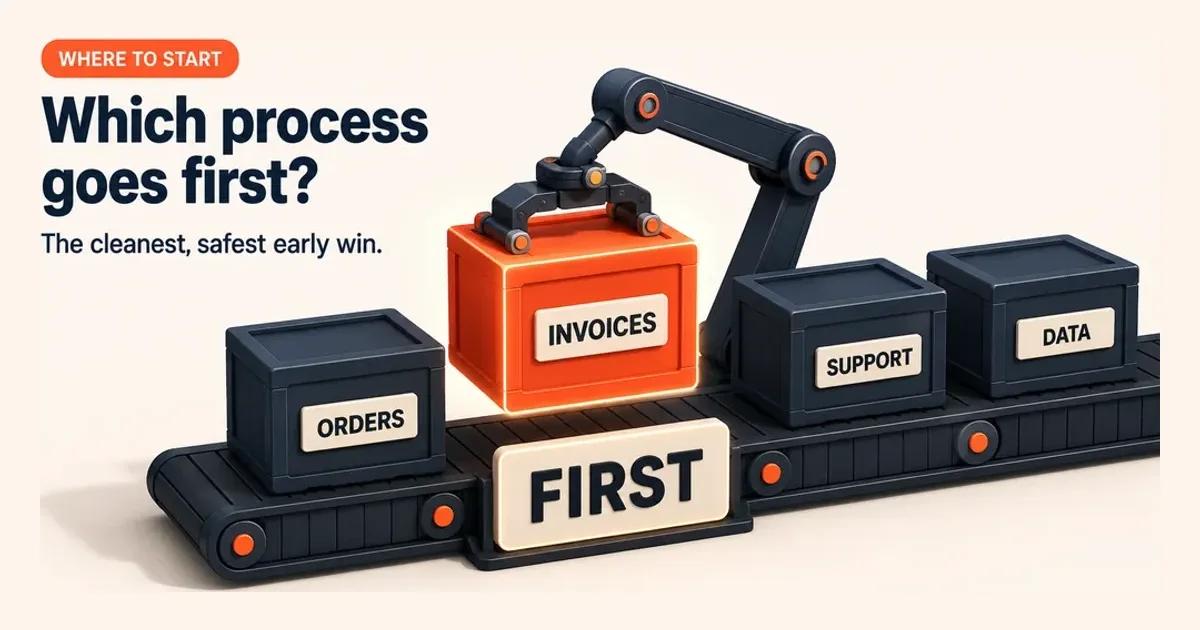
You have a ranked shortlist: the top three processes worth automating, scored and sorted. Now comes the question the ranking does not answer on its own: which one goes first? The instinct is to start with the biggest number, the highest-ROI process. That instinct is usually wrong. The first automation should be your highest-suitability, lowest-risk candidate, even when its return is smaller. The job of project one is not to capture the largest prize. It is to win cleanly, prove the method, and earn the budget for project two.
Quick Answer. Automate the highest-suitability, lowest-risk process first, not the highest-ROI one. Among your ranked shortlist, pick the high-volume, rules-bounded task such as invoice processing, order entry or ticket triage, where an error is cheap to catch. Deciding which process to automate with AI is about sequencing for an early, defensible win.
Why the highest-ROI process is the wrong place to start
A ranked shortlist tells you which processes are worth automating. It does not tell you the order, and order is its own decision. The temptation is to attack the largest payback immediately. But the highest-ROI candidate on a typical SMB shortlist is frequently the riskiest: an automated pricing engine, a credit or eligibility decision, a customer-facing recommendation. These score high on return precisely because they touch money and customers, which is also what makes an error expensive and human oversight costly.
A sound scoring model therefore subtracts risk rather than ignoring it. The Agent Opportunity Score AI Priority Map uses, ROI plus Suitability minus Risk, is built so that a high-return, high-stakes process does not automatically rank above a boring, safe, high-volume one. The full ranking method is covered in the parent guide, the AI opportunity assessment for SMBs. But even after the score ranks your top three, the first-mover choice deserves its own logic. The cost of a failed first project is more than the wasted spend: it is the credibility you lose for everything after it.
The evidence for caution is blunt. MIT's 2025 Project NANDA study found that roughly 95% of enterprise generative-AI pilots delivered no measurable profit impact, and traced the failure to organisational and selection factors rather than to the models themselves 4. When the technology works but the projects fail, the lever is which work you point it at, and in what sequence. Starting your programme on the hardest, highest-stakes process maximises the chance your first data point is a failure, which makes the second project harder to fund. Start where success is most likely instead.
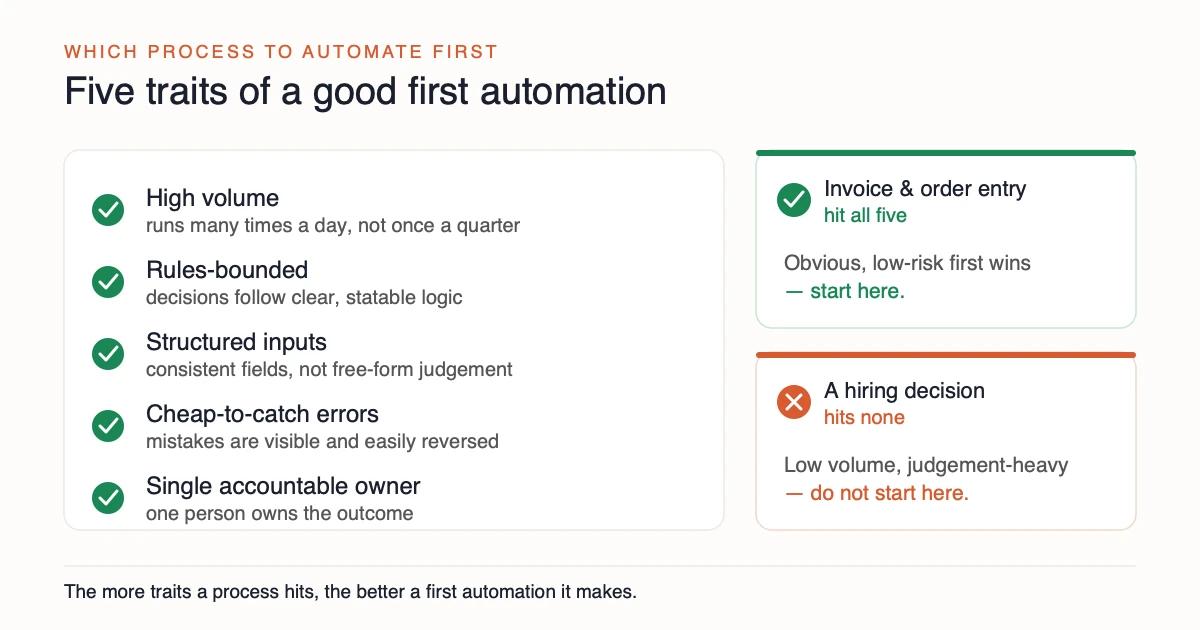
The five traits of a good first automation
| Trait | What it means | Why it matters for project one |
|---|---|---|
| High volume | Runs many times a week | Even partial automation compounds into hours saved quickly |
| Rules-bounded | Decision logic fits in a checklist | Less judgement means more reliable model behaviour |
| Structured inputs | Invoices, orders, tickets rather than free-form context | Predictable shape is what current extraction handles well |
| Low blast radius | An error is caught before it reaches a customer or the ledger | A first failure costs credibility as well as spend |
| Measurable today | You already know the volumes and the hours | The result can be proved rather than argued |
A good first automation is not defined by how impressive it looks in a demo. It is defined by five traits that make a clean win likely.
- High volume. The process runs many times a week, so even a partial automation compounds into real hours saved. A task that runs twice a quarter cannot prove anything quickly.
- Rules-bounded. The inputs and decision logic are clear enough to describe in a checklist. The less judgement the work requires, the better current models handle it reliably.
- Structured inputs. The work runs on text or data in a predictable shape, such as an invoice, an order or a support ticket, not on free-form context that lives only in someone's head.
- Cheap-to-catch errors. When the automation is wrong, the mistake is visible and reversible before it reaches a customer or the ledger. Low blast radius is what lets you ship without months of guard-rails.
- A single accountable owner. One person can verify the output and own the result. This maps directly onto the human-oversight discipline the NIST AI Risk Management Framework organises governance around: mapping context, measuring impact, and managing risk at the level of a single process 1.
These traits are why suitability and risk, not raw ROI, should drive the first pick. A process that hits all five gives you a fast, measurable, low-stakes result. A process that hits none, such as a strategic hiring call, a contract negotiation or a one-off pricing decision, is exactly where an SMB should not begin, however large the theoretical prize.
Four process archetypes that make strong first automations
| Archetype | Why it opens well | What a mistake costs |
|---|---|---|
| Invoice processing | High volume, rules-bounded, document-heavy, with well-defined PO-receipt-invoice matching | Caught at approval, before money moves |
| Order entry and confirmation | Repetitive, structured and high-frequency re-keying into the ERP | A human confirms exceptions, so customer-facing judgement is untouched |
| Support ticket triage | Rules-bounded and high-volume classification and routing | A misroute is low-cost and recoverable |
| Data re-keying between systems | Pure structured transfer where two systems do not integrate | Low risk, and the time saved is easy to measure |
Across SMB shortlists, the same handful of back-office processes recur as ideal openers. They share the five traits above and carry low blast radius.
Invoice processing. High volume, rules-bounded, document-heavy. The inputs arrive in predictable formats, the matching logic (PO, receipt, invoice) is well defined, and an error is caught at approval before money moves. Among the cleanest possible starting points for a finance-heavy SMB.
Order entry and confirmation. Re-keying customer orders from email, PDF or portal into the ERP is repetitive, structured, and high-frequency. Automating extraction and entry, with a human confirming exceptions, removes a chronic source of slow, error-prone manual work without touching customer-facing judgement.
Support ticket triage. Classifying and routing inbound tickets is rules-bounded and high-volume, and the cost of a misroute is low and recoverable. It also sits one safe step away from customer contact: the AI sorts and drafts, a person sends. That makes it a strong early win for a service-led SMB.
Data re-keying between systems. Where two systems do not integrate and a person manually copies records between them, the work is pure structured transfer: no judgement, fully rules-bounded, and often surprisingly high-volume. Automating it is low-risk and the time saving is easy to measure.
The common thread is that these are unglamorous, internal, document-and-data processes, and that is the point. MIT found more than half of generative-AI budgets went to visible sales-and-marketing use cases, while the cleanest returns sat in exactly this kind of back-office automation 4. U.S. Census Bureau survey data shows the same pull: smaller firms cluster in marketing-led use cases 5, the very category that tends to disappoint. The first-mover discipline is to resist the visible project and start where the payback is clean.
When the rule bends: oversight, and when ROI does win
The "lowest-risk first" rule is a default, not a law. Two situations legitimately change the pick.
When human-in-the-loop design lowers the risk. A process with moderate error cost can become a safe first automation if you design verification rather than full hand-off. The AI drafts or proposes, and a named person approves before anything is committed. This widens your menu of viable openers, because risk is partly a design variable, not a fixed property of the process. The trade-off is real: oversight adds labour cost and caps the hours saved, so verify-heavy designs suit the first project and should taper as confidence grows. The discipline of designing that safeguard well, rather than treating it as a rubber-stamp, is covered in human-in-the-loop as a design discipline. Census data underlines why this matters for smaller firms specifically: AI use is rising fastest where the work is structured and the oversight is cheap 5.
When the highest-ROI process is also low-risk. Occasionally the biggest prize is the rules-bounded, structured, cheap-to-catch one. If your top-ROI candidate also scores high on suitability and low on risk, the rule does not bend. It agrees with you, and you should start there. The point of the framework is never "avoid ROI." It is "don't let a large number drag you into a high-risk process before you have shipped anything." When return and safety point the same way, follow them both.
What does not justify bending the rule is enthusiasm. The OECD notes that AI adoption among smaller firms is held back by skills and knowledge gaps rather than appetite 3. SMBs rarely lack the will to start an ambitious project; they lack the margin to absorb its failure. A failed first project on a hard process burns exactly the scarce credibility a smaller firm needs to fund a programme.
What to do on Monday
Take your ranked shortlist and re-sort the top three by a single tie-breaker: suitability minus risk. The process that floats to the top of that re-sort is your first automation, not necessarily the one with the biggest ROI number, but the one most likely to ship cleanly and prove the method.
Then pressure-test it against the five traits. Is it high-volume? Rules-bounded? Are the inputs structured? Are errors cheap to catch? Is there one owner who can verify the output? If it passes all five, you have your opener. If it fails two or more, drop to the next candidate. The arithmetic that produced your shortlist in the first place, and the step-by-step scoring behind it, is covered in how to prioritise AI use cases (a companion guide; publishing shortly), and the broader method sits in the parent, the AI opportunity assessment for SMBs.
If you would rather have the shortlist and the first-mover sequencing done rigorously, that is what AI Priority Map's AI Foundation Audit delivers. Every process is scored, the top three ranked, and a phased implementation roadmap names which one to start with and why. It runs as a guided wizard and the package arrives within 24 hours, with a 100% money-back guarantee if no process with measurable savings is identified. The downside of running it is bounded; the downside of starting on the wrong process is not.
Summary
Which process first — sequence the safe win
│
├─ The rule · suitability minus risk
│   ├─ Not highest-ROI — big prizes touch money & customers
│   └─ Win cleanly — project one proves method, funds project two
│
├─ Five traits of a good opener
│   ├─ High volume + rules-bounded — compounds, models handle it
│   ├─ Structured inputs — invoice, order, ticket; not free-form
│   └─ Cheap errors + one owner — low blast radius, verifiable
│
└─ When the rule bends
    ├─ Human-in-loop — verification design lowers a moderate risk
    └─ ROI agrees — top prize that's also low-risk: start there
Related insights
- AI Opportunity Assessment for SMBs: Rank Your Top 3 Wins — the parent guide on scoring and ranking every process before you commit budget.
- Human-in-the-Loop Isn't Oversight. It's a Design Discipline. — how verification design turns a moderate-risk process into a safe first automation.
- How to Prioritise AI Use Cases — the step-by-step scoring framework behind the shortlist.
Last updated: June 2026. Version 1.0.
Frequently Asked Questions
Which process should a small business automate with AI first?
Should I automate the highest-ROI process first?
What traits make a process a good first automation?
What are the best processes to automate first for a small business?
How does keeping a human in the loop affect which process I pick first?
How long before the first automation should pay back?
Sources
- 1.Artificial Intelligence Risk Management Framework (AI RMF 1.0) — NIST · 2023
- 2.The 2025 AI Index Report — Economy chapter — Stanford Institute for Human-Centered AI (HAI) · 2025
- 3.AI adoption by small and medium-sized enterprises — OECD · 2025
- 4.The GenAI Divide: State of AI in Business 2025 (Project NANDA) — Massachusetts Institute of Technology (MIT) · 2025
- 5.Tracking Firm Use of AI in Real Time: A Snapshot from the Business Trends and Outlook Survey (CES-WP-24-16) — U.S. Census Bureau (Center for Economic Studies) · 2024
Want this run on your business?
AI Foundation Audit — a structured assessment of your AI footprint: integration risks, governance gaps, ROI opportunities. Delivered as a comprehensive report you can act on.
You receive your AI Opportunity Report and Implementation Brief — tailored to your business and delivered immediately.