AI Implementation Roadmap for Small Business: Pilot to Scale
An AI implementation roadmap for a small business turns a ranked top-three shortlist into phases: pilot, stabilise, expand, with oversight from day one.
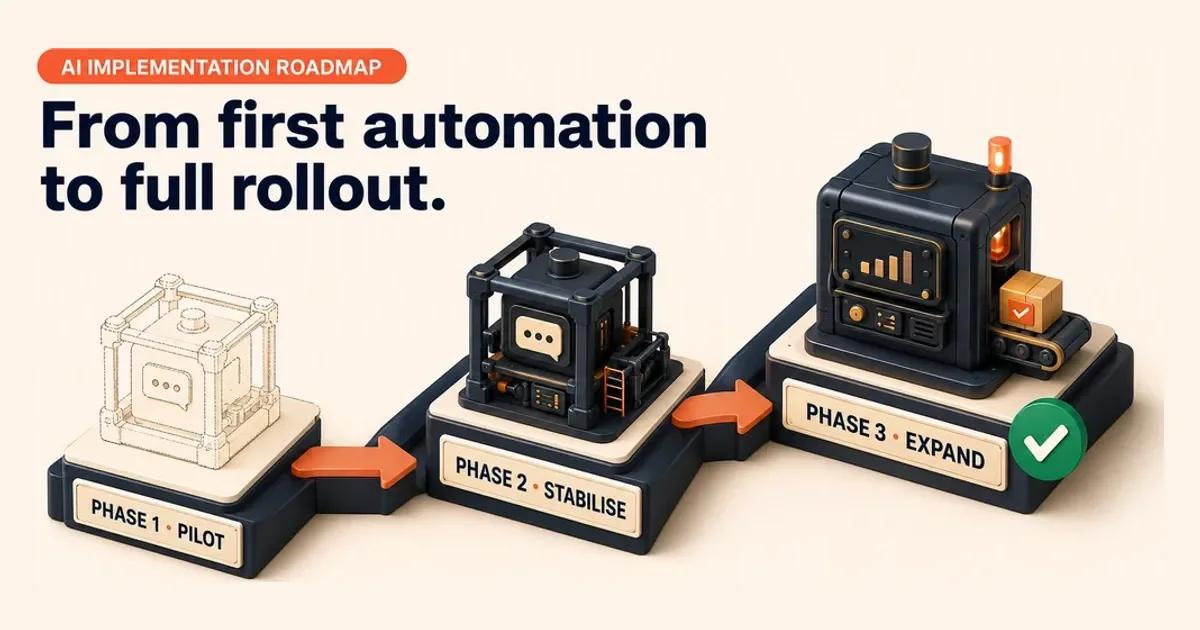
You have run the assessment, scored your processes, and you are holding a ranked top three. The hard part is not the list. It is the order and the rhythm. An AI implementation roadmap for SMBs turns that shortlist into a phased rollout. One process at a time, each proven before the next starts, with governance built in from the first automation rather than retrofitted later. The mistake most SMBs make next is launching all three at once and stalling on every one.
Quick Answer. An AI implementation roadmap for small business sequences a ranked shortlist into pilot, stabilise and expand phases, so each automation proves measurable value before the next begins. It names a human owner and oversight step from phase one, leads with the highest-confidence process, and lets readiness, not a fixed deadline, decide when to advance.
Why the rollout, not the shortlist, is where firms stall
The ranked shortlist answers what to automate. The roadmap answers in what order and at what pace. That second question is where the value actually leaks out. BCG's 2024 study of AI adopters found only 26% of companies had built the capabilities to move beyond proofs of concept, and just 4% were generating substantial value across functions 2. The bottleneck is not picking the first project. It is everything between a working pilot and a stable, scaled system.
MIT's 2025 Project NANDA study reached the same conclusion from the failure side. Roughly 95% of enterprise generative-AI pilots delivered no measurable profit impact, and the researchers attributed that to organisational choices rather than model quality 4. A pilot that never becomes a stabilised, owned, measured automation is indistinguishable from a pilot that failed. The roadmap exists to carry the first automation past the demo and into the operating model, and then to repeat that crossing for the next two processes deliberately, not hopefully.
For an SMB the margin for a stalled rollout is thinner than for an enterprise. OECD data shows AI use among businesses with 10 or more employees rose from 5.6% in 2020 to 14% in 2024 5. Skills and integration gaps still hold it back, not appetite. UK DSIT's 2025 Technology Adoption Review found use concentrated in larger firms 6. 68% of large accountancy and consulting firms use AI, against just 15% of small ones. Smaller firms have a thinner team to run a rollout. That is exactly why sequencing, doing one thing well before starting the next, matters more for them, not less.
The three phases: pilot, stabilise, expand
| Phase | What it is for | The gate out of it |
|---|---|---|
| 1. Pilot | One chosen process in real use at limited scope, with a human checking output and the manual fallback always available | The automation produces acceptable results and the oversight routine actually functions |
| 2. Stabilise | The phase SMBs skip, and skipping it is why rollouts stall | The numbers hold across weeks rather than one good day, and the owner runs oversight without heroics |
| 3. Expand | The next process on the ranked list begins its own pilot, or the first widens to more volume and teams | Each new process re-enters at Phase 1 with its own stabilise gate |
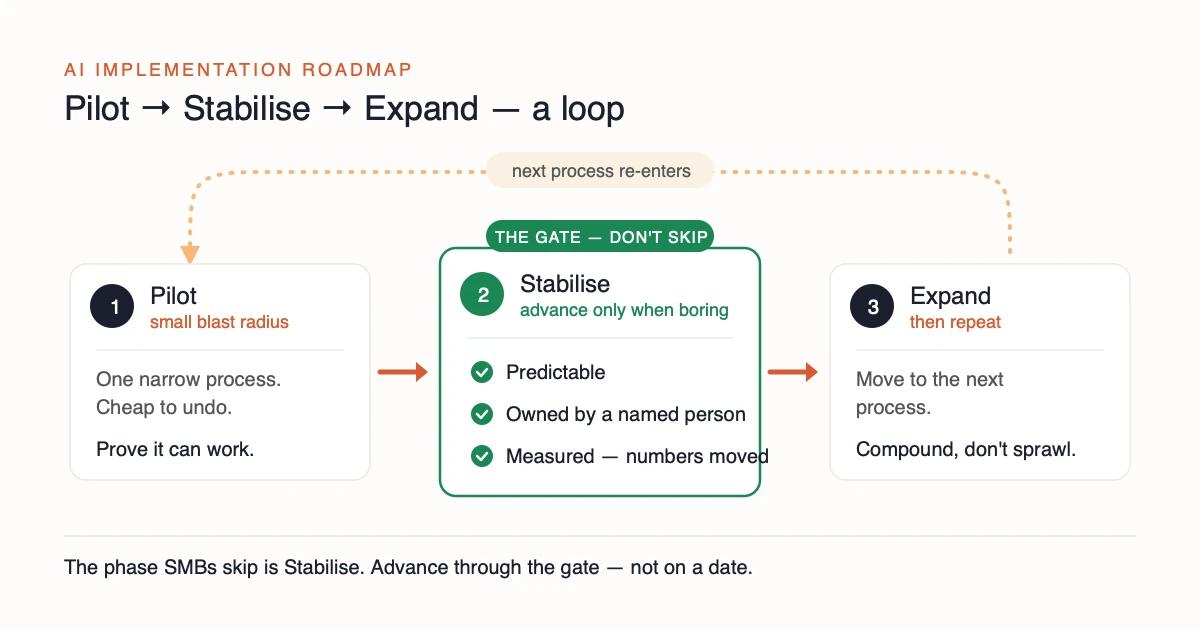
A phased AI implementation has a simple shape. The discipline is in the gates between phases, not the phase count.
Phase 1, Pilot. Take the single process you have chosen to go first (see sequencing below) and put it into real use at limited scope. The goal is not perfection. It is a working automation handling live volume with a human checking output. You are testing two things at once: does the automation produce acceptable results, and does your team's oversight routine actually function? Keep the blast radius small: one team, one workflow, a fallback to the manual process always available.
Phase 2, Stabilise. This is the phase SMBs skip, and skipping it is why rollouts stall. Stabilise means four things. The numbers hold across a few weeks, not one good day. The human owner can run oversight without heroics. Error rates and exceptions are understood and handled. And the before-and-after metric the assessment promised is now real and board-readable. You do not advance on a calendar date. You advance when the pilot is genuinely boring: predictable, owned and measured.
Phase 3, Expand. Only now does the next process on the ranked list begin its own pilot. Expansion can mean widening the first automation (more volume, more teams) or starting the second process. Usually the latter, because the ranked list is the plan. Each new process re-enters at Phase 1 with its own pilot and its own stabilise gate. The roadmap is therefore not three steps but a repeating loop applied down the shortlist.
The reason to phase rather than parallelise is attribution and attention. McKinsey's 2025 research ties real value capture to fundamental workflow redesign rather than bolting AI onto an unchanged process 3. Redesign is hard to do well for three workflows at once with a small team. Run them in sequence and each one gets the redesign it needs. Run them in parallel and each gets a fraction of the attention and none gets a clean result.
Where governance and human oversight slot in
The instinct is to add governance once several automations are live and "it starts to matter." That is the retrofit trap, and it is more expensive than building it in. NIST's AI Risk Management Framework is explicit that its Govern function is continuous and runs across the entire lifecycle alongside Map, Measure and Manage, not a final sign-off step 1. Translated to an SMB rollout, governance is a phase-one deliverable, not a phase-three one.
In practice, designing oversight in from the pilot means three concrete things, all of them lightweight at small scale:
- A named human owner for the automation: one person accountable for reviewing output and authorised to override or pause it. This is the single most important governance artefact and it costs nothing to assign.
- An oversight step in the workflow: a defined point where a human checks or approves before an action has consequences, with the threshold tightening for higher-risk processes. The pilot is where you discover whether that step is workable or theatre.
- A log of what the system did: even a simple record of inputs, outputs and overrides. It is trivial to build into a pilot and painful to reconstruct after the fact, and it is what makes the stabilise gate measurable.
Build those three during the pilot and they scale automatically as you expand down the list. The second and third automations inherit the same operating model. Skip them and every new process compounds an ungoverned estate. That is precisely the entanglement that makes later cleanup cost a multiple of designing it in. For the full picture of why AI governance is cheaper built in than retrofitted, the broader strategy layer is covered in the AI strategy framework for SMBs.
Sequencing the Top 3: which goes first, and why
A ranked top three is not automatically a running order. The Agent Opportunity Score ranks by prize-adjusted-for-risk. But the first process in a rollout should optimise for a clean, confidence-building win, which is a slightly different test.
The rule of thumb: lead with the highest suitability and lowest risk, not the highest ROI. An early automation that is well-structured, low-stakes and easy to oversee proves the operating model and earns the internal credibility to fund the next phase. A high-ROI but high-risk or high-integration process makes a poor first move. If it stumbles, it stumbles publicly and poisons appetite for the whole roadmap. Save it for phase two or three, once the team has a stabilised win behind them.
After the first, order the remaining two by descending Agent Opportunity Score. Override that order whenever a process's dependencies are not ready. A process whose data lives in a system nobody has integrated yet should wait, regardless of its score. Starting it means starting an integration project, not an automation. Readiness gates sequence as firmly as score does. The decision framework for that specific call, which of the three to put first, is covered in depth in which processes to automate first.
How long does each phase take
Each phase takes as long as the firm's evidence says it takes. There is no responsible standard duration to borrow. Estimate the first pilot by inspecting five determinants: data readiness, process complexity, the integration surface, the vendor-versus-build choice and internal availability. A clean workflow with accessible data is a different job from one that depends on several systems and a thin internal team. A single calendar promise hides the work that actually governs the finish.
Measure active work separately from blocked or waiting time once the first real pilot starts. That distinction shows whether the pace comes from the automation itself or from approvals, access, vendor responses and staff availability. Use the completed pilot to establish the firm's own pace. Then forecast later phases only from that evidence, and revise the roadmap as each stabilise gate reveals more.
When a phased roadmap is the wrong frame
Phasing is the right default, but recommending it universally would be the same gut-feel error the assessment exists to prevent. Three cases break the pattern.
When the processes are genuinely independent and the team is not the constraint. If two automations share no data, no system and no people, and you have the capacity to own both, strict sequencing buys less. You can run two pilots in parallel, but each still needs its own stabilise gate. The phasing discipline is per-process. It does not always have to be one-at-a-time across the whole firm.
When the binding constraint is integration, not rollout. If the real blocker is that your top process lives in a system nobody can integrate with, no amount of phasing helps. The first move is an integration project, and the roadmap resumes once the data is reachable. Sequencing a rollout you cannot technically start is planning theatre.
When a deadline genuinely overrides the stabilise gate. Occasionally a regulatory or contractual date forces a launch before a pilot is fully boring. That is a real trade-off, not a free pass. It means accepting more oversight cost and a tighter human-in-the-loop during the unstable window. Name it as a deliberate risk decision, with the owner and the extra checks documented, rather than pretending the stabilise gate was met.
In all three cases the underlying discipline holds: advance on readiness, not enthusiasm, and never let a visible launch substitute for a stable one.
What to do on Monday morning
If your assessment has handed you a ranked top three, the next move is not to launch all three. It is to draw the roadmap:
- Pick the phase-one process: highest suitability, lowest risk, dependencies ready.
- Name its human owner and oversight step before any automation goes live.
- Define the stabilise gate: the specific metric and the duration over which it must hold before phase two starts.
- Queue the remaining two in score order, flagging any whose dependencies need work first.
That four-line plan is a working AI implementation roadmap, and you can run it yourself. You might rather have it built rigorously: the ranked shortlist, the phased implementation roadmap, and an IT brief your team or integrator can act on. That is what AI Priority Map's AI Foundation Audit delivers, in a 40-90 minute guided wizard, with the package within 24 hours and a 100% money-back guarantee if no process with measurable savings is found. The roadmap is only as good as the ranking beneath it. That is why this article's parent, the AI opportunity assessment for SMBs, is the place to start if you have not scored your processes yet.
Summary
AI rollout roadmap — sequencing a ranked top 3
│
├─ Pilot → stabilise → expand
│   ├─ Pilot — one process, limited scope, human checking output
│   ├─ Stabilise — advance only when it's boring, not on a date
│   └─ Expand — next process re-enters as its own pilot; it loops
│
├─ Governance from phase one
│   ├─ Named owner — one person who can override or pause it
│   └─ Oversight + log — built into the pilot, not bolted on later
│
└─ Which goes first
    ├─ Lead with — highest suitability & lowest risk, not top ROI
    └─ Readiness gates — defer any process whose data isn't reachable
Related insights
- AI Opportunity Assessment for SMBs: Rank Your Top 3 Wins — the parent cornerstone: how to score and rank the processes this roadmap then sequences.
- AI Strategy Framework for SMBs — the strategy layer above the rollout: why you are adopting AI and what good looks like a year out.
- Which Processes to Automate First — the decision framework for choosing the phase-one process.
Last updated: June 2026. Version 1.0.
Frequently Asked Questions
What is an AI implementation roadmap for a small business?
How many phases should a small business AI rollout have?
How long does AI implementation take for a small business?
Where does governance fit in a phased AI rollout?
How do you sequence the top three processes in a rollout?
Why do AI rollouts stall after the first pilot?
Does a small business need a phased roadmap, or can it automate everything at once?
Sources
- 1.Artificial Intelligence Risk Management Framework (AI RMF 1.0) — NIST · 2023
- 2.Where's the Value in AI? — AI adoption in 2024 — Boston Consulting Group (BCG) · 2024
- 3.The State of AI in 2025: Agents, innovation, and transformation — McKinsey & Company (QuantumBlack) · 2025
- 4.The GenAI Divide: State of AI in Business 2025 (Project NANDA) — Massachusetts Institute of Technology (MIT) · 2025
- 5.AI adoption by small and medium-sized enterprises — OECD · 2025
- 6.Technology Adoption Review 2025 — UK Department for Science, Innovation and Technology (DSIT) · 2025
Want this run on your business?
AI Foundation Audit — a structured assessment of your AI footprint: integration risks, governance gaps, ROI opportunities. Delivered as a comprehensive report you can act on.
You receive your AI Opportunity Report and Implementation Brief — tailored to your business and delivered immediately.