What Are AI Agents? Cost and Where a Small Business Starts
An AI agent takes multi-step actions toward a goal rather than only generating text. What that means for a small business, what it costs, and where to start.
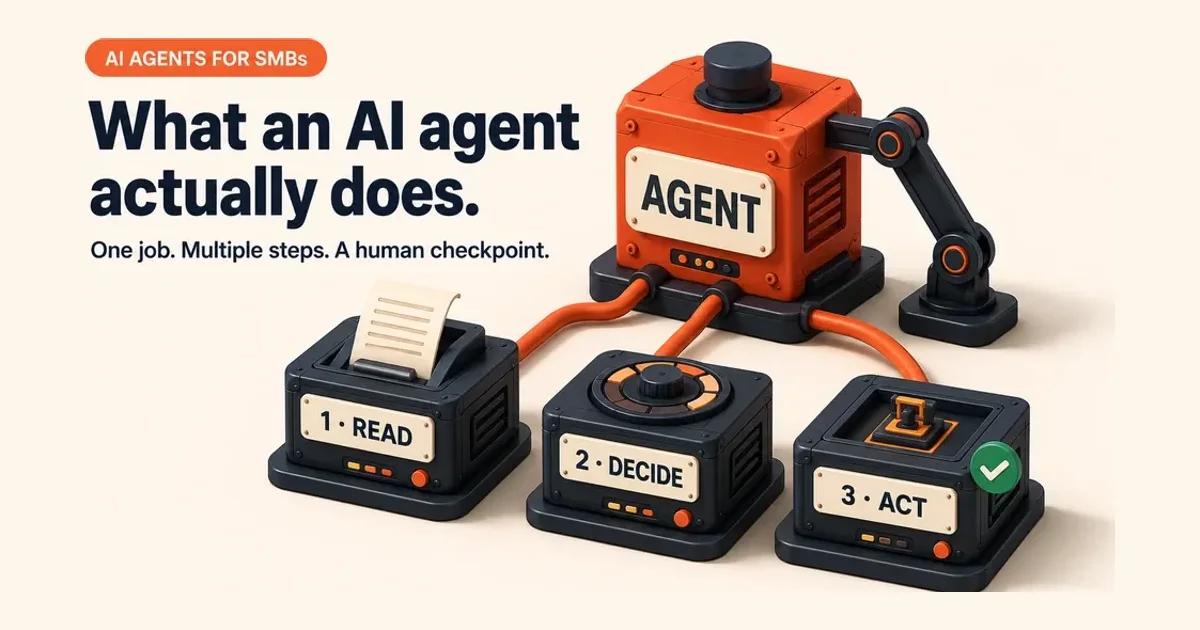
An AI agent is software that takes a goal and works through the steps to reach it. It reads data, calls other tools and takes actions, rather than just generating text in reply to a single prompt 1. That one distinction, action versus answer, is the whole difference between an agent and the chatbot you already know.
Quick Answer. AI agents for small business are goal-directed software that plans and takes multi-step actions toward an outcome, rather than models that only return text. The realistic version is one narrow agent doing one well-scoped job, such as invoice entry or ticket triage, with a human checkpoint before anything consequential.
Origin and context
The word "agent" predates the current hype by decades. It comes from AI research describing any system that perceives its environment and acts on it. What changed in 2024–2025 is that large language models became capable enough to be wrapped in a loop. Instead of returning one answer, the model is given a goal, a set of tools it can call, and permission to take the next step itself. That loop is what people now mean by an "AI agent."
The enterprise term for the pattern is agentic AI, and it is the centre of gravity in current vendor marketing. McKinsey's 2025 report frames the moment as a paradox. Nearly eight in ten companies report using generative AI, yet just as many report no significant bottom-line impact. It positions agents as the bridge from generic adoption to actual value 2. That same survey year, Stanford HAI's AI Index recorded that 78% of organisations reported using AI in 2024, up from 55% a year earlier 3. Generative-AI use in at least one business function rose to 71%. Adoption is near-universal. Useful, paying-back deployment is not. Agents are the industry's current answer to closing that gap. That is exactly why an SMB needs to translate the hype into something it can actually run.
Key components or types
Every AI agent, no matter how it is marketed, is built from four moving parts:
- A model: the language model that reasons about what to do next (usually a rented foundation model, not one you train).
- A goal: the outcome it is pointed at ("process this invoice into the accounting system"), not a one-off question.
- Tools: the systems it is allowed to call: an email inbox, an ERP API, a database, a search function. Tools are what let it act rather than only describe.
- A loop with oversight: the cycle of plan → act → check that repeats until the goal is met or a human is asked to confirm.
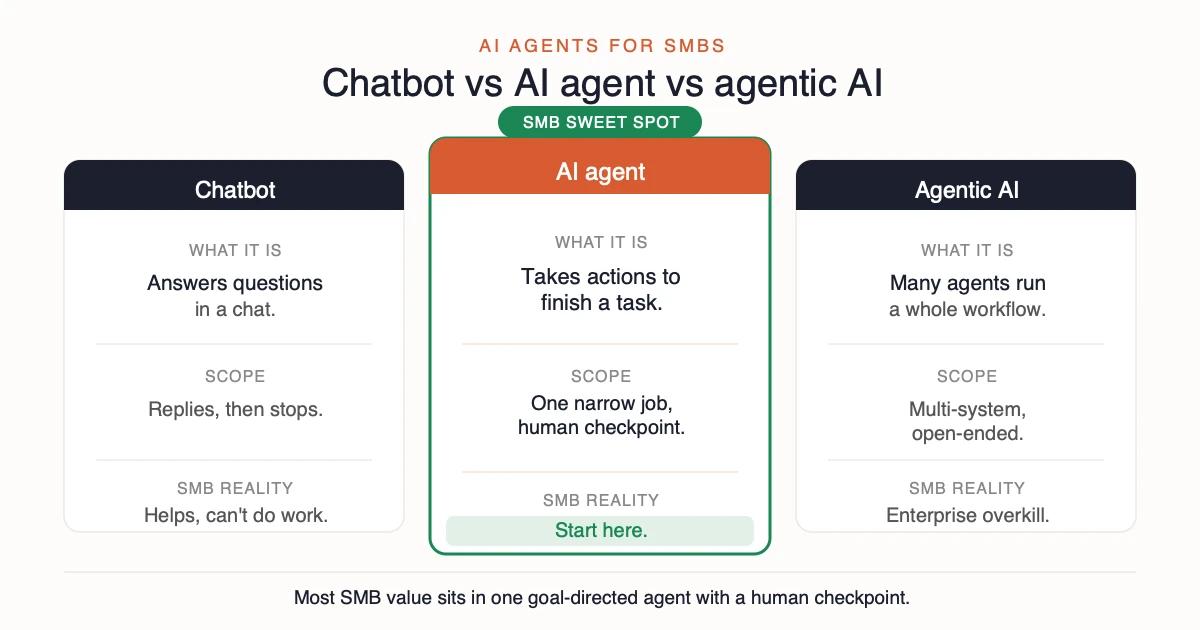
It helps to separate three things that get blurred together. A chatbot generates a reply and stops. RPA (robotic process automation) follows a fixed, pre-recorded script and breaks when a screen changes. An agent adapts its own steps toward a goal: more flexible than RPA, less predictable than a script. NIST's Generative AI Profile is explicit that increasing a system's autonomy is precisely what amplifies its risks 1. That is why the "oversight" component is not optional decoration. In real SMB deployments the three are often combined. An agent calls RPA for the brittle, repetitive parts and pauses for a human at the risky ones.
Common use cases in the UK and EU
For a 50–250-person firm, the agent worth deploying is narrow and back-office, not a science-fiction digital employee:
- Invoice and order processing. An agent reads an incoming invoice, extracts the fields, matches it against a purchase order, and stages it in the accounting system. A person approves before anything posts.
- Customer ticket triage. It classifies inbound tickets, drafts a first response, and routes to the right queue, leaving the human to send or correct.
- Document classification and data entry. It moves structured information between systems that do not talk to each other, a job that otherwise eats hours of re-keying.
- Quote and proposal preparation. It assembles a draft quote from a price list and a request, which a salesperson reviews rather than builds from scratch.
The common thread: high volume, rules-bounded, and cheap to check. OECD found AI use among businesses with 10 or more employees still trailing mature tools 4. Skills and knowledge gaps hold it back, not appetite. That is exactly why the first agent should reduce a known, boring workload, not chase a flashy one.
Common confusions (AI agent vs chatbot vs agentic AI)
| What it is | SMB reality | |
|---|---|---|
| Chatbot | Generates text in reply to a prompt, then stops | Useful, low-risk, but does not do anything on its own |
| AI agent | Goal-directed software that takes multi-step actions via tools | The SMB-relevant unit: one narrow job, with a checkpoint |
| Agentic AI | The broad pattern — often multi-agent systems planning and acting with autonomy | Mostly enterprise framing; multi-agent platforms are usually overkill for an SMB |
The trap is reading "agentic AI" enterprise material and concluding you need a fleet of coordinating agents. You almost certainly do not. McKinsey's own State of AI work shows that even large organisations capturing value tend to start with focused deployments before scaling 5. For an SMB, "agentic AI" should translate to a single, well-scoped agent. Nothing more, until that one has proven its payback.
When this is relevant
Agents become relevant the moment you have a repeatable, high-volume process where a person is doing predictable, rules-bounded work many times a week. The other condition is that a wrong answer is cheap to catch before it does damage. They are not yet the right tool for decisions that move money or touch customers unsupervised, such as credit calls or pricing or anything where a confident error is expensive. Current agents still make those errors, and the cost of catching them outweighs the saving. NIST's autonomy-raises-risk principle is the line to hold: keep a human checkpoint wherever an error is costly 1.
The honest hard part is not the technology. It is choosing which process goes first. Pick wrong and you join the majority McKinsey found reporting no bottom-line impact 2. That choice is what an AI opportunity assessment is built to make. It scores each process so the first agent lands where the return is cleanest. AI Priority Map's AI Foundation Audit runs that scoring and produces an Agent Opportunity Score per process: ROI plus Suitability minus Risk. The agent then gets pointed at a process the numbers, not the hype, put at the top. It delivers within 24 hours and carries a 100% money-back guarantee if no process with measurable savings is found.
Summary
AI Agents for SMBs — action, not just answers
│
├─ What an agent is
│   ├─ Definition — chases a goal across steps, acts
│   └─ Not a chatbot — chatbot replies once and stops
│
├─ What it costs
│   ├─ Model — tens to hundreds of pounds a month
│   ├─ Integration — the biggest line, depends on data
│   └─ Oversight — a human checks consequential actions
│
└─ Where to start
    ├─ One narrow job — invoice entry, ticket triage
    └─ Hard part — picking which process goes first
Related insights
- AI Opportunity Assessment for SMBs — how to score and rank your processes before deploying any agent. (Forward reference — this pillar is not published yet; the link will 404 until it ships.)
- How the Agent Opportunity Score Is Calculated — the exact ROI + Suitability − Risk arithmetic that ranks agent candidates.
- Local LLM vs Cloud LLM Data Security — where the model behind your agent should run, and what that means for your data.
- AI Governance From Day One — the oversight, logging and accountability an agent deployment needs to stay compliant.
Last updated: June 2026. Version 1.0.
Frequently Asked Questions
What is an AI agent in simple terms?
How much do AI agents cost for a small business?
Are AI agents the same as chatbots or RPA?
Are AI agents safe for a small business to deploy?
Where should a small business start with AI agents?
Do AI agents work without a data science team?
What is the difference between an AI agent and agentic AI?
Sources
- 1.Artificial Intelligence Risk Management Framework: Generative AI Profile (NIST AI 600-1) — NIST · 2024
- 2.Seizing the agentic AI advantage — McKinsey & Company (QuantumBlack) · 2025
- 3.The 2025 AI Index Report — Economy chapter — Stanford Institute for Human-Centered AI (HAI) · 2025
- 4.AI adoption by small and medium-sized enterprises — OECD · 2025
- 5.The State of AI in 2025: Agents, innovation, and transformation — McKinsey & Company (QuantumBlack) · 2025
Want this run on your business?
AI Foundation Audit — a structured assessment of your AI footprint: integration risks, governance gaps, ROI opportunities. Delivered as a comprehensive report you can act on.
You receive your AI Opportunity Report and Implementation Brief — tailored to your business and delivered immediately.