Build vs Buy AI for Small Business: Which Path Fits Your Firm?
Build vs buy AI for a small business: what each path costs in time, talent and control, when building is justified, and why most firms should buy first.
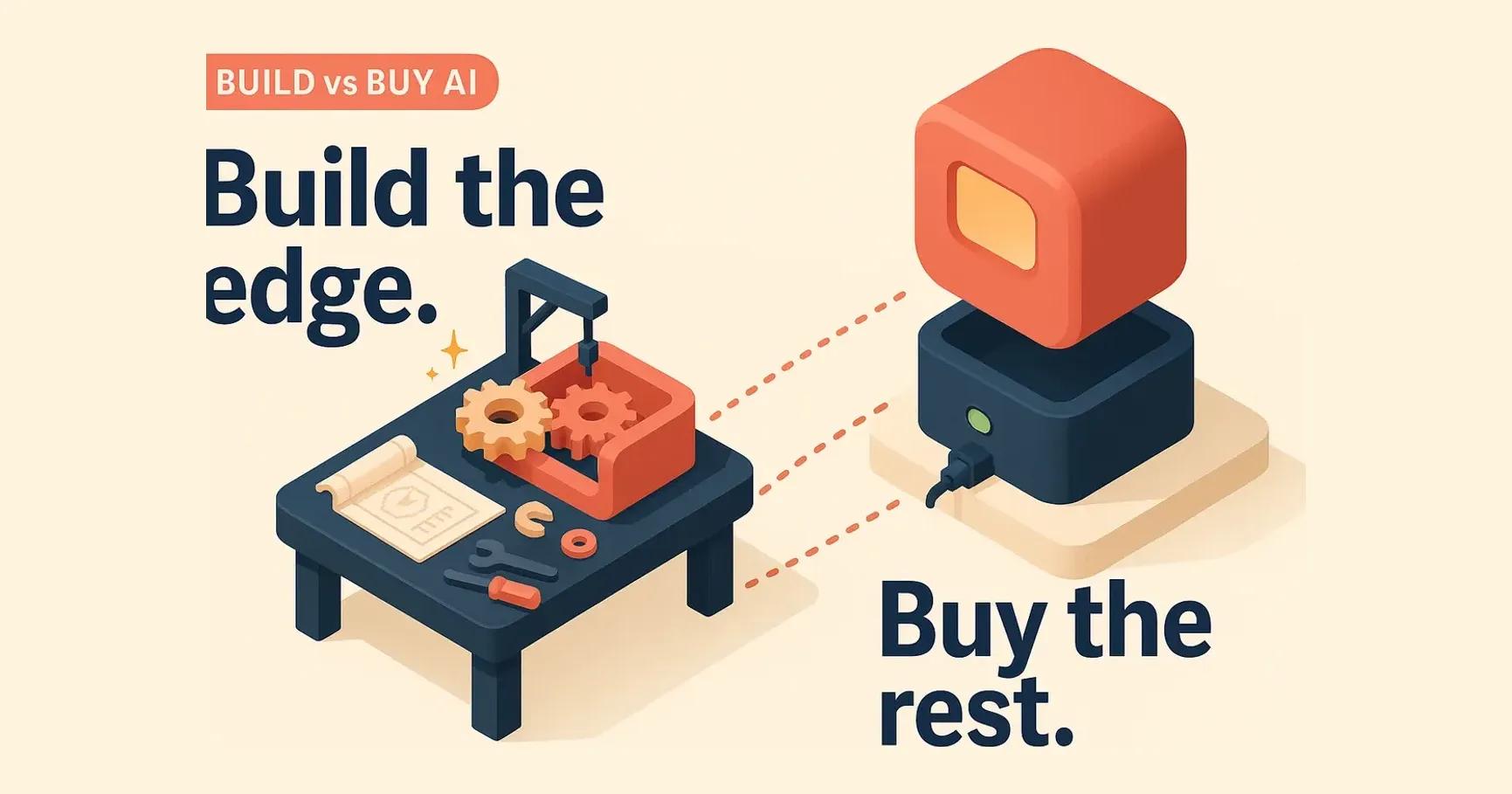
If you are weighing whether to build vs buy AI for an SMB, the honest starting point is that they are not equal-cost options. Building means your own team designs, develops, hosts, and maintains a custom system. Buying means licensing a ready-made or configurable product and setting it up to your process. The two differ most on time, talent and control. For a small or mid-sized business those differences usually push in one direction, though not always. Here is what each path actually involves, where each one fits, and how to decide for the capability in front of you.
Quick Answer. In build vs buy AI for small business, buy or configure an off-the-shelf product when the process is a common commodity: it is faster, cheaper and needs no AI team. Build in-house only when the capability is a genuine competitive edge you can staff and maintain. Both fail on a broken process.
Summary
Build vs buy AI for an SMB — match the path to the capability
│
├─ Build · custom, in-house
│   ├─ What it is — your team designs, builds, hosts and owns the AI
│   ├─ Best for — a core capability that is a genuine competitive edge
│   └─ Watch out — scarce AI talent, long build, permanent run-and-maintain
│
├─ Buy · configure off-the-shelf
│   ├─ What it is — license a ready-made AI product, set it to your process
│   ├─ Best for — a common, commodity process many firms run the same way
│   └─ Watch out — bounded by the product; little unique advantage
│
└─ Choosing between them
    ├─ Default to buy — build only where it truly differentiates you
    ├─ Hybrid — buy the commodity base, build the thin edge on top
    └─ How to decide — differentiation, talent, time-to-value, total cost
At a glance: build vs buy AI scorecard
The table below compares the two paths across the dimensions that actually drive the decision for an SMB. Treat it as a sorting tool rather than a contest. The aim is to route each capability to the column where it belongs, not to crown a winner in the abstract.
| Dimension | Build (custom, in-house) | Buy (configure off-the-shelf) |
|---|---|---|
| What it is | Your team designs, develops, hosts, and maintains a custom AI system | You license a ready-made or configurable AI product and configure it for your process |
| Time to first value | Months of design, build, and testing before anything runs in production | Days to weeks to configure, connect, and go live |
| Cost shape | High, front-loaded engineering plus a permanent run-and-maintain bill 3 | Lower upfront; a predictable subscription or per-use price |
| Talent needed | Scarce in-house AI, data, and operations skills you must hire and keep 5 | Configuration and process knowledge; no machine-learning team required |
| Control & differentiation | Full control; can encode a genuine competitive edge | Bounded by the product; the same capability every other customer has |
| Maintenance & risk | You own security, model drift, upgrades, and uptime indefinitely | The vendor maintains the platform; you manage configuration and your data |
| Best fit | A core, differentiating capability no product serves well | A common, commodity process many firms run the same way 1 |
A capability that is common to your industry belongs in the right-hand column, and one that is genuinely core to how you win belongs in the left. Many workflows carry a bit of both, exactly the situation the hybrid pattern exists for.
What building AI means
Building AI means owning the whole thing. Your team scopes the problem, chooses and integrates the models, connects them to your systems and data, wraps them in guardrails. Then it runs, monitors, and maintains the result for as long as you use it. For an SMB, "building" almost never means training a model from scratch. Stanford's AI Index reports that training a frontier model can cost well over one hundred million dollars 3. That is a scale only the largest technology companies can absorb. In practice, building means assembling and customising existing models into a system that is specifically yours. Your prompts, your data, your logic, your integrations.
That is real engineering work, and it needs real skills. The World Economic Forum finds the skills gap is the single biggest barrier to business transformation 5. AI and data skills are among the most in-demand and hardest to hire. A build is only as durable as the team behind it. Someone has to fix it when a model changes, when a system it connects to shifts, or when its behaviour drifts. The upside is control. When you build, the capability is yours to shape without compromise. That is exactly what you want when the capability is core to how the business competes, and exactly what you are over-paying for when it is not.
What buying AI means
Buying AI means licensing a product someone else built, then configuring it to your process. The vendor has already done the model selection, the engineering, the security work, and the maintenance. You supply the settings, the connections, and your data. The running cost of AI has fallen fast: the price of inference for a capable model dropped by more than two orders of magnitude in about two years 3. Off-the-shelf tools are now both cheap and capable, which is a large part of why buying has become the default. By 2024, 78% of organisations reported using AI in at least one business function, up from 55% a year earlier. Most of that adoption is through tools they configure rather than systems they built.
The trade-off is that you get what the product gives you. Its capabilities are bounded by the vendor's roadmap, its price by the vendor's pricing, and its data handling by the vendor's terms. You share the same capability as every other customer. For a common, commodity process, that is a good trade. OECD research finds process automation is one of the benefits SMEs most consistently report from digital adoption, precisely because so much SMB work is repetitive and shared across firms 1. You get a supported, maintained, quick-to-deploy capability without carrying an engineering team. The limit only bites when the capability needs to be uniquely yours.
Side-by-side: where they actually differ
The scorecard lists the dimensions. A few of them decide most cases.
Time and talent. This is the sharpest line. A bought product can be configured and live in days or weeks. A build runs to months of design, development, and testing before it produces anything, and then needs a team to keep it running. McKinsey finds most organisations are still in the early stages of capturing value from AI, with the harder organisational work lagging the technology 4. For an SMB the hardest part of that work is staffing it at all. If you cannot hire and retain AI and data skills, a build is not cheaper or slower. It simply does not happen.
Cost shape. The two cost curves are different animals, not different sizes of the same animal. Buying is mostly operating cost: a predictable subscription or per-use fee, with the vendor absorbing the engineering and maintenance 3. Building is a large capital-style outlay up front, for design and development. Then comes a permanent run-and-maintain bill for security, upgrades, monitoring, and the specialists to do them. A build that looks affordable on day one often is not once that ongoing cost is counted over its life.
Control and differentiation. This is the one dimension where building genuinely wins. A bought product gives every customer the same capability, so it cannot, by definition, be a source of advantage. A build can encode something specific to your business that no competitor can simply buy. The question is whether the capability in front of you is one where being different actually matters. For most back-office and operational processes, it does not. The goal is to do a common thing well and cheaply, which is what buying delivers.
Maintenance and lock-in. Neither path is free of long-run cost. They just move it. When you build, maintenance is yours forever. You patch the security holes, absorb the model and dependency changes, and keep the specialists who understand the system. When you buy, you trade that for dependence on a vendor. That means their uptime, their price rises, their roadmap, and the friction of moving your data and workflow elsewhere if the fit sours. For a commodity capability, vendor dependence is a manageable risk you can shop around. For a core one, being locked to someone else's roadmap is exactly the exposure that argues for owning the build.
When to build AI in-house
Building earns its cost in a narrow set of cases. Choose to build when several of these hold at once:
- Build when the capability is a genuine competitive edge: something core to how you win that no off-the-shelf product serves well, where doing it differently from rivals is the point.
- Build when you can staff and keep the team: the AI, data and operations skills to develop it and, just as important, to run and maintain it for years rather than ship a first version 5.
- Build when the process is unusual to your business: so specific to your model or data that no product is designed for it, and configuring a generic tool would mean fighting it.
- Build when the long-run economics work: the value of owning and shaping the capability outweighs the front-loaded development cost plus the permanent run-and-maintain bill 3.
If only one of these is true, a great idea but no team or a capable team but a commodity process, building is usually the wrong call. A hybrid or a bought product will serve you better and sooner.
When to buy AI off-the-shelf
Buying is the right default for the large majority of SMB use cases. Choose to buy when:
- Buy when the process is a common commodity: invoice handling, support triage, document extraction or scheduling, a task many firms run the same way, where a proven product already exists 1.
- Buy when you need value quickly: a configured tool can be live in days or weeks, against the months a build takes before it does anything.
- Buy when you cannot or should not staff a build: no in-house AI team, and no case for hiring one just for this 5.
- Buy when predictable cost and low risk matter more than control: a subscription with vendor-maintained security and upgrades, rather than an open-ended engineering commitment 3,4.
For most operational and back-office work, this is simply the better deal. It is faster, cheaper, supported and good enough, because the capability was never going to be a differentiator anyway.
How to decide for your capability
Decide from the capability, never from the appeal of "having built it". For the specific workflow in front of you, work through four questions in order.
In words, the tree branches like this:
- Process not stable or documented? Fix or simplify it first. Do not build or buy on top of a broken process.
- A common commodity many firms run the same way? Buy: configure a proven off-the-shelf product.
- Not a commodity, but not a genuine edge either? Buy: a capability that does not differentiate you is still not worth a custom build.
- A genuine competitive edge you must own, and you have the AI talent? Build: own the differentiator.
- A competitive edge, but no team to build and run it? Hybrid: buy the base, build the thin edge on top (or partner to build it).
The order matters. Most capabilities never make it past the second question, because most operational work is a commodity. Only the rare workflow that is both differentiating and staffable justifies a full build.
When a hybrid is the answer
For many SMBs the best answer is not build or buy but both, applied to different layers of the same workflow. The robust pattern is to buy or configure a proven product for the commodity base, the parts that are the same as everyone else's. Build only the thin layer that is genuinely specific to your business on top of it. You confine the expensive, hard-to-staff custom work to the one part that actually differentiates you, and keep the rest supported, maintained, and cheap to run.
A concrete example makes the split clear. Suppose a wholesaler wants to automate how it turns inbound supplier emails into purchase orders. The reading and extraction, pulling line items and quantities out of messy email and PDF text, is a commodity that plenty of products already do well, so you buy it. But the logic that decides which supplier, price break, or substitution to apply reflects years of trading relationships unique to that firm. So you build a thin rules-and-data layer for just that step, and let the bought product handle everything around it. The result costs a fraction of a full custom build, ships far sooner, and still protects the one part that is genuinely yours.
Before you commit to any of these paths, though, check that automation is the right answer at all. OECD work on SME digitalisation is clear that the binding constraints are rarely the technology. They are data quality, skills, and the management capacity to integrate and run new tools 2. Automating a broken or undocumented process just produces a poor outcome faster, whether you build it or buy it. Often the right first move is to simplify the steps, clean the data, and document the workflow. Sometimes that alone removes the pain, and the build-or-buy question disappears.
Doing this well across a business means comparing many candidate processes rather than one. Rank them by where automation actually pays back, before you spend a pound on building or buying. That is the job of a structured AI opportunity assessment. Our fixed-price AI Foundation Audit scores every repeatable process in the business and ranks the top three opportunities by ROI, suitability, and risk, then ships a phased implementation roadmap. The build-versus-buy decision is then made against evidence, not a hunch. For the full method and how the scoring works, start with our cornerstone guide to an AI opportunity assessment for SMBs.
Related insights
- AI Opportunity Assessment for SMBs — the parent method that ranks where automation pays back first.
- The AI Talent Trap for SMBs — why hiring an internal AI lead to build is harder than it looks.
- AI Agents vs Automation Platforms — the sibling comparison on which kind of tool to use.
- RPA vs AI Agents for SMBs — the sibling comparison for rules-based bots versus agents.
Last updated: July 2026. Version 1.0.
Frequently Asked Questions
Should a small business build or buy AI?
Is building custom AI cheaper than buying off-the-shelf for a small business?
When does it make sense for a small business to build its own AI?
Can a small business combine building and buying AI?
What are the risks of buying off-the-shelf AI instead of building?
Should I build or buy AI first, before deciding on a strategy?
Sources
- 1.The Digital Transformation of SMEs — OECD · 2021
- 2.SME Digitalisation to Manage Shocks and Transitions — OECD SME and Entrepreneurship Papers · 2024
- 3.Artificial Intelligence Index Report 2025 — Stanford University, Institute for Human-Centered AI (HAI) · 2025
- 4.The state of AI: How organizations are rewiring to capture value — McKinsey & Company (QuantumBlack) · 2025
- 5.The Future of Jobs Report 2025 — World Economic Forum · 2025
Want this run on your business?
AI Foundation Audit — a structured assessment of your AI footprint: integration risks, governance gaps, ROI opportunities. Delivered as a comprehensive report you can act on.
You receive your AI Opportunity Report and Implementation Brief — tailored to your business and delivered immediately.