RPA vs AI Agents: Which Should You Use to Automate?
RPA vs AI agents for a small business: what each suits, what each costs, where each fails, and when the right move is both or fixing the process first.
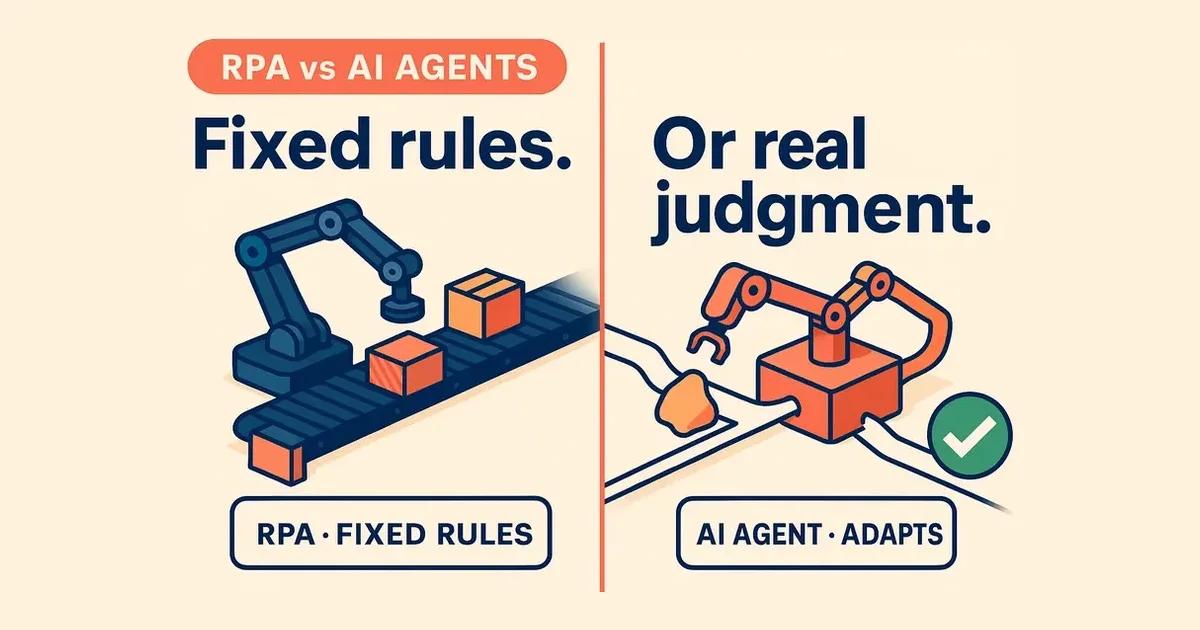
If you are choosing between RPA and AI agents for an SMB, the honest answer is that they solve different problems. The better one depends entirely on your process. RPA, meaning rules-based robotic process automation, is fast, cheap and reliable when a task is structured and predictable. AI agents are goal-directed and LLM-powered, earning their cost when inputs are messy or a step needs judgement. For many real workflows the right choice is both, applied to different steps. Here is what each one is, where each fits, and how to decide for your process.
Quick Answer. In RPA vs AI agents, RPA follows fixed rules on structured, predictable inputs: deterministic, cheap and auditable. AI agents interpret unstructured input and make judgement calls, but cost and risk more. Choose RPA for rule-based steps, agents for messy or judgement-heavy ones, and hybrids when a process needs both.
What RPA and AI Agents Actually Are
RPA is software that imitates the clicks and keystrokes a person makes across applications. You define the rules: read this field, copy it there, if the value is X then do Y. The bot repeats them exactly, every time. It does not understand the work; it follows a script. That is its strength. On a stable, structured process, RPA is deterministic, fast, and produces an audit trail of exactly what it did.
An AI agent is a different kind of system. International standards define an AI agent as an automated entity that senses and responds to its environment and takes actions to achieve its goals 1. In practice today that means an LLM-powered system that can read unstructured input such as an email, a PDF or a free-text request. It reasons about that input and decides which steps to take within the boundaries you set. Where RPA repeats a fixed path, an agent chooses a path. That flexibility is exactly what lets it handle work RPA cannot, and exactly what makes it harder to predict and govern.
The distinction that matters for an SMB is not "old vs new". It is deterministic execution versus goal-directed judgement. RPA gives you certainty on predictable inputs. An agent gives you adaptability on unpredictable ones. Knowing which your process needs is most of the decision.
RPA vs AI Agents: Side-by-Side Comparison
The table below compares the two across the dimensions that actually drive a build-or-skip decision for an SMB.
| Dimension | RPA (rules-based) | AI agents (goal-directed, LLM-powered) |
|---|---|---|
| What it is | Software that follows fixed, pre-defined rules to move data and operate applications | An LLM-powered system that interprets input, reasons, and chooses its own steps toward a goal 1 |
| Best for | Structured, high-volume, repetitive tasks with stable inputs and clear rules | Messy or unstructured input, ambiguous cases, and steps needing interpretation or judgement |
| Inputs | Structured and predictable — fixed fields, consistent formats, stable screens | Unstructured and variable — emails, documents, free text, mixed formats |
| Error handling | Fails visibly and predictably; a changed field or screen stops the bot, which is easy to catch | Can fail silently with a plausible-but-wrong action; needs confidence checks and human review 2 |
| Cost / effort | Lower running cost; effort is in mapping rules and maintaining bots when systems change | Higher running and governance cost; effort is in guardrails, evaluation, and oversight design |
| Risk | Brittle to change but low-surprise; behaviour is auditable and repeatable | Broader risk surface, including new exposure such as prompt injection via the data it reads 3 |
Read the table as a routing guide, not a scoreboard. Neither column "wins". A process that is structured and rule-based belongs in the left column, and a messy or judgement-heavy one belongs in the right. A great many processes have steps in both, which is why hybrids are so common.
Where Each One Fits Best
| Work | Fits RPA | Fits an AI agent |
|---|---|---|
| Moving validated data between systems | Yes: inputs do not vary and the rules are clear | No: nothing needs interpreting |
| Reconciling two reports in a fixed format | Yes: determinism and a clean audit trail matter here 4 | No |
| Nightly batch of routine updates | Yes: same result every time, low running cost | No |
| Reading a supplier email to work out what was ordered | No: the input is too variable to script | Yes: it reads unstructured content and acts |
| Triaging an inbound request to the right team | No | Yes |
| Interpreting a free-text exception | No | Yes |
RPA fits a stable, structured, repetitive process. Think of moving validated data from one system into another, reconciling two reports that always arrive in the same format, or running a nightly batch of routine updates. The inputs do not vary, the rules are clear, and you want the same result every time without surprises. OECD research finds process automation is one of the benefits SMEs most consistently report from digital adoption 4. So much SMB work is exactly this kind of repetitive, structured task. On that work, RPA's determinism and low running cost are hard to beat. The clean audit trail matters for anything financial or regulated.
AI agents fit where the input is messy or a step needs judgement. Reading a supplier email and working out what was actually ordered, triaging an inbound request to the right team, summarising a document, or interpreting a free-text exception. These defeat fixed rules because the input is too variable to script. An agent can read the unstructured content, interpret it, and act. This is the work that RPA historically could not touch, and where agents add genuinely new capability rather than just speed.
The hybrid fits most real workflows. A common and robust pattern is to put the agent at the front, where it reads and interprets the messy input. The structured result then goes to deterministic RPA or a direct API call to execute the transaction. You get judgement where you need flexibility and rules-based reliability where you need control and an audit trail. For an SMB, this hybrid is often the most pragmatic answer. It confines the harder-to-govern AI to the one step that genuinely requires it, and keeps the rest of the workflow predictable.
When Neither Is the Move
Before you build either, check that automation is the right answer at all, because often it is not.
Skip automation when the process itself is broken or undocumented. Automating an inefficient process simply makes a poor outcome arrive faster. And a workflow no one can describe cannot be reliably automated by rules or by an agent. Skip it when the data is unreliable. Both RPA and AI agents produce confident output, so automating on top of bad data just generates wrong results at scale. Skip it when volume is low and exceptions dominate. If a task runs occasionally and almost every case is a special case, neither a brittle rule set nor an agent's running cost will repay the build. A person handling it directly is cheaper and safer.
OECD work on SME digitalisation is clear that the constraints are rarely the technology. They are data quality, skills, and management capacity to integrate and run new tools 5. The right first move in these cases is to fix the process first. Simplify the steps, clean the master data, and document the workflow. Sometimes that alone removes the pain, and the automation question disappears. When it does not, you will at least be automating something worth automating.
How to Decide for Your Process
Decide from the process, never from the technology. For the specific workflow in front of you, answer four questions:
- Inputs: are they structured and predictable, or messy and variable? Structured points to RPA; messy points to an agent.
- Decisions: are the steps fixed rules, or do they need interpretation and judgement? Rules point to RPA; judgement points to an agent.
- Volume: is it high and repetitive enough to repay a build? Low volume often points to neither.
- Cost of a wrong action: how bad is a silent error? High stakes raise the bar on human review, especially for agents, which can fail without flagging it 2. NIST's risk framework treats this kind of measurement and oversight as core to deploying AI responsibly. Its newer guidance treats autonomous agents as a distinct security surface that needs its own controls 3.
If the answers split, with structured inputs but judgement-heavy decisions, that is your signal for a hybrid: an agent for the messy step, rules-based execution for the rest. Whatever you choose, design human review in from the start rather than bolting it on later.
In short, an unstable or undocumented process should be fixed first. A stable, high-volume, rules-bounded one points to RPA. A messy or judgement-heavy one points to an AI agent with human review. A process that needs both is a hybrid: the agent reads and interprets, rules-based automation or an API executes.
Doing this well across an SMB means comparing many candidate processes rather than one, and ranking them by where automation actually pays back. That is the job of a structured AI opportunity assessment. Our fixed-price AI Foundation Audit scores every repeatable process in the business and ranks the top three opportunities by ROI, suitability, and risk, then ships a phased implementation roadmap. The RPA-versus-agent decision is then made against evidence, not a hunch. For the full method and how the scoring works, start with our cornerstone guide to an AI opportunity assessment for SMBs.
Summary
RPA vs AI Agents — choosing the right tool per process
│
├─ RPA · rules-based
│   ├─ What it is — fixed rules on structured inputs; it repeats
│   ├─ Best for — stable, high-volume, rules-bounded work
│   └─ Watch out — brittle if a screen changes, but fails loudly
│
├─ AI agent · reasoning
│   ├─ What it is — reads messy input, makes judgement calls
│   ├─ Best for — unstructured input: emails, exceptions, triage
│   └─ Watch out — can fail silently; needs human review
│
└─ Choosing between them
    ├─ Use both (hybrid) — agent reads, RPA / API executes
    └─ How to decide — map inputs, decisions, volume, error cost
Related insights
Last updated: June 2026. Version 1.0.
Frequently Asked Questions
What is the difference between RPA and AI agents?
Is RPA cheaper than AI agents for a small business?
Can RPA and AI agents work together?
When should I avoid both RPA and AI agents?
Are AI agents riskier than RPA?
How do I decide which one my process needs?
Sources
- 1.ISO/IEC 22989:2022 — Information technology — Artificial intelligence — Concepts and terminology — ISO/IEC (international standard) · 2022
- 2.Artificial Intelligence Risk Management Framework (AI RMF 1.0), NIST AI 100-1 — US National Institute of Standards and Technology (NIST) · 2023
- 3.Adversarial Machine Learning: A Taxonomy and Terminology of Attacks and Mitigations, NIST AI 100-2e2025 — US National Institute of Standards and Technology (NIST) · 2025
- 4.The Digital Transformation of SMEs — OECD · 2021
- 5.SME Digitalisation to Manage Shocks and Transitions — OECD SME and Entrepreneurship Papers · 2024
Want this run on your business?
AI Foundation Audit — a structured assessment of your AI footprint: integration risks, governance gaps, ROI opportunities. Delivered as a comprehensive report you can act on.
You receive your AI Opportunity Report and Implementation Brief — tailored to your business and delivered immediately.