AI Agents vs Automation Platforms: Which One Fits Your Work
AI agents vs automation platforms, for a small business: what each one suits, what each costs, how each fails, and when a hybrid beats both of them.
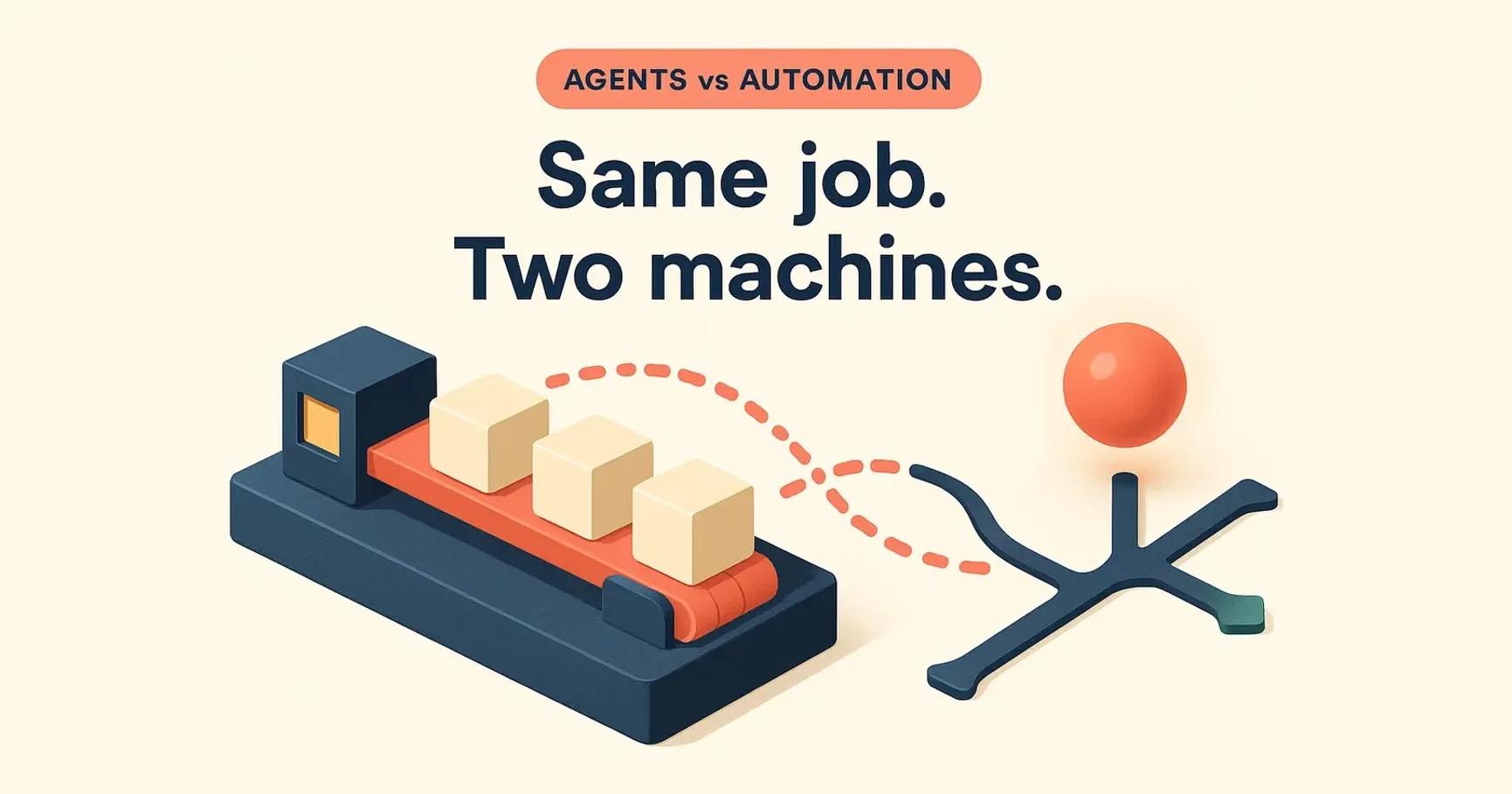
If you are choosing between an AI agent and an automation platform for an SMB, the honest answer is that they solve different problems and the better one depends on your workflow. An automation platform, meaning the connector-based, mostly no-code tools that move data between your apps, is fast, cheap and reliable when a task is structured and predictable. AI agents are goal-directed and LLM-powered, earning their cost when inputs are messy or a step needs judgement. For many real workflows the right choice is both, applied to different steps. Here is what each one is, where each fits, and how to decide.
Quick Answer. In AI agents vs automation platforms, an automation platform runs fixed, connector-based flows on structured app data: deterministic, cheap, auditable. An AI agent interprets messy, unstructured input and makes judgement calls, but costs and risks more. Choose the platform for rule-based data movement, the agent for judgement, a hybrid when both.
Summary
AI agents vs automation platforms — matching the tool to the workflow
│
├─ AI agent · goal-directed
│   ├─ What it is — an LLM reads messy input, reasons, picks its own steps
│   ├─ Best for — unstructured input: emails, documents, exceptions, triage
│   └─ Watch out — non-deterministic; can fail silently; needs human review
│
├─ Automation platform · connectors
│   ├─ What it is — no-code flows that move data between apps on a trigger
│   ├─ Best for — structured, predictable app-to-app data on fixed rules
│   └─ Watch out — brittle to schema changes, but fails loudly and is auditable
│
└─ Choosing between them
    ├─ Use both (hybrid) — agent interprets, the platform executes
    └─ How to decide — map inputs, judgement, autonomy, cost of a wrong action
At a glance: AI agents vs automation platforms scorecard
The table below compares the two across the dimensions that actually drive a build-or-skip decision for an SMB. Read it as a routing guide, not a scoreboard. Neither column "wins".
| Dimension | AI agent (goal-directed, LLM-powered) | Automation platform (connector-based, no-code) |
|---|---|---|
| What it is | An LLM-powered system that interprets input, reasons, and chooses its own steps toward a goal 3 | A cloud service that runs integration and workflow flows connecting apps, services, and data 5 |
| Best input | Unstructured and variable — emails, documents, free text, mixed formats | Structured and predictable — fixed fields, stable app APIs, consistent records |
| How it decides | Goal-directed reasoning within guardrails; non-deterministic | Fixed if-this-then-that rules; deterministic and repeatable |
| Setup & skills | Guardrails, evaluation, and oversight design; higher build effort | Low-code or no-code connector configuration; lower build effort |
| Running cost | Per-use model plus oversight cost; higher and more variable | Subscription or per-task; lower and more predictable |
| Failure mode | Can fail silently with a plausible-but-wrong action; needs human review | Fails visibly — a changed field, connector, or schema stops the flow |
| Auditability | Probabilistic; needs logging and evaluation to trace a decision | Deterministic run logs; a clean, repeatable audit trail |
| Governance load | Higher — a new surface, including exposure through the data it reads | Lower — bounded to the rules and connectors you configure |
A process that is structured and rule-based belongs in the right-hand column, and a process that is messy or judgement-heavy belongs in the left. A great many workflows have steps in both, which is why hybrids are so common.
What an AI agent is
An AI agent is a goal-directed, LLM-powered system. You give it an objective and guardrails, and it reads unstructured input such as an email, a PDF or a free-text request, reasons about it, and decides which steps to take to reach the goal. Where a fixed rule repeats one path, an agent chooses a path. That flexibility is exactly what lets it handle work that defeats fixed rules, and exactly what makes it harder to predict and govern.
The capability is real but still young. Stanford's AI Index reports that agents have made large gains on benchmarks that test them on real computer tasks. They still fail a meaningful share of structured attempts, so human review remains essential 3. Adoption reflects that. McKinsey finds organisations are only beginning to deploy agents, with most agent use concentrated in a few functions such as IT and knowledge management, and the majority of AI programmes still in piloting rather than at scale 4. For an SMB, an agent is best understood as a judgement layer you supervise, not a hands-off worker.
The distinction that matters is not "new versus old". It is goal-directed judgement versus deterministic execution. An agent gives you adaptability on unpredictable inputs. Knowing whether your workflow actually needs that is most of the decision.
What an automation platform is
An automation platform is the deterministic counterpart. Gartner calls this category integration platform as a service, or iPaaS. It describes them as cloud services that enable the development, execution and governance of integration flows connecting applications, services and data, most commonly built in low-code or no-code environments 5. In everyday terms, these are the tools that watch for a trigger: a new form submission, a new row, a scheduled time. They then move and transform data between your apps along a path you define.
The platform does not interpret anything. You wire the connectors and the rules: when this happens, take that field, send it there, and if a value is X do Y. It repeats them exactly, every time. That is its strength. On structured, predictable data, a connector flow is deterministic, cheap to run, and produces a clean log of exactly what it did. OECD research finds process automation is one of the benefits SMEs most consistently report from digital adoption, precisely because so much SMB work is this kind of repetitive, structured, app-to-app task 1.
The trade-off is brittleness of a manageable kind. Change an app's schema or a field name and the flow can break, but it breaks visibly and stops, which is easy to catch and fix. There is no silent, confident wrong answer, because there is no judgement being exercised.
Side-by-side: where they actually differ
The scorecard lists the dimensions; three of them decide most cases.
Inputs. This is the sharpest line. Automation platforms need structured, predictable inputs: stable fields and app APIs. AI agents are built for the opposite: variable, unstructured content a fixed rule cannot parse. If your workflow starts with a messy email or a free-text document, a connector flow alone will struggle; if it starts with a clean webhook or a database row, an agent is overkill.
Failure mode. An automation platform fails loudly and predictably. A broken connector halts the run. An AI agent can fail silently, producing a plausible but wrong action, and it introduces a new risk surface through the very data it reads 3. That difference should shape how much human review you design in, and how much you log. A deterministic flow can be replayed to explain itself; an agent's reasoning has to be captured and evaluated deliberately.
Cost and effort. A no-code connector flow is lower effort to build and cheaper and more predictable to run 5. An agent carries a per-use model cost plus the ongoing cost of guardrails, evaluation, and oversight. Neither is "the cheap option" in the abstract. The cheaper choice is the one matched to the work.
Autonomy and maintenance. The two age differently. An automation platform does exactly what its rules say until an app it connects to changes. Maintenance is periodic and predictable: you fix the connector when a schema shifts, and the flow is otherwise stable. An AI agent decides its own steps, so its behaviour can drift as the model, the prompts or the inputs change. Maintenance is continuous: you monitor outputs, refine guardrails, and re-evaluate as cases evolve. A platform is something you set and check; an agent is something you supervise. That ongoing supervision is a real cost, and it is why agents are still deployed narrowly even where the capability exists 4.
When to choose an AI agent
Choose an AI agent when the workflow's difficulty is interpretation, not integration.
- Choose an agent when the input is unstructured and variable: reading a supplier email to work out what was actually ordered, or interpreting a free-text exception no rule anticipates.
- Choose an agent when a step needs judgement: triaging an inbound request to the right team, summarising a document, or classifying a case that does not map to a fixed lookup.
- Choose an agent when the value of handling messy cases well outweighs the added cost of oversight, and you can put a human in the loop on anything consequential.
In each case the agent adds capability a connector flow simply does not have: it turns unstructured input into a decision. Keep it supervised, because its adoption is still early and its failures are quiet 3,4.
When to choose an automation platform
Choose an automation platform when the workflow is structured data moving between systems on rules you can state.
- Choose the platform when inputs are clean and predictable: a form submission, a new CRM record or a scheduled export, flowing between apps through stable connectors.
- Choose the platform when the steps are fixed rules: copy these fields, apply this mapping, post to that system, with no interpretation required.
- Choose the platform when you need determinism and a clean audit trail: anything financial, regulated or high-volume, where the same input must always produce the same result 1,5.
This is the larger share of everyday SMB automation, and it is where a low-code platform pays back fastest: quick to build, cheap to run, and easy to trust.
How to decide for your workflow
Decide from the process, never from the technology. For the specific workflow in front of you, answer four questions:
- Inputs: structured and predictable, or messy and variable? Structured points to a platform; messy points to an agent.
- Decisions: fixed rules, or interpretation and judgement? Rules point to a platform; judgement points to an agent.
- Autonomy: can the steps be fully pre-defined, or must the system choose its own path? Pre-defined points to a platform; open-ended points to an agent.
- Cost of a wrong action: how bad is a silent error? High stakes raise the bar on human review, especially for agents, which can fail without flagging it 3.
In words, the tree branches like this:
- Process not stable or documented? Fix or simplify it first. Do not automate a broken process.
- Inputs structured and predictable? Use an automation platform: connector-based, deterministic, auditable.
- Messy input that needs judgement? Use an AI agent with human review.
- A bit of both? Use a hybrid: the agent reads and interprets, the platform executes.
When a hybrid is the answer
For most real workflows, the honest answer is not one or the other. A common and robust pattern puts the agent at the front, where it reads and interprets the messy input, then hands the structured result to the automation platform to execute the transaction across your apps. You get judgement where you need flexibility and rules-based reliability where you need control and an audit trail. For an SMB, this hybrid is often the most pragmatic answer: it confines the harder-to-govern agent to the one step that genuinely requires it, and keeps the rest of the workflow deterministic.
Before you build either, though, check that automation is the right answer at all. Skip it when the process is broken or undocumented, when the data is unreliable, or when volume is low and exceptions dominate. OECD work on SME digitalisation is clear that the binding constraints are rarely the technology. They are data quality, skills, and the management capacity to integrate and run new tools 2. Often the right first move is to simplify the steps, clean the data, and document the workflow; sometimes that alone removes the pain.
Doing this well across an SMB means comparing many candidate processes rather than one, and ranking them by where automation actually pays back. That is the job of a structured AI opportunity assessment. Our fixed-price AI Foundation Audit scores every repeatable process in the business, ranks the top three opportunities by ROI, suitability and risk, and ships a phased implementation roadmap. You can start the audit online. The agent-versus-platform decision is then made against evidence, not a hunch. For the full method and how the scoring works, see our cornerstone guide to an AI opportunity assessment for SMBs.
Related insights
- AI Opportunity Assessment for SMBs — the parent method that ranks where automation pays back first.
- AI Agents for SMBs — what agents are and where they earn their keep.
- RPA vs AI Agents for SMBs — the sibling comparison for screen-based, rules-driven bots.
- Which Processes to Automate First — how to pick the workflow before you pick the tool.
Last updated: 24 September 2026. Version 1.0.
Frequently Asked Questions
What is the difference between an AI agent and an automation platform?
Is an automation platform cheaper than an AI agent for a small business?
Can AI agents and automation platforms work together?
When should I avoid both an AI agent and an automation platform?
Are AI agents riskier than automation platforms?
Which should I choose for my small business — an AI agent or an automation platform?
Sources
- 1.The Digital Transformation of SMEs — OECD · 2021
- 2.SME Digitalisation to Manage Shocks and Transitions — OECD SME and Entrepreneurship Papers · 2024
- 3.Artificial Intelligence Index Report 2025 — Stanford University, Institute for Human-Centered AI (HAI) · 2025
- 4.The state of AI: Agents, innovation, and transformation — McKinsey & Company (QuantumBlack) · 2025
- 5.Integration Platform as a Service (iPaaS) — IT Glossary — Gartner · 2025
Want this run on your business?
AI Foundation Audit — a structured assessment of your AI footprint: integration risks, governance gaps, ROI opportunities. Delivered as a comprehensive report you can act on.
You receive your AI Opportunity Report and Implementation Brief — tailored to your business and delivered immediately.