Automated Quality Control: Azure Image Specs and End Date
Automated quality control with Azure Custom Vision needs varied training images, defined inspection evidence and a migration plan before its 2028 retirement.
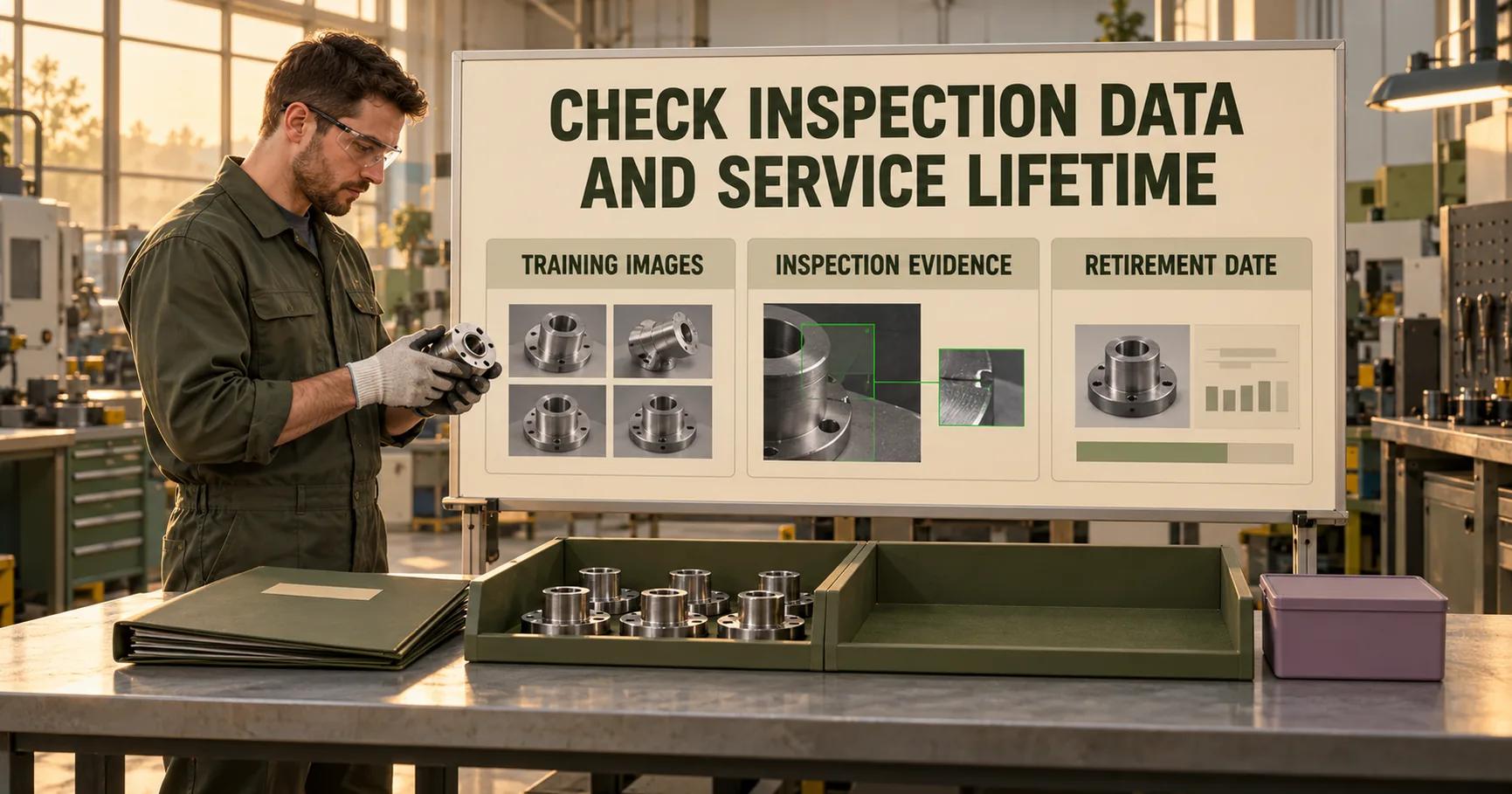
Quick Answer: For automated quality control with Azure Custom Vision, define the inspection decision and collect at least 30 training images per tag, varying angle, light and background, plus test images. Microsoft accepts .jpg, .png, .bmp and .gif, up to 6 MB for training and 4 MB for prediction. The service retires 25 September 2028.4,5
Summary in a mind map
Automated Quality Control: Azure Image Specs and End Date
│
├─ Define the decision
│   ├─ Name the defect and accepted outcome
│   ├─ Keep measurement evidence separate
│   └─ Record who reviews uncertain cases
│
├─ Build the image set
│   ├─ Start with at least 30 images per tag
│   ├─ Vary angle, lighting and background
│   └─ Reserve extra images for testing
│
├─ Respect file limits
│   ├─ Use jpg, png, bmp or gif training files
│   ├─ Training images: at most 6 MB
│   └─ Prediction images: at most 4 MB
│
└─ Plan the exit
    ├─ Custom Vision retires 25 September 2028
    ├─ Export labelled data and model metadata
    └─ Test a replacement against the same cases
Define the inspection outcome
The pilot begins with a workshop decision. The team names the inspection outcome before choosing images. For a machined part, that may concern a visible feature. Does it meet the agreed acceptance description? The team should state what image evidence supports the decision and what measurement still requires separate equipment. ISO 9001 says operations meeting customer requirements need planning, implementation and control. The standard also calls for monitoring, measurement, analysis and evaluation of quality-system performance.1
The acceptance description belongs in a document the operator and reviewer can use. It should name the part, the feature being checked, the possible outcomes and what an uncertain result triggers. A classifier can place an image under a tag, but the tag has meaning only if the workshop defines it. That definition matters later. Staff compare the model decision with human inspection or a calibrated measurement. Without it, a high score has no obvious quality meaning.
Measurement traceability is a separate issue. ISO guidance sets a condition: traceability is required or essential to confidence. Then equipment should be calibrated or verified, identified and safeguarded. It asks for objective evidence of traceability.2 A camera image may document a surface condition. It cannot by itself establish that a physical dimension was measured with traceable equipment. The pilot record should separate visual classification from dimensional acceptance.
NIST's AIMS research plan combines on-machine measurements and machine-control data to update machine-learning models for monitoring and optimisation. It also tests prototypes in real-world scenarios.3 The workshop should test in its production setting. A folder of attractive images alone is insufficient. The stated NIST project is research, so its plan should not be mistaken for a certification of this workshop's model.
Count and label training images
Microsoft's Azure Custom Vision classifier guide recommends at least 30 training images per tag, plus additional images for testing, as checked on 16 October 2026.4 Each tag needs a defined workshop outcome. If one tag means 'acceptable surface' and another means 'visible flaw', the team needs written examples of what belongs in each group. Otherwise inspectors may label similar images differently. Apparent model performance then becomes hard to interpret.
The minimum is a starting recommendation, not a guarantee of adequate performance. Thirty near-identical images meet a count. They do not show how the model behaves on a later shift. Microsoft specifically asks for variation in camera angle, lighting and background.4 Collect examples from the actual range of conditions the camera will encounter. Keep the reason for each variation in the dataset record so a future reviewer can tell deliberate coverage from accidental inconsistency.
Test images serve a different purpose from training images. The pilot should hold back examples that did not teach the model, then ask whether it classifies those cases correctly under the agreed acceptance description. Microsoft recommends extra images for testing.4 Training-set results alone are insufficient. They cannot show how the model handles unfamiliar production images. The test record should include each image identifier, expected tag, model output and reviewer decision.
| Pilot item | Documented starting point | Workshop record |
|---|---|---|
| Training count | At least 30 images per tag 4 | Tag definition and image identifiers |
| Conditions | Angle, light and background variation 4 | Which real conditions are represented |
| Test set | Extra images beyond training 4 | Expected and observed outcomes |
| Measurement | Traceability where required 2 | Equipment ID and verification evidence |
Check format and file limits
The Custom Vision guide accepts .jpg, .png, .bmp and .gif training images. It states a 6 MB limit per training image and a 4 MB limit for a prediction image, as checked on 16 October 2026.4 These are service file constraints. They do not say that every supported file will show a tiny surface defect clearly enough for the workshop's decision.
Microsoft also specifies at least 256 pixels on the image's shortest edge. Custom Vision automatically scales up images whose shortest edge is below 256 pixels; that processing does not restore defect detail missing from the original image.4
The camera owner can check each incoming file. The sheet records format, size, part view and label. The visual checks are local workshop criteria; Microsoft supplies the documented formats and limits. Keep both kinds of requirement separate. A file can pass the upload rule while failing the practical image-quality check.
The same distinction applies to test files. A workshop might collect an image under unusual light because that condition occurs on the production line. It should retain the image and note the condition even if the model fails on it. Discarding hard cases would make the pilot look better while reducing the evidence needed to decide whether the system belongs on the bench.
Plan for the service end date
Microsoft says Azure Custom Vision will retire on 25 September 2028, with full support for existing customers until then. Microsoft says service calls fail after retirement, as checked on 16 October 2026.5 A workshop starting a pilot in October 2026 should treat this as a design constraint now. It needs to know what it will preserve and how it will compare a replacement before calls stop working.
Microsoft's guidance includes export of labelled datasets and model metadata.5 Keep those items with the workshop's own tag definitions, inspection criteria and test cases. Dataset export preserves examples and labels. It does not preserve the operator's explanation of an acceptance decision. Model metadata helps document the current setup, yet a future service still needs to be tested against the same production cases.
The service date should appear in the project's decision record beside an owner for migration. If a pilot remains experimental, the business may decide against further work before that date. Routine inspection needs a testable migration plan. The existing service must still be available during that test. The deadline is not a reason to skip the first quality test; it is a reason to avoid building a process with no exit path.5
Keep safety and quality distinct
The workshop's quality record should show the inspection result, the basis for accepting or rejecting it and any traceable measurement required by its own process.1,2 Combining those separate findings into one 'AI passed' field hides their different evidence. Recognising a sample image does not establish that the workshop's measurement requirements have been met.
This article cannot choose the workshop's defect tolerance, camera placement or safety obligations. It can identify the Microsoft starting specifications and service end date. The workshop must test representative cases, decide what error is tolerable and keep human review where a wrong classification carries material consequences. The difference between AI agents and automation platforms concerns a related implementation choice, but this inspection decision rests on its own evidence.
What to do next
Write one inspection question, define its tags and collect varied examples. Reserve independent test images. Record the accepted file formats, size limits, traceable measurements and the person who will review uncertain cases. Add the 25 September 2028 retirement date to the project plan and identify who will retain labelled data and model metadata.2,4,5
Other examples of workflow evidence appear in support triage, accounts payable automation and order processing automation. For the next planning step, consider AI Foundation Audit.
In words, the tree branches like this: without a defined inspection outcome, the workshop writes the acceptance description first. With a definition, it checks varied training images and an independent test set. If measurement traceability is needed, it records verified equipment separately. The final branch asks whether labelled data, model metadata and a migration owner are ready before relying on the service beyond the pilot.
Frequently Asked Questions
How many images per tag should an Azure Custom Vision pilot start with?
Which image files and sizes does the classifier guide allow?
When will Azure Custom Vision retire?
What can be exported for a Custom Vision migration?
Does an image classifier replace measurement traceability?
Sources
- 1.ISO 9001:2026 - Quality management systems — Requirements — ISO · 2026
- 2.Guidance on: Measurement Traceability — ISO 9001 Auditing Practices Group · 2016
- 3.Augmented Intelligence for Manufacturing Systems (AIMS) — NIST · 2026
- 4.Quickstart: Build an image classification model with the Custom Vision portal — Microsoft Learn · 2026
- 5.Migrate from Custom Vision Service — Microsoft Learn · 2026
Want this run on your business?
AI Foundation Audit — a structured assessment of your AI footprint: integration risks, governance gaps, ROI opportunities. Delivered as a comprehensive report you can act on.
You receive your AI Opportunity Report and Implementation Brief — tailored to your business and delivered immediately.