What Is an API and Why Does AI Integration Need One?
What is an API? Learn how machine-to-machine connections supply AI models, move data between systems and shape practical integration choices.
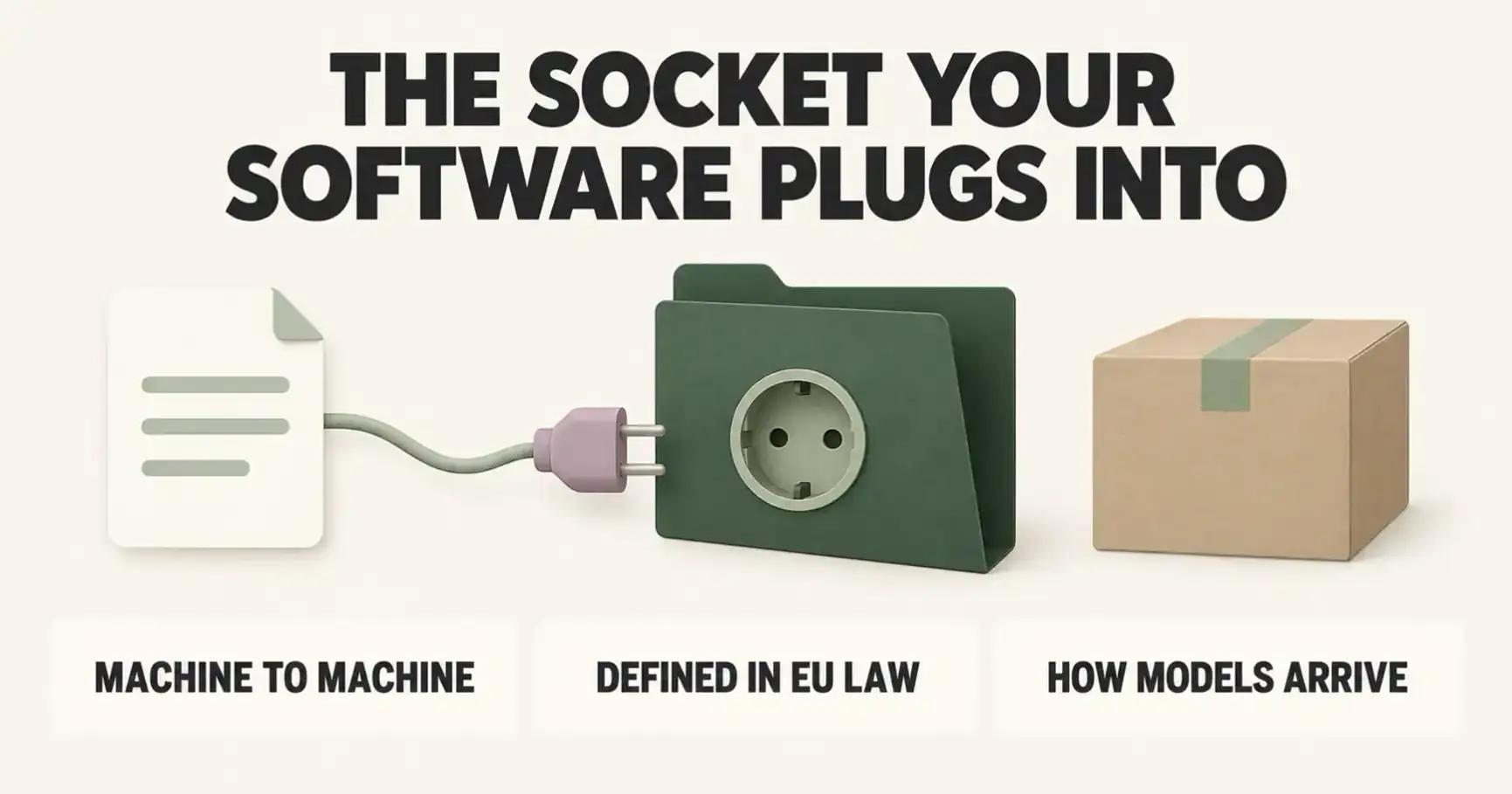
Quick Answer: An API is a set of rules that lets software communicate machine to machine. AI integration often uses one to send inputs to a hosted model and return outputs to business software. It is a connection method, not the model or complete AI system, and EU law gives the term a formal definition.1,2
Summary in a mind map
What Is an API and Why Does AI Integration Need One?
│
├─ The defined connection
│   ├─ Functions, procedures, definitions and protocols
│   ├─ Machine-to-machine communication and data exchange
│   └─ A legal term as well as a technical one
│
├─ What the API does
│   ├─ Sends structured requests between systems
│   ├─ Returns structured responses without repeated clicks
│   └─ Leaves decisions and error controls around the link
│
├─ How models arrive
│   ├─ Library, API, direct download or physical copy
│   ├─ A model alone is not a complete AI system
│   └─ Supply route does not settle legal roles alone
│
└─ Terms and oversight
    ├─ Describe terms of use and quality of service
    ├─ Support machine-readable access where required
    └─ Authorities may use remote API access in scope
The term has a legal as well as a technical meaning
An application programming interface is a controlled vocabulary for software. One system makes a request in an agreed form; the other system accepts or rejects it and returns a response in an agreed form. A print shop's till could send a completed order to courier software without an employee retyping the address.
The term is not merely industry shorthand. Article 2, point (6) of Regulation (EU) 2023/2859 defines an API as a set of functions, procedures, definitions and protocols for machine-to-machine communication and the exchange of data.1 The legal definition identifies the arrangement, not a particular product or coding language.
Four elements sit inside that definition:
| Element | Plain meaning in an integration |
|---|---|
| Functions | The actions one system is allowed to request |
| Procedures | The sequence and conditions for making a request |
| Definitions | The agreed meaning and structure of fields |
| Protocols | The rules for sending, receiving and responding |
An API therefore acts more like a documented service counter than a database. It specifies what may be asked, how to ask and what form the answer takes. It need not reveal the internal workings of the system behind the counter.
Machine-to-machine work replaces repeated clicking
An API lets one program perform a defined interaction directly. A web interface is designed for a person to read a screen, choose an option and click. An API is designed for software to form the same sort of request in a machine-readable way.
Consider a print order. A person could open a courier website, copy the customer's address, choose a service and paste the tracking number back into the till. An API connection can pass the agreed fields between the till and courier system. The business still decides the rules and handles exceptions; the repetitive transfer no longer depends on a person operating two interfaces.
That distinction matters for AI integration. A person can paste a prompt into a chatbot and copy the answer. An API allows the business application to send the input and receive the output as part of its own workflow. The API does not decide whether the input is appropriate, whether the answer is accurate or what action should follow. Those controls belong to the surrounding system and operating process.
Readers considering that wider control layer can compare how AI agents differ from automation platforms. The connection itself is only one component.
AI models can arrive by several routes
An API is one supply route, not the definition of an AI model. Recital 97 of the AI Act says general-purpose AI models may be placed on the market through libraries, APIs, direct download or physical copy.2
| Supply route | What the business receives |
|---|---|
| Library | Software components that developers add to an application |
| API | Remote access through defined machine-to-machine requests |
| Direct download | A copy of model files delivered to the recipient |
| Physical copy | Model materials supplied on physical media |
The route changes the integration work. An API requires a connection, request formats and handling for responses or failures. A download moves more of the technical environment to the recipient. A finished product may hide both routes from the end user. Recital 97 establishes that several routes exist; it does not declare one universally preferable.2
A model becomes useful through a surrounding system
An AI model on its own is not a complete AI system. Recital 97 says models are essential components, but require further components, such as a user interface, to become AI systems.2
The surrounding components can include an input form, permissions, business rules, storage, an API connection and a screen where a person reviews the result. For the print shop, a model might classify an emailed order. The complete system also needs to retrieve the message, send the permitted content, present the classification and route uncertain cases to a person.
This boundary explains why connecting a model is not the same as completing an integration. The model supplies a capability. The system determines where inputs come from, what happens to outputs, who may act on them and how errors are contained. The distinction also matters when deciding whether to build or buy AI: the surrounding system still has to turn the model into a working integration.
Buying access through an API does not, by itself, settle who is the provider or deployer under the AI Act. In the print-shop example, the model company may be the provider of a model reached through its API. If the print shop puts the completed order-classification system into use under its authority, it acts as the deployer of that system. If the shop instead develops and places its own AI system on the market under its name, its role can change. The API is the supply route; the parties' conduct determines their legal roles.2
Terms, service quality and oversight must be intelligible
An API is usable only when its access conditions are described well enough for machines and organisations to rely on it. Article 33(1)(c) of the Data Act binds participants in data spaces that offer data or data-sharing services. Within that scope, they must describe the technical means for access, such as APIs, their terms of use and their quality of service sufficiently.3
The description must enable automatic access and transmission between parties in a machine-readable format. Article 33(1)(c) expressly contemplates continuous access, bulk download and real-time access.3 These are different operating patterns. A nightly batch transfer does not behave like a live request made while a customer waits.
Before relying on an API, a business should identify the required access pattern, the fields to be exchanged and what happens when a request fails. Those are integration questions, not promises supplied by the definition. Connections between ageing or poorly documented systems can also reveal hidden IT integration debt.
An API can also provide regulatory access in a specific legal setting. Article 74(12) of the AI Act requires providers to grant market surveillance authorities full access to documentation and to the training, validation and testing data sets used for high-risk AI systems.2
Where appropriate, that access may be supplied through an API or another technical means enabling remote access.2 The provision does not give every public authority a general doorway into every AI tool. It concerns market surveillance authorities, providers and the material used for high-risk AI systems under the conditions of Article 74(12).
The narrow wording matters. An ordinary commercial API lets customers or connected software make agreed requests. Regulatory remote access serves a statutory oversight purpose. The same technical mechanism can support different relationships, but the legal authority and permitted scope must come from the applicable rule.
What this article cannot decide
Knowing that a service has an API does not show that it is secure, suitable, accurate or lawful for a particular use. The definition explains the connection mechanism. It does not prove what data the supplier keeps, which model sits behind the interface or whether the business may send a particular record.
The supply route also cannot decide AI Act roles without facts about the product and each party's conduct. Nor can it determine data-protection roles or a lawful basis. Those questions require the contract, technical documentation, actual data flow and intended use.
What to do next
Draw one real exchange before discussing integration. Name the sending system, receiving system, permitted fields, requested action, returned fields and failure path. Then ask the supplier for the API description, terms of use and quality-of-service information relevant to that exchange. Keep the question focused on the connection; assess the complete AI system separately.
Frequently asked questions
What is an API in simple terms?
An API is an agreed way for one machine to request data or an action from another machine. EU law defines it as functions, procedures, definitions and protocols for machine-to-machine communication and data exchange. In practice, it lets business software send a structured request and receive a structured response without a person clicking through another application's interface.
Does every AI integration need an API?
No. The AI Act recognises that a general-purpose AI model may be supplied through a library, an API, a direct download or a physical copy. An API is common when one hosted service must communicate with another system, but a locally downloaded model or a finished product can use a different technical route.
Is an AI model supplied through an API already an AI system?
Not necessarily. Recital 97 of the AI Act says that AI models are essential components but do not constitute AI systems on their own. Further components, such as a user interface, are needed to turn a model into an AI system. An API can supply access to the model while the surrounding business application completes the system.
What API information should a supplier provide?
Article 33(1)(c) of the Data Act binds participants in data spaces that offer data or data-sharing services. They must describe access means, including APIs, terms of use and quality of service sufficiently for automatic, machine-readable data transfer, including continuous access, bulk download or real-time access where relevant.
Can an authority access a high-risk AI system through an API?
Yes, where appropriate under Article 74(12) of the AI Act. Providers must give market surveillance authorities full access to documentation and to training, validation and testing data sets used for high-risk AI systems. That access may be provided through an API or another technical means that enables remote access.
Frequently Asked Questions
What is an API in simple terms?
Does every AI integration need an API?
Is an AI model supplied through an API already an AI system?
What API information should a supplier provide?
Can an authority access a high-risk AI system through an API?
Sources
Want this run on your business?
AI Foundation Audit — a structured assessment of your AI footprint: integration risks, governance gaps, ROI opportunities. Delivered as a comprehensive report you can act on.
You receive your AI Opportunity Report and Implementation Brief — tailored to your business and delivered immediately.