Machine Learning vs Generative AI: BigQuery Pilot Choices
Machine learning vs generative AI in BigQuery: compare TimesFM forecasting, managed ARIMA_PLUS, remote Gemini text models and each retail pilot setup.
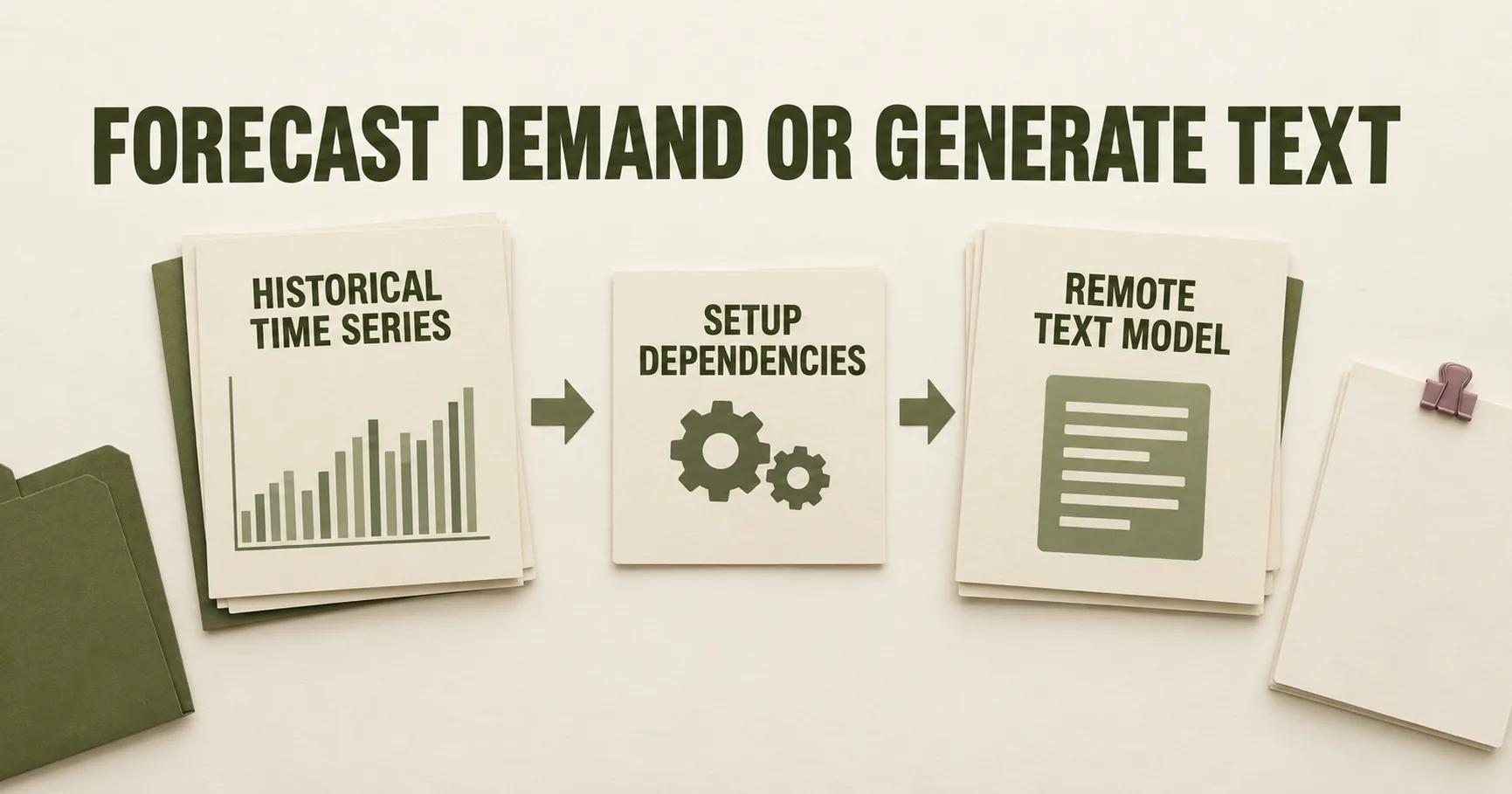
Quick Answer: For machine learning vs generative AI in BigQuery, a retailer can forecast demand from time series with built-in TimesFM via AI.FORECAST or a managed ARIMA_PLUS model via ML.FORECAST. AI.GENERATE_TEXT instead calls a remote Gemini model for text. That route needs a same-location connection and Agent Platform User permission.2,3
Summary in a mind map
Machine Learning vs Generative AI: BigQuery Pilot Choices
│
├─ Forecast demand
│   ├─ Start with historical time-series data
│   ├─ AI.FORECAST uses built-in TimesFM
│   └─ ML.FORECAST needs managed ARIMA_PLUS
│
├─ Generate text
│   ├─ AI.GENERATE_TEXT calls a remote model
│   ├─ Place the connection with the dataset
│   └─ Grant Agent Platform User to its account
│
└─ Choose by output
    ├─ Check forecasts against later observations
    ├─ Check draft descriptions against product facts
    └─ Keep legal output terms separate from setup
Two retail pilot outputs
The first pilot has a numerical output: a forecast of demand from historical time-series data. A retailer might choose a product category and a period, then compare predicted demand with values observed later. Google's BigQuery forecasting overview describes that use of historical time series.2 The output can inform a planning decision. The team still needs to define acceptable forecast error for its buying or stocking process.
The second pilot has a different output: draft product-description text. Google documents AI.GENERATE_TEXT as generating text through a remote model representing a Gemini Enterprise Agent Platform model.3 A catalogue owner should review the draft against actual product information. That check happens before customers see it. The question for that pilot is whether the wording is accurate and useful, not whether a predicted number is close to later sales.
| Choice | Input and intended output | BigQuery path | Review |
|---|---|---|---|
| Demand planning | Historical time series to forecast | AI.FORECAST or ML.FORECAST | Compare prediction with later data |
| Catalogue copy | Product facts and prompt to text | AI.GENERATE_TEXT with remote model | Check every published claim |
NIST calls predictive AI and generative AI two broad classes. It describes generative AI as developing models that produce content with properties similar to their training data.1 The vocabulary explains the different evaluations. A demand forecast and a product description answer different questions. It does not imply that a model's brand name determines whether the retailer's particular workflow succeeds.
AI.FORECAST and TimesFM
Google's forecasting overview says AI.FORECAST uses its built-in TimesFM model to analyse historical time-series data.2 The route suits an initial forecasting test. The team need not first create and manage its own ARIMA_PLUS model. That is a setup distinction, not a conclusion that one path will be more accurate for every category.
The retailer should choose a representative series and an evaluation period before running the pilot. It can then save the forecast and later observations under the same product and time definition. If the input series changes, the result should be marked as a new test. This procedure makes the decision auditable. Google supplies the feature distinction. The retailer judges acceptable error.2
It helps to ask what a wrong forecast would cost operationally. A small miss on a low-volume item and the same numerical miss on a frequently ordered item need not lead to the same decision. The measurement should therefore sit beside the intended use. A forecast is evidence for planning, not an automatic purchase order.
ML.FORECAST and ARIMA_PLUS
ML.FORECAST uses an ARIMA_PLUS model that the customer creates and manages, according to Google's BigQuery overview. Google identifies this path for teams wanting full control over model customisation or needing to explain model output.2 Those are selection criteria alongside setup cost: the retailer should establish whether it needs to tune the model or explain an individual forecast before committing to the managed path.
The comparison of agents and automation platforms addresses a wider workflow choice. For a fair comparison, the retailer can hold the demand question constant and compare the outputs on the same category and period. It should record which model path produced each forecast, the data range used and the subsequent outcome. If the forecast is used in a buying meeting, the decision record should preserve the human choice as well as the model output. Without that context, a model comparison becomes a contest of numbers detached from the work it was meant to improve.
Neither function generates a product description. A numerical demand estimate might help decide how many units to plan for; it cannot substitute for a clear statement of a product's properties. The agent opportunity score offers a separate way to frame whether the task is worth pursuing, but the BigQuery documentation resolves which forecasting path requires a managed model.2
AI.GENERATE_TEXT setup
AI.GENERATE_TEXT generates text by calling a remote model that represents a Gemini Enterprise Agent Platform model.3 In a catalogue pilot, the retailer can provide verified product facts and examine the draft text. The model produces content, not a sales forecast. That distinction sets the review: a human checks the output against source product data and rejects claims that cannot be substantiated.
The overview of AI agents for small businesses addresses where this text step might sit in a larger process. The remote setup has explicit dependencies. Google places the Cloud resource connection in the dataset location. The connection service account needs the Agent Platform User role.3 The technical owner should verify those two conditions before planning a repeatable test. A prompt alone is not the whole implementation. The location and permission are part of getting the remote model connected.
Predictive and generative terms
Machine learning describes methods that learn from data. NIST's glossary distinguishes supervised learning, which learns to predict labelled outputs, from unsupervised learning, which learns patterns in unlabelled data.1 The distinction concerns the training approach. Predictive versus generative AI concerns the kind of output and task. These axes should not be collapsed into a claim that all machine learning is forecasting or that generative systems never learn from data.
The EU AI Act defines an AI system as machine-based. It can infer from inputs how to produce predictions, content, recommendations or decisions. Its autonomy varies, and it may adapt after deployment.4 Recital 12 says inference may use machine-learning methods learned from data. It may also use logic- and knowledge-based methods that draw on encoded knowledge.4 Those categories are broader than the two BigQuery features in this retail example.
Recital 99 identifies large generative AI models as a typical example of general-purpose AI models because they can generate text, audio, images or video across varied tasks. Article 3(63) defines a general-purpose AI model through its generality, range of tasks and ability to integrate into downstream systems.4 Those legal terms do not decide which BigQuery function to call. The retailer still begins with the desired output: forecast or draft text.
Generated content and marking
Article 50(2) of the EU AI Act addresses providers of AI systems, including general-purpose AI systems, that generate synthetic audio, image, video or text. It requires machine-readable marking so such output is detectable as artificially generated or manipulated.4 That duty concerns generated content, unlike a demand prediction. It is an EU-law distinction and should not be presented as a general US obligation for this retailer.
Regulation (EU) 2026/1744 inserts Article 111(4). For qualifying providers, it sets a 2 December 2026 deadline for Article 50(2) marking. This concerns systems placed on the market before the Article 50 date of 2 August 2026.5 These conditions matter to the named providers under that instrument. They do not change TimesFM into a text generator or establish that a US catalogue team has that same duty.
For the pilot decision, keep this regulatory distinction in its own record. The business can choose a forecast task without implying that generated text is involved. If it chooses a text-generation task, it should identify the system provider and where the output will be used before anyone asserts that a particular legal obligation applies. The feature documentation gives the setup; the legal source defines its own scope.3,4,5
What this comparison cannot decide
The cited sources give no measured result for this retailer’s demand or catalogue, so this comparison cannot set an acceptable error rate or publication threshold.2,3
What to do next
Write two distinct pilot statements. For demand, name the historical series, forecast period, BigQuery function and acceptable decision error. For catalogue text, name the verified product facts, remote-model connection owner and reviewer. Compare the cost of correcting each output in the real workflow. Accounts payable automation is another example of a process where the output and reviewer need to be defined before choosing a tool.
Frequently Asked Questions
What is the BigQuery forecasting task in a retail pilot?
Does AI.FORECAST require a separately managed ARIMA_PLUS model?
What model does BigQuery AI.GENERATE_TEXT call?
Are machine learning and generative AI opposites?
Does the EU AI Act's content-marking rule cover a demand forecast?
Sources
- 1.Adversarial Machine Learning: A Taxonomy and Terminology of Attacks and Mitigations — NIST · 2025
- 2.Forecasting overview — Google Cloud · 2026
- 3.Generate text by using the AI.GENERATE_TEXT function — Google Cloud · 2026
- 4.Regulation (EU) 2024/1689 of the European Parliament and of the Council — EUR-Lex · 2024
- 5.Regulation (EU) 2026/1744 — EUR-Lex · 2026
Want this run on your business?
AI Foundation Audit — a structured assessment of your AI footprint: integration risks, governance gaps, ROI opportunities. Delivered as a comprehensive report you can act on.
You receive your AI Opportunity Report and Implementation Brief — tailored to your business and delivered immediately.