Who Does the EU AI Act Apply To? US, UK, Swiss Firms
Who does the EU AI Act apply to? It binds by role and market, not location: US, UK and Swiss firms are in scope when they sell AI into the EU market.
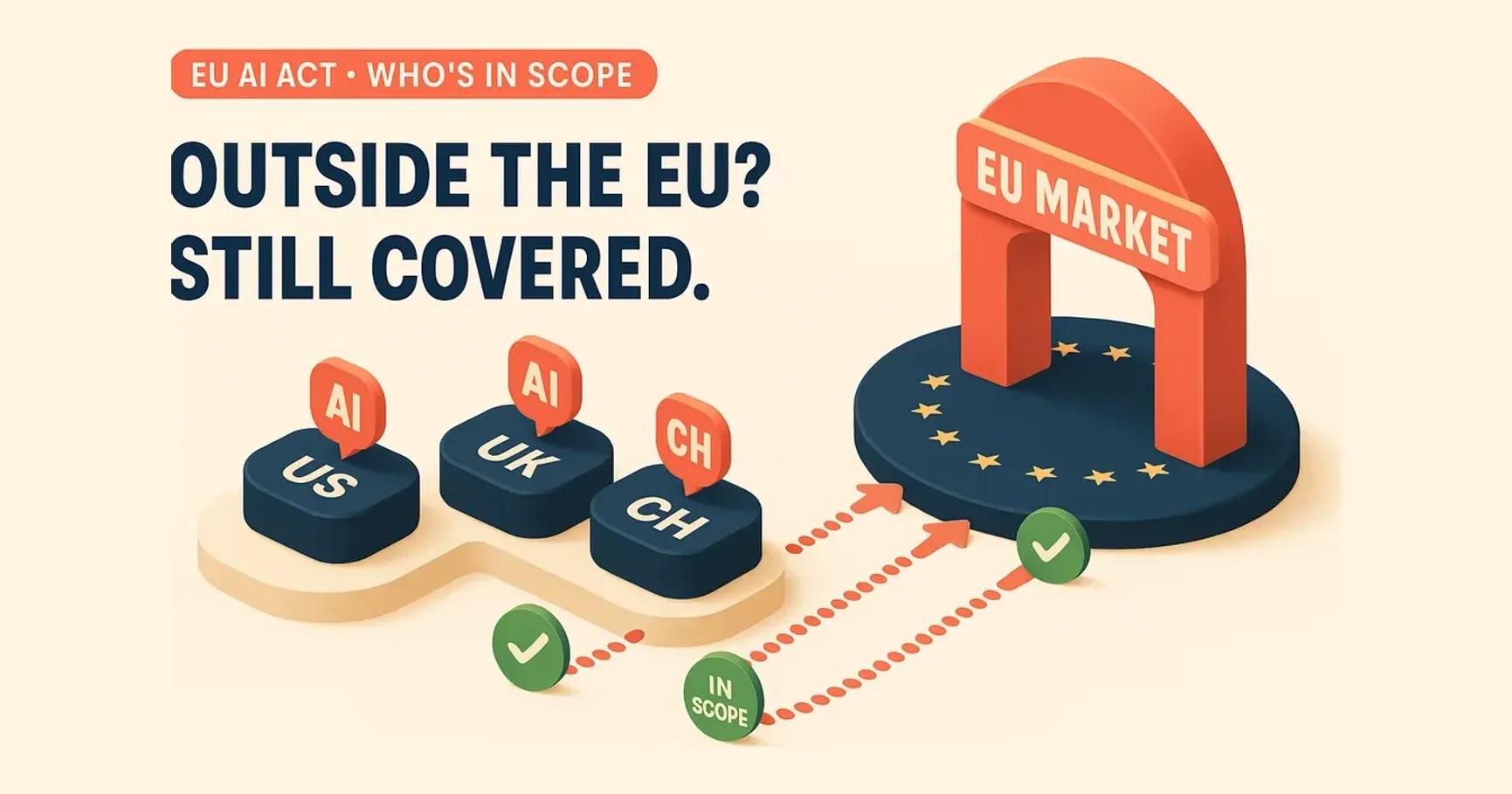
"Does the EU AI Act even apply to us, we are not in the EU?" is the first question most companies ask. The honest answer surprises them. The Act's reach is defined by role and market, not by where the head office sits. Like the GDPR before it, it is extraterritorial. A US, UK or Swiss company is in scope the moment it places an AI system on the EU market, puts one into service in the EU, or its AI system's output is used in the EU. Here is who is caught, who is not, and how to tell which you are.
Quick Answer. The EU AI Act applies by role and market, not by where a company sits. It covers providers who place AI systems on the EU market, deployers established in the EU and, extraterritorially, any provider or deployer whose AI output is used in the EU. US, UK and Swiss firms are caught on those triggers.
Last updated: 24 September 2026 · Verified against Regulation (EU) 2024/1689 as amended by Regulation (EU) 2026/1744 (Digital Omnibus on AI, in force since 27 July 2026).
Summary
Who does the EU AI Act apply to? — decided by role + market/output, not by where you sit (Art. 2)
│
├─ Reach is by ROLE, not location — and it is extraterritorial (like GDPR)
│   ├─ Provider — places an AI system on the EU market — in scope wherever it is established
│   └─ Deployer — uses AI under its authority — in scope if EU-based OR its output is used in the EU
│
├─ Outside the EU? Still covered — US, UK and Swiss firms included
│   ├─ Sell an AI system into the EU, or its output is used in the EU → in scope (Art. 2(1)(a)/(c))
│   └─ Importers, distributors and AI-bearing product makers on the EU market count too
│
└─ When it does NOT apply — the honest boundary
    ├─ Purely internal non-EU use, nothing placed on the EU market, no output used in the EU
    └─ But scope attaches the moment output reaches the EU or you sell in — so check your role
Who does the EU AI Act apply to?
Scope is set by Article 2 of Regulation (EU) 2024/1689. The roles it uses are defined in Article 3 1. Article 2 never asks where you are incorporated. It asks what you do with an AI system and whether that touches the EU. In its own terms, the Regulation applies to:
- Providers placing AI systems on the EU market or putting them into service, irrespective of whether those providers are established in the EU or in a third country 1.
- Deployers of AI systems that have their place of establishment, or are located, within the EU.
- Providers and deployers located in a third country, where the output produced by the AI system is used in the EU.
- Importers and distributors of AI systems, and product manufacturers placing an AI-bearing product on the EU market under their own name or trademark.
Read that list again and the design becomes obvious. The trigger is always a role, provider or deployer, combined with a connection to the EU market or its output. Your office location is never the deciding factor. This is the same extraterritorial reach the GDPR made familiar, and it is deliberate. The EU did not want a rule that a company could escape simply by hosting its servers or its headquarters abroad. For how this sits next to the data-protection rules you already know, see how the AI Act sits alongside GDPR and UK data rules. There the extraterritorial logic is nearly identical.
"Does it apply to us?" is only the first question. It helps to see the answer against the full set of obligations that follow. For the records a company in scope actually has to keep, work through our complete EU AI Act documentation guide. It maps each duty to a document. This article answers the narrower question that comes before all of that: are you in, and in what role?
The decision reduces to three questions: your role, your market, and where the output lands:
In words, the tree works like this:
- Neither a provider nor a deployer of an AI system? You have no role under the Act, so you are out of scope.
- A provider, and the system is placed on the EU market, put into service in the EU, or its output is used in the EU? In scope as a provider, and this holds even with no EU establishment.
- A deployer, and you are established or located in the EU, or the system's output is used in the EU? In scope as a deployer.
- A provider or deployer with no EU market connection and no output used in the EU? Out of scope, for now.
Not sure which triggers you hit? Free checkers tell you whether the Act concerns you; the free EU AI Act Documentation tool works out your role and generates the actual documents, in ~20 minutes: https://aiprioritymap.com/en/tools/eu-ai-act
How the Act reaches US companies
Yes, whenever a US company crosses one of Article 2's triggers. Most that touch the EU do. A US SaaS vendor that sells an AI-enabled product to EU customers is placing an AI system on the EU market. That makes it a provider in scope under Article 2(1)(a), regardless of having no office, entity or server inside the EU 1. The Regulation says so in as many words. It applies to providers "irrespective of whether those providers are established or located within the Union or in a third country".
The output trigger reaches further still. A US company whose AI system produces output that is used in the EU is caught under Article 2(1)(c) even where it has no direct EU customer relationship 1. Your model might score, draft, rank or decide something. If the result is then used by someone in the EU, that connection alone can pull you into scope. For US companies the practical test is rarely "are we established in the EU?". It is "does anything our AI produces end up being used there?"
How it reaches UK companies
Yes. Since Brexit the United Kingdom is a third country for the purposes of the Act, exactly like the US or Switzerland. Being outside both the EU and the single market changes nothing about the triggers. A UK firm that sells an AI system into the EU is a provider placing it on the EU market, in scope under Article 2(1)(a). A UK firm whose AI system's output is used in the EU is in scope under Article 2(1)(c), even if it never signs an EU customer directly 1.
This bites harder in the UK than many firms expect. So many UK businesses still serve EU clients, run EU-facing operations, or process work whose results cross the Channel. "We left the EU" is not an exemption from the EU AI Act any more than it was from the GDPR. The reach is defined by the market you touch, not the trade bloc you belong to.
How it reaches Swiss companies
Yes. Switzerland is neither an EU nor an EEA member, so for the Act it is a third country. The analysis is identical to the US and UK cases. A Swiss provider that places an AI system on the EU market is in scope under Article 2(1)(a). A Swiss company whose AI system's output is used in the EU is in scope under Article 2(1)(c) 1. Proximity to the EU, or bilateral agreements in other areas, does not create an exemption here.
For Swiss firms with EU subsidiaries, EU customers or cross-border data flows, the safe assumption is that at least the output trigger is live. The question to answer is not whether Swiss law mirrors the Act. It is whether anything your AI produces is used inside the EU, because that is what Article 2 asks.
Are you a provider or a deployer?
Once you know the Act reaches you, your role decides what you owe. The two roles carry very different weights, and Article 3 defines them 1.
- A provider (Article 3(3)) develops an AI system, or has one developed, and places it on the market or puts it into service under its own name or trademark, whether for payment or free of charge.
- A deployer (Article 3(4)) uses an AI system under its authority, except where it is used in the course of a purely personal, non-professional activity.
Most companies are deployers. They buy or subscribe to AI tools and use them in their work. They do not build systems and sell them under their own brand. Providers carry the heavier obligations, since the Act's high-risk conformity, documentation and post-market duties fall primarily on them. But deployers are far from obligation-free, and a company can be both. Fine-tune and rebrand a model, for example, and you may step into a provider's shoes for that system.
The worked examples below show how role and market combine to decide scope:
| Entity | In scope? | Role and trigger |
|---|---|---|
| US SaaS vendor selling an AI tool to EU customers | Yes | Provider: placing an AI system on the EU market, Art. 2(1)(a) |
| UK company whose AI system's output is used in the EU | Yes | Provider or deployer: third country, output used in EU, Art. 2(1)(c) |
| Swiss provider placing an AI system on the EU market | Yes | Provider: third-country provider on the EU market, Art. 2(1)(a) |
| EU-based company using a third-party AI tool internally | Yes | Deployer: established in the EU, Art. 2(1)(b) |
| Non-EU firm using AI purely domestically, no EU output or sales | No | No EU market connection: outside Art. 2 triggers |
Once you are in scope, the question becomes what you owe. Deployers have real duties. They must ensure staff are competent under the Article 4 AI-literacy duty, meet the Article 50 transparency rules that apply from 2 August 2026, and set all of it out in an internal AI use policy. Two things then matter: exactly when each duty bites, and what the Digital Omnibus did and did not move. Pin the dates to our corrected post-Omnibus timeline. (Verified on 13 July 2026.)
When the Act does not apply to you
The Act is broad, but it is not universal. Overclaiming universal application helps no one. Say your company is based outside the EU, uses AI purely internally, and places nothing on the EU market. If none of that system's output is used in the EU either, you are likely outside Article 2's scope. The Regulation also excludes certain uses regardless of where you sit. Those are AI used by an individual in a personal, non-professional capacity and, subject to conditions, systems used solely for scientific research and development or for national-security, defence and military purposes 1,2.
Treat "out of scope", though, as a live status, not a permanent one. The triggers in Article 2 are activity-based, so they attach the instant your circumstances change. The moment your AI system's output is used in the EU, or you begin selling into the EU market, you are in, as a provider or a deployer depending on your role 1. The safe posture for any company with EU customers, EU operations or cross-border output is to assume the output trigger could apply, and to check your role deliberately. Your address is not a shield.
Related insights
- EU AI Act Compliance: The Documentation Guide — the deployer-first path and the document pack that follows once you are in scope.
- AI Governance: UK GDPR and the EU AI Act — how the Act's extraterritorial reach mirrors the data-protection rules you already run.
- The EU AI Act Deadlines After the Digital Omnibus — when each duty applies once your company is in scope.
Last updated: July 2026. Version 1.0.
Frequently Asked Questions
Does the EU AI Act apply to US companies?
Does the EU AI Act apply to UK companies?
Does the EU AI Act apply to Swiss companies?
What is the difference between a provider and a deployer?
When does the EU AI Act not apply to my company?
Sources
- 1.Regulation (EU) 2024/1689 — Artificial Intelligence Act, Article 2 (scope) and Article 3 (definitions), CELEX 32024R1689 — European Parliament and Council of the European Union · 2024
- 2.AI Act Service Desk — scope and application of the EU AI Act — European Commission — AI Act Service Desk · 2026
- 3.Regulatory framework on AI — European Commission — Shaping Europe's Digital Future · 2024
Want this run on your business?
AI Foundation Audit — a structured assessment of your AI footprint: integration risks, governance gaps, ROI opportunities. Delivered as a comprehensive report you can act on.
You receive your AI Opportunity Report and Implementation Brief — tailored to your business and delivered immediately.