Internal AI Use Policy: What It Must Contain (2026)
An internal AI use policy is how a deployer puts the EU AI Act into effect for staff — what it must contain, who owns it, and how to keep it a living document.
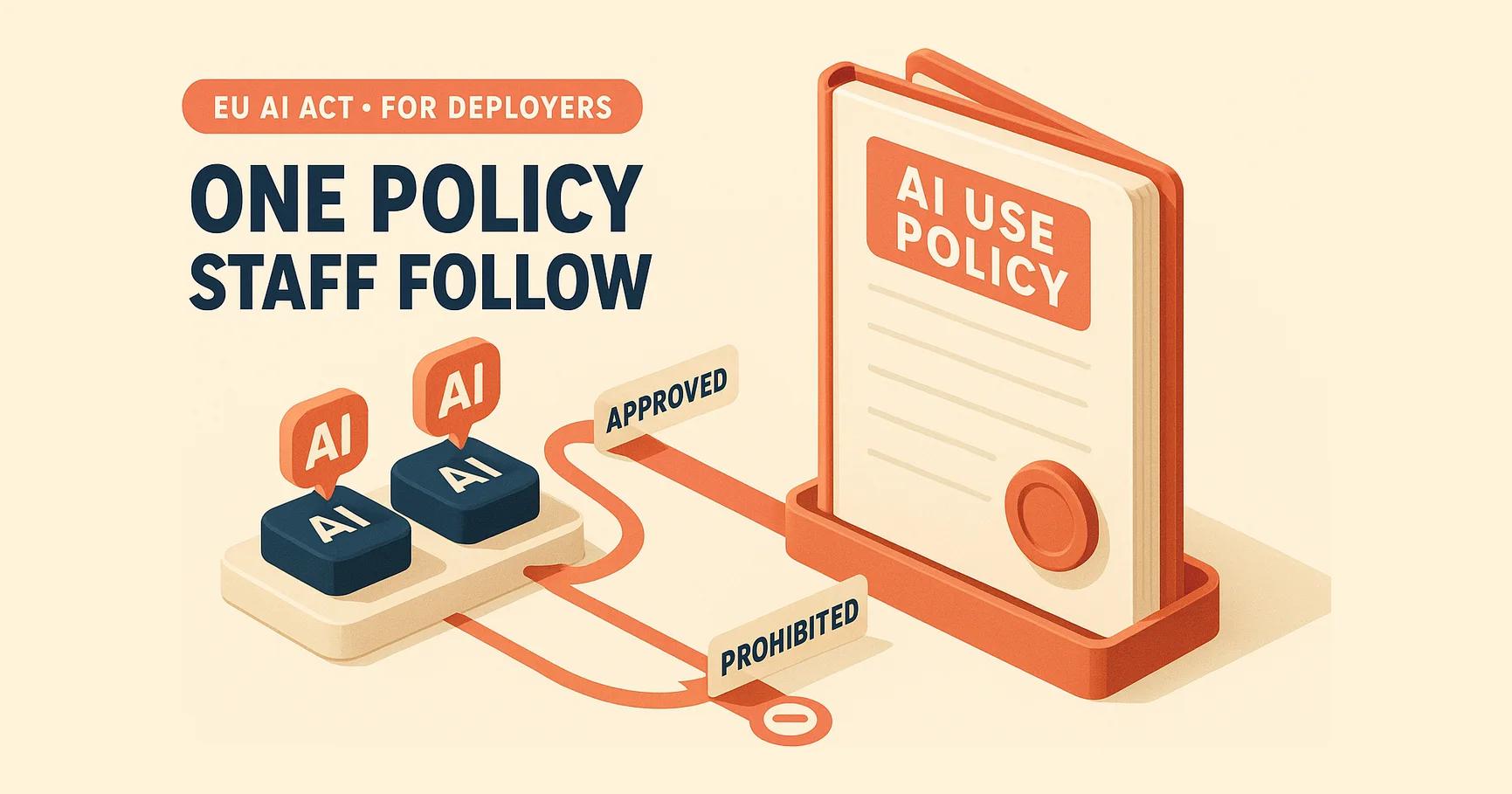
If your organisation uses AI, an internal AI use policy is the single document that turns "we must comply with the EU AI Act" into "here is what you may and may not do with AI". The Act does not demand a document by that name. But a written policy is how deployers meet their obligations, and how you evidence it. Here is what a good one must contain, who owns it, and how to keep it alive.
Quick Answer. No EU AI Act article names an "internal AI use policy", but a written internal AI use policy is how a deployer actually meets the Act — turning Article 4 literacy, Article 50 transparency, human oversight, acceptable-use and vendor rules into one rulebook staff can follow and you can evidence.
Last updated: 24 September 2026 · Verified against Regulation (EU) 2024/1689 as amended by Regulation (EU) 2026/1744 (Digital Omnibus on AI, in force since 27 July 2026).
Summary
Internal AI use policy — the one document that turns "we must comply" into "here is what you may do"
│
├─ Not named in the Act — but it is how you comply
│   ├─ No article mandates a document called an "AI use policy" — be honest about that
│   └─ Yet it is how a deployer meets Art. 4, Art. 50, oversight and Art. 5 in one place
│
├─ What it must contain — eight working sections
│   ├─ Scope · approved vs prohibited tools · transparency & labelling
│   ├─ Human oversight · data & confidentiality · roles & responsibilities
│   └─ Incident & escalation · a review cadence — each maps to a real duty
│
└─ Keep it living, or it is shelfware
    ├─ One named owner · train staff on it (Art. 4) · a light sign-off
    └─ Review yearly and on every new tool; log what changed and who approved it
Does the EU AI Act require an internal AI use policy?
The honest answer is no, not by that name. Nowhere in Regulation (EU) 2024/1689 is there an article headed "AI use policy" that every organisation must adopt 1. If a checker or a template tells you the Act "requires an AI use policy", it is paraphrasing, not quoting. Being clear about that matters. A policy written to satisfy an imaginary statutory line item tends to be generic and lifeless.
But that is not the end of the story. The Act loads a set of real duties onto deployers, organisations that use AI systems under their own authority. A written internal policy is simply the most practical way to meet them coherently and to prove you did. Article 4 requires you to take measures to support your people's AI literacy. Article 50 requires transparency when someone interacts with AI or AI-generated content, applicable from 2 August 2026. Article 5 bans certain uses outright. And any high-risk system carries human-oversight and record-keeping duties 1,2. Those obligations are scattered across the regulation. A policy is where they become one set of rules a member of staff can actually follow.
So think of the policy as the operational hub. Your AI-literacy training, your transparency notices, your vendor checks and your record-keeping all hang off it. It is the document that says who may use what, for which tasks, and with which guardrails. For the full picture of the records a company using AI has to keep, work through our complete EU AI Act documentation guide. It maps the policy against the rest of the pack. These duties did not all arrive on one date: some are already live and others land later. So pin any deadline claim to our corrected post-Omnibus timeline. (Verified on 13 July 2026.)
What must an internal AI use policy contain?
A policy that earns its place does eight things. Each maps to a real duty or a real risk. None needs a lawyer to draft, though a lawyer should read it before it is adopted. The table below is the checklist: the section, what it covers, and the obligation it puts into effect.
| Policy section | What it covers | Which duty it puts into effect |
|---|---|---|
| Scope & definitions | Who and what the policy applies to; what counts as "AI"; which tools and staff are in scope | Grounds the whole policy; mirrors the Article 3 definitions 1 |
| Approved vs prohibited tools & uses | The allow-list of sanctioned tools, and the red lines, meaning uses that are banned outright | Article 5 prohibited practices; kills "shadow AI" |
| Transparency & labelling | When staff must tell people they are dealing with AI, or that content is AI-generated | Article 50 transparency, applicable from 2 August 2026 |
| Human oversight | Which outputs need a human check before they are used or sent, and who signs off | The human-oversight safeguard behind every AI-assisted decision |
| Data & confidentiality | What may and may not be typed into a tool; personal, client and confidential data rules | Overlaps GDPR and confidentiality duties the AI Act sits alongside |
| Roles & responsibilities | Who owns the policy, who approves tools, who trains, who to ask | Article 4 literacy scope; accountability |
| Incident & escalation | How to report a bad output, a breach or a near-miss, and who acts on it | Risk management; evidences that you took active measures |
| Review cadence | When and how the policy is refreshed; version control and a change log | Keeps measures current, because the Act's duties are ongoing rather than one-off |
The two sections people underestimate are the allow-list and the data rules. The allow-list, approved tools and the red lines around them, is what stops staff quietly pasting work into whatever tool they found online. It also carries your Article 5 red lines, the uses the Act prohibits outright 1. The data-and-confidentiality section is where the AI Act meets your existing obligations. It sets what may be entered into a tool, how client and personal data are handled, and which tools are contractually cleared for sensitive input. Because AI use almost always processes personal data too, this section overlaps heavily with data-protection law. Our guide on how the AI Act sits alongside GDPR and UK data rules shows where the two regimes meet.
Writing eight sections from a blank page is the reason so many AI policies never ship. If you would rather start from a draft than a blank document, the free EU AI Act Documentation tool produces an internal AI use policy as an editable DOCX. It comes prefilled for the company and the systems you describe. Free readiness checkers tell you whether the Act concerns you. This tool generates the actual document you adapt and adopt. It is a documentation aid, not legal advice, an audit or a certification.
Generate your own EU AI Act documents — free, in ~20 minutes: https://aiprioritymap.com/en/tools/eu-ai-act
Who writes and owns the policy
A policy nobody owns is a policy nobody updates. Name a single accountable owner, usually whoever owns operations or compliance. That is a chief operating officer, an operations director, or a nominated governance or data-protection lead at a larger organisation. The owner is responsible for keeping the policy current. They do not have to write every word alone.
In practice a short cross-functional group should shape it: operations, IT, legal (or an external adviser), and whoever runs your data protection. The policy touches tools, contracts, data and people all at once. Draft it in one place, agree it once, and give one person the pen for future changes.
The owner works from your inventory of AI systems, not from a template's imagination. You cannot write a credible allow-list, or scope oversight, without knowing which systems are actually in use and who touches each one. If you have not mapped that yet, start with our guide on how to build your AI register in about 90 minutes. It gives you the who-and-what the policy references. The register and the policy are a pair. The register is the inventory, the policy is the rulebook that governs it.
Rolling it out so people actually follow it
A policy filed on a shared drive changes no behaviour. Three things turn it into practice. First, training. Staff have to understand the rules for the tools they actually use, which is the Article 4 AI-literacy duty in action. The policy and the Article 4 AI-literacy duty are siblings. One sets the rules, the other makes people competent to follow them, and each is weaker without the other. Second, a light sign-off: people acknowledge they have read it, so you hold a record. Third, and most practical, a simple decision aid staff can use in the moment.
Most day-to-day questions reduce to one: "may I use this AI tool for this task?" A good policy answers it in a few steps, so an employee does not have to reread all eight sections to make a sensible call:
In words, the decision aid works like this:
- Tool not on your approved list? It needs approval: do not use it yet; ask for it to be assessed and added.
- Approved, but the task involves personal or confidential data? It is prohibited unless the policy specifically clears that tool for that kind of data.
- Approved, no sensitive data, but nobody will check the output? It needs approval: add a human review step before the output is used or sent.
- Approved, no sensitive data, and a human reviews the output first? Allowed: proceed, and log it where the policy requires.
The point of the aid is not to replace judgement. It is to make the safe default obvious and the risky path visible, so people stop guessing.
How often to review it
An AI use policy is a living document or it is worthless, because the tools, the risks and the law all move. Review it on a fixed cadence, at least once a year, and on trigger events. Those are when you adopt a new tool, change a use case, onboard people, or when the law shifts. Two dates matter for the policy's content. Article 50's transparency duties have applied since 2 August 2026, and after the Digital Omnibus the high-risk (Annex III) obligations apply from 2 December 2027 1,2. If any system you run becomes high-risk, the policy is where the extra oversight and record-keeping rules land. (Verified on 25 September 2026.)
Version each revision and keep the old ones. The Act frames its duties as ongoing rather than one-off, and the same logic runs through the whole regulation. A policy dated 2025 that never moved is evidence you stopped, not evidence you complied 1. A short review log recording the date, what changed and who approved it is cheap insurance. It is exactly what a customer's procurement team or a regulator will ask to see.
Related insights
- EU AI Act Compliance: The Documentation Guide — the deployer-first path and the document pack this policy sits inside.
- AI Literacy Under Article 4: The EU AI Act Duty in Force — the training that makes staff competent to follow the policy.
- How to Build Your AI Register in About 90 Minutes — the inventory of who and what touches AI that the policy governs.
Last updated: July 2026. Version 1.0.
Frequently Asked Questions
Who should own the internal AI use policy?
How is an AI use policy different from AI literacy training?
How often should you review an internal AI use policy?
Is an internal AI use policy the same as legal advice?
Sources
- 1.Regulation (EU) 2024/1689 — Artificial Intelligence Act, Articles 3 (definitions), 4 (AI literacy), 5 (prohibited practices) and 50 (transparency), CELEX 32024R1689 — European Parliament and Council of the European Union · 2024
- 2.Timeline for the implementation of the EU AI Act — European Commission — AI Act Service Desk · 2026
- 3.Regulatory framework on AI — European Commission — Shaping Europe's Digital Future · 2024
- 4.AI Literacy — Questions & Answers — European Commission — Shaping Europe's Digital Future · 2025
Want this run on your business?
AI Foundation Audit — a structured assessment of your AI footprint: integration risks, governance gaps, ROI opportunities. Delivered as a comprehensive report you can act on.
You receive your AI Opportunity Report and Implementation Brief — tailored to your business and delivered immediately.