EU AI Act Article 50: AI Transparency and Labelling
EU AI Act Article 50 makes you tell people when they deal with AI and mark AI-generated content from 2 August 2026 — the four duties and example wordings.
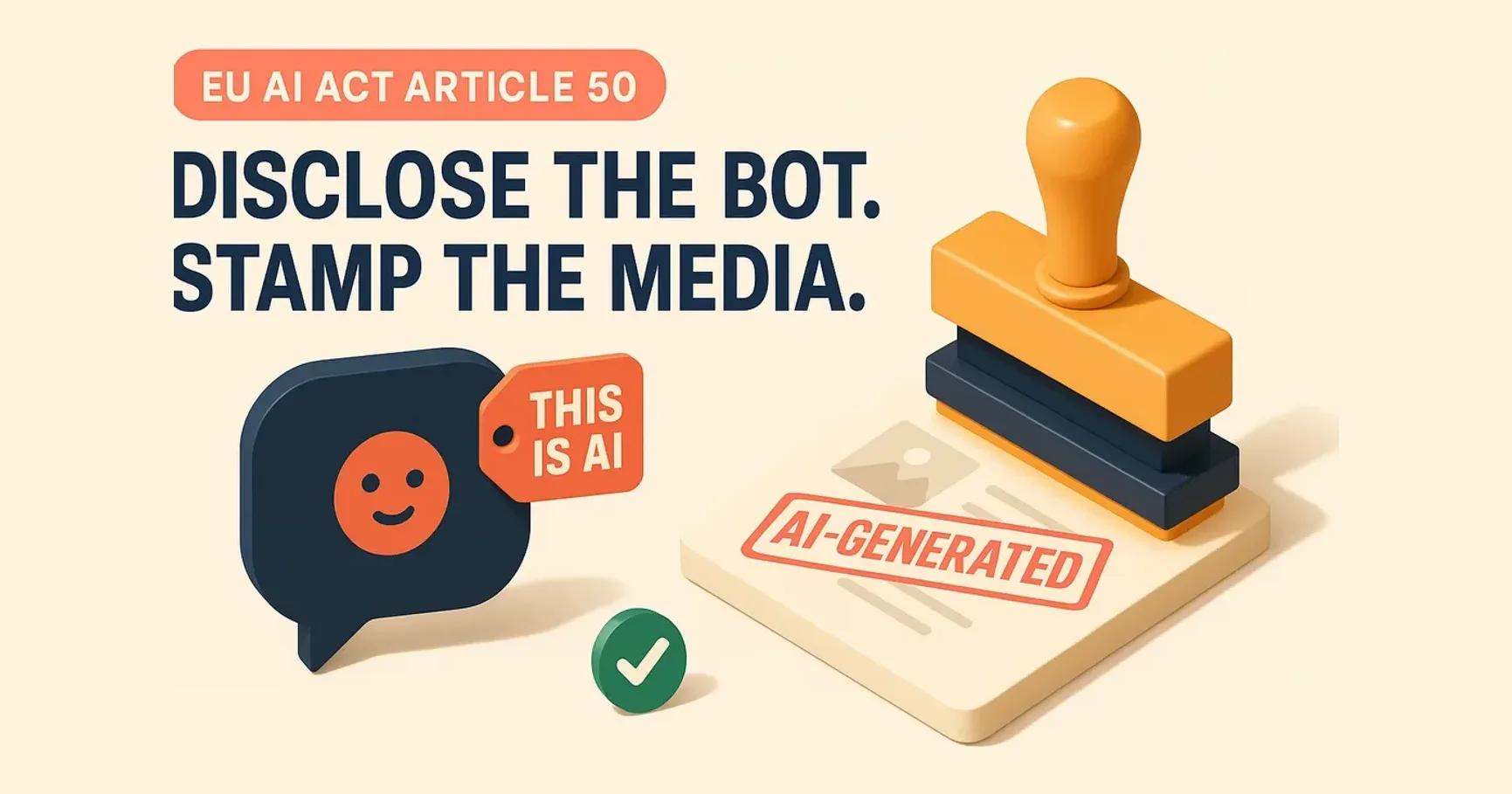
Article 50 of the EU AI Act is the transparency rule most companies actually meet in practice. It makes you tell people when they are dealing with an AI system, and mark content your AI generates. It has applied since 2 August 2026. Despite the headlines, the Digital Omnibus did not delay it, apart from a grace period to 2 December 2026 for marking by generative tools already on the market. This article sets out the four duties, who owes each one, and gives example disclosure wordings you can adapt.
Quick Answer. EU AI Act Article 50 sets four transparency duties from 2 August 2026. Providers must design AI so people know they are dealing with it (50(1)) and mark synthetic media machine-readably (50(2)). Deployers must disclose deepfakes and public-interest AI text (50(4)) and inform people exposed to emotion recognition (50(3)).
Last updated: 24 September 2026 · Verified against Regulation (EU) 2024/1689 as amended by Regulation (EU) 2026/1744 (Digital Omnibus on AI, in force since 27 July 2026).
Summary
EU AI Act Article 50 — tell people when it is AI, and mark AI-generated content (since 2 Aug 2026)
│
├─ Four transparency duties — split between providers and deployers
│   ├─ 50(1) providers — AI that talks to people must say it is AI (unless obvious)
│   ├─ 50(2) providers — synthetic audio/image/video/text marked machine-readably as AI
│   ├─ 50(3) deployers — emotion recognition / biometric categorisation: inform those exposed
│   └─ 50(4) deployers — deepfakes + public-interest AI text disclosed as AI-generated
│
├─ The deadline the Digital Omnibus did NOT move
│   ├─ Transparency applies since 2 Aug 2026 (Art. 113); legacy generative tools mark by 2 Dec 2026 (Art. 111(4))
│   └─ The Omnibus delayed high-risk (Annex III to 2 Dec 2027); Art. 50 kept its date
│
└─ How to comply without a lawyer
    ├─ Add a short AI-disclosure line to chatbots, media and public-interest text — adapt them
    └─ A breach sits in the €15M/3% tier — the free tool drafts the transparency notices
What does Article 50 of the EU AI Act require?
Article 50 is the Act's transparency chapter, written as four distinct duties. They split between the party that builds an AI system (the provider) and the party that uses one under its own authority (the deployer) 1. It is the part of the Act that touches the most companies, because you do not need a high-risk system to be caught. An ordinary customer-service chatbot or a marketing image generator is enough. The four duties are:
- Article 50(1), providers. An AI system intended to interact directly with natural persons must be designed and built so the person is informed that they are interacting with an AI system. The duty falls away only where that is obvious to a reasonably well-informed, observant and circumspect person.
- Article 50(2), providers. A system that generates synthetic audio, image, video or text must mark its outputs as artificially generated or manipulated in a machine-readable format. Narrow exceptions apply, for example assistive or standard editing functions that do not substantially alter the input.
- Article 50(3), deployers. A deployer of an emotion-recognition or biometric-categorisation system must inform the natural persons exposed to it.
- Article 50(4), deployers. A deployer of AI that produces deepfakes (image, audio or video) must disclose that the content is artificially generated or manipulated. Where AI-generated text is published to inform the public on matters of public interest, that must be disclosed as AI-generated, subject to exceptions such as human editorial review and responsibility.
Getting the provider-versus-deployer split right matters, because it decides which duty is yours. If you only use a third-party tool, you are a deployer and typically owe 50(3) or 50(4). If you build or brand the system, you are a provider and owe 50(1) or 50(2). For the full set of obligations around these transparency duties, and the document pack that evidences them, work through our complete EU AI Act documentation guide. It maps each duty to a record.
When the transparency rules apply
The headline date is 2 August 2026. Under Article 113, the Article 50 transparency obligations became applicable then, on the Act's general date of application 2. This is the point many companies miss, because so much recent coverage said the Act had been "postponed".
It was not, at least not this part. The Digital Omnibus (Regulation (EU) 2026/1744, in force since 27 July 2026) moved the high-risk obligations, Annex III to 2 December 2027 and Annex I to 2 August 2028. For Article 50 it kept the date and added only a grace period to 2 December 2026 for the machine-readable marking of generative systems placed on the market before 2 August 2026 2. So if a summary tells you the AI Act has been delayed, it is wrong about transparency. Article 50 was not delayed, and 2 August 2026 stands. For the corrected schedule of what moved and what did not, pin the dates to the corrected post-Omnibus timeline. There the "Article 50 applies from 2 August 2026" line sits alongside the deadlines that were pushed. (Verified on 25 September 2026.)
There is one nuance worth stating accurately. Under Article 111(4), added by the Digital Omnibus, providers of generative AI systems placed on the market before 2 August 2026 have until 2 December 2026 to comply with the Article 50(2) marking duty. The Omnibus also reworded Article 50(7): the Commission encourages codes of practice on the detection, marking and labelling of AI-generated content and may adopt an implementing act if they prove inadequate 1,3. The grace period covers only that marking duty for tools already on the market. The core transparency duties are live from 2 August 2026. And if you are still unsure whether the Act reaches you at all, that is the prior question: see who the EU AI Act applies to. If you are in scope, Article 50 is likely your first live duty.
Which Article 50 disclosure do you owe?
The routing from "what your AI does" to "which duty you owe" is short enough to draw:
In words, the tree branches like this:
- Does your AI interact directly with people? Tell them it is AI (Article 50(1)) unless it is obvious to a reasonable person.
- Does it generate synthetic audio, image, video or text? Mark the output machine-readably as artificial (Article 50(2)).
- Is it a deepfake, or AI-generated text on a matter of public interest? Disclose that it is AI-generated or manipulated (Article 50(4)).
- Is it an emotion-recognition or biometric-categorisation system? Inform the people exposed to it (Article 50(3)).
- None of the above? No Article 50 transparency duty attaches.
One system can trigger more than one duty. A branded chatbot that also generates images owes both 50(1) and 50(2), so work through every branch rather than the first that fits.
Disclosing an AI chatbot
For a chatbot, voice agent or any AI that talks to people directly, Article 50(1) turns on one thing. You must tell the person clearly and in good time that they are interacting with an AI system 1. In practice that means a short, plain disclosure at the start of the interaction, before the user has typed a question. It does not mean a line buried in a privacy policy three clicks away. A single line does it: "You're chatting with an AI assistant."
The only carve-out is the "unless it is obvious" test. You may skip the notice where it would be obvious to a reasonably well-informed, observant and circumspect person that they are dealing with AI 1. That is a genuinely narrow exception. Do not lean on it for a chatbot that opens with a human-sounding name and a friendly "Hi, I'm Sam". When in doubt, disclose. The notice costs nothing and the exception is easy to get wrong.
Marking AI-generated content
If you provide a system that generates synthetic media, Article 50(2) requires its outputs to be marked as artificially generated or manipulated in a machine-readable format 1. Think watermarks, metadata or provenance signals a machine can detect rather than a caption a human might read. The duty sits with the provider of the generating system, so much of the marking is done at the tool level. If you build or brand such a tool, this is your obligation.
There are narrow exceptions. One is where the AI performs an assistive or standard editing function and does not substantially alter the input data; another is where the output is legally authorised for purposes such as detecting or preventing crime 1. To help firms meet the marking duty consistently, the Commission is encouraging codes of practice on the detection and labelling of AI-generated content under Article 50(7). The detailed technical expectations firm up around late 2026 3. Until they settle, apply the best available machine-readable marking your tool supports. Keep a record of the approach you took.
Deepfakes and emotion recognition
These are the two deployer duties, and they catch companies that use AI without building it. A deepfake here means a synthetic or manipulated image, audio or video of a real person, place or event. If you deploy AI that produces one, Article 50(4) requires you to disclose that the content has been artificially generated or manipulated 1. The same article also covers AI-generated text published to inform the public on matters of public interest. That must be flagged as AI-generated, unless it has undergone human review and a person or organisation holds editorial responsibility for it. A marketing team spinning up a synthetic spokesperson, or a newsroom auto-drafting public-interest copy, is squarely in scope.
The other deployer duty is Article 50(3). If you deploy an emotion-recognition or biometric-categorisation system, you must inform the natural persons exposed to it 1. That covers, for example, a system inferring mood from a webcam or sorting people by inferred attributes. Across all of these, a breach is not free. An Article 50 transparency failure sits in the Act's middle penalty tier, up to €15 million or 3% of worldwide turnover, so it is worth getting right. For how the tiers work, see what the fines are for breaching this.
Example disclosure wordings you can adapt
The table below gives generic example wordings for the common cases. They are illustrative templates to adapt to your context, not legal advice. The right wording depends on your system, your users and your regulator's guidance, and you should have them reviewed before you rely on them.
| System type (article) | What to disclose | Example wording — adapt, not legal advice |
|---|---|---|
| AI chatbot / assistant — 50(1) | The user is talking to an AI, not a person | "You're chatting with an AI assistant. It can help with common questions and will pass you to a human whenever you ask." |
| AI voice / phone agent — 50(1) | The caller is speaking to an AI, said up front | "You're speaking with [Company]'s automated AI assistant. Say 'agent' at any time to reach a colleague." |
| AI-generated image / audio / video — 50(2) | The output is artificially generated | Machine-readable: embed a provenance/watermark tag in the file. Visible label: "Generated with AI." |
| Deepfake image / audio / video — 50(4) | The content is artificially generated or manipulated | "This video has been artificially generated and digitally altered using AI." |
| Public-interest AI-generated text — 50(4) | The text is AI-generated (unless human-edited) | "Parts of this article were generated using AI and reviewed by our editorial team." |
| Emotion recognition / biometric categorisation — 50(3) | The people exposed are informed it is in use | "This service uses AI to [detect emotion / categorise attributes]. You are being informed that it is in operation." |
Where these disclosures live is a good question for your internal AI use policy. That is the natural home for "when and how we disclose AI" as a standing rule rather than an afterthought: see what your internal AI use policy must contain, where the transparency section carries exactly this.
Need the notices drafted rather than described? Free checkers tell you whether the Act concerns you; the free EU AI Act Documentation tool generates the actual AI transparency notices (DOCX) — as part of the pack, in ~20 minutes: https://aiprioritymap.com/en/tools/eu-ai-act
Related insights
- EU AI Act Compliance: The Documentation Guide — the full set of obligations Article 50 sits within, and the document pack that evidences them.
- Who Does the EU AI Act Apply To? — whether you are in scope at all; if you are, Article 50 is likely your first live duty.
- The EU AI Act Deadlines After the Digital Omnibus — why 2 August 2026 still stands for transparency after the Omnibus.
Last updated: July 2026. Version 1.0.
Frequently Asked Questions
When does Article 50 of the EU AI Act apply?
Did the Digital Omnibus delay Article 50?
How do I disclose that a chatbot is AI?
Do I have to label AI-generated content?
What are the penalties for breaching Article 50?
Sources
- 1.Regulation (EU) 2024/1689 — Artificial Intelligence Act, Article 50 (transparency obligations for providers and deployers of certain AI systems), CELEX 32024R1689 — European Parliament and Council of the European Union · 2024
- 2.Regulation (EU) 2024/1689 — Artificial Intelligence Act, Article 113 (entry into force and application dates), CELEX 32024R1689 — European Parliament and Council of the European Union · 2024
- 3.AI Act Service Desk — transparency obligations, codes of practice and guidance under the EU AI Act — European Commission — AI Act Service Desk · 2026
Want this run on your business?
AI Foundation Audit — a structured assessment of your AI footprint: integration risks, governance gaps, ROI opportunities. Delivered as a comprehensive report you can act on.
You receive your AI Opportunity Report and Implementation Brief — tailored to your business and delivered immediately.