AI Readiness Assessment: What Microsoft Delivers in 2026
AI readiness assessment: see Microsoft's seven pillars and tailored recommendations, then check purpose, training and risk gaps with NIST guidance.
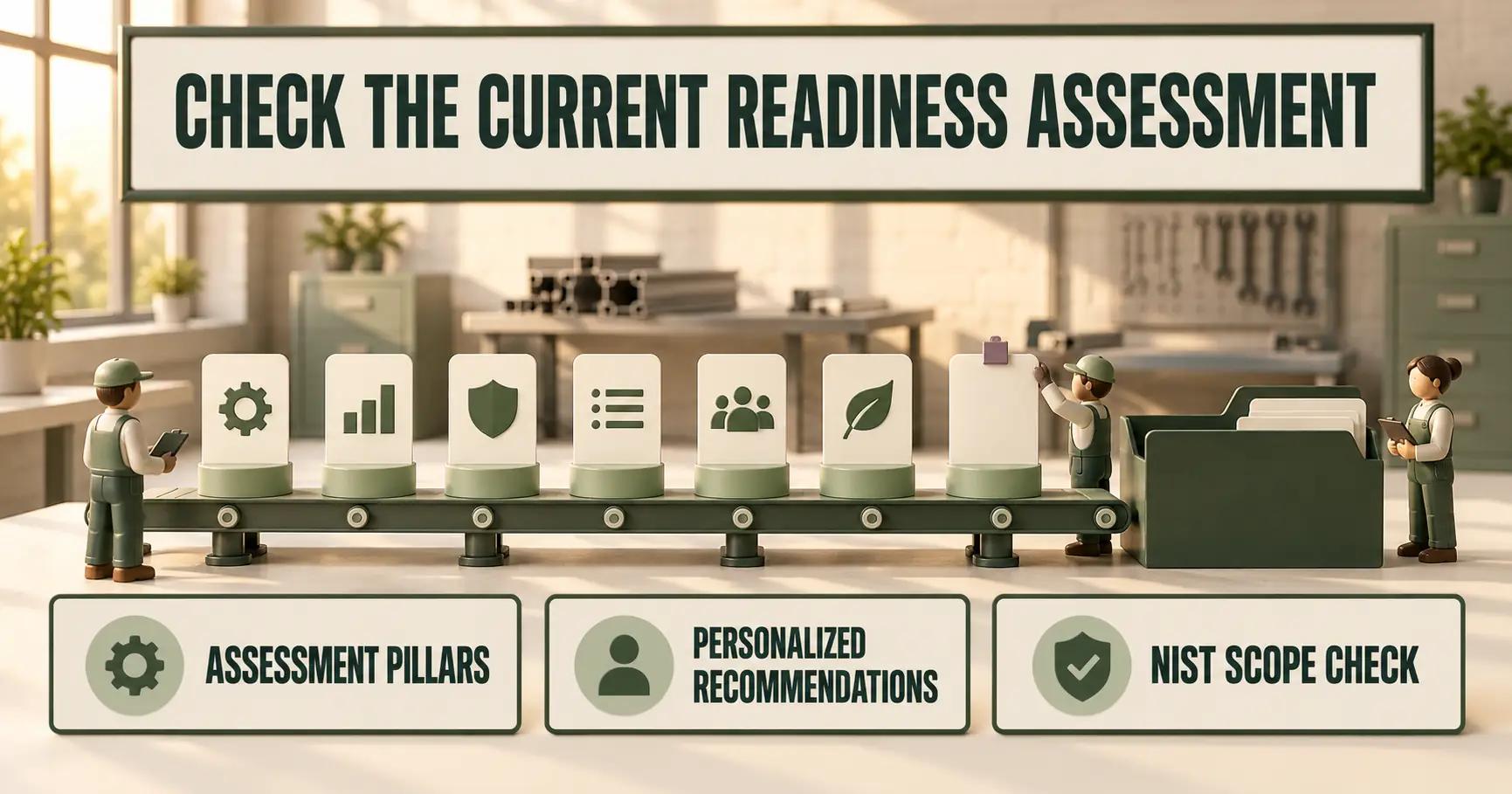
Quick Answer: Microsoft's AI Readiness Assessment covers seven pillars and offers personalised guidance and pragmatic recommendations after completion 1,2. In October 2026, check those outputs against NIST's voluntary Govern, Map, Measure and Manage Playbook 3: document purpose, users, data, training, unmeasured risks and a deployment decision tied to objectives 4,5,6,7.
Summary in a mind map
AI Readiness Assessment: What Microsoft Delivers in 2026
├─ Microsoft output
│   ├─ Seven named readiness pillars
│   ├─ Curated, personalised guidance
│   └─ Pragmatic recommendations after completion
├─ Business context
│   ├─ Name the manufacturing problem first
│   ├─ Record users, purpose and setting
│   └─ Check data, systems and process
├─ NIST scope check
│   ├─ Govern: training by responsibility
│   ├─ Measure: significant and unmeasured risks
│   └─ Manage: decide against stated objectives
└─ Next decision
    ├─ Test one bounded use case
    ├─ Keep evidence and unresolved gaps
    └─ Revisit when guidance changes
Start with the seven pillars
Microsoft's current AI Readiness Assessment covers Business Strategy, AI Governance & Security, Data Foundations, AI Strategy & Experience, the organisation and culture pillar, Infrastructure for AI, and Model Management 1. These are seven separate lenses on readiness. The business should keep the names as Microsoft presents them, then record where its own evidence sits. A generic high score cannot replace a description of the process the firm intends to change.
A metal fabrication company offers a practical example. Its operations manager wants to reduce late production handoffs between quoting, scheduling and the workshop. The company has a specific business problem, several existing systems and people who will act on a recommendation. It can use the assessment's Business Strategy pillar to frame the objective, then inspect whether the other pillars expose a gap that makes a proposed AI tool premature. This is the firm's method for using the assessment, not a promise that Microsoft will prescribe a particular application.
| Microsoft pillar 1 | Question for the fabrication team |
|---|---|
| Business Strategy | Which handoff is costly or slow? |
| AI Governance & Security | Who approves a use and its access? |
| Data Foundations | Which records are accurate enough to use? |
| AI Strategy & Experience | Who will use and review the output? |
| the organisation and culture pillar | Which staff need support to change work? |
| Infrastructure for AI | Which systems must operate reliably? |
| Model Management | Who will monitor and revise the chosen model? |
The table is a decision aid, not a quotation of Microsoft's individual questions. A team can answer each row with a named owner and evidence. If it cannot, the assessment has already done useful work by exposing a gap. Readiness is not a single permission to deploy; the separate pillars help identify which preparation belongs to which part of the business.
A useful first meeting assigns one owner to gather facts for each relevant pillar. The sales lead can explain the quote data, operations can explain scheduling, and IT can describe system access. The assessment should not be completed by one enthusiastic buyer guessing at another team's work. Where the answer is unknown, the team should record that uncertainty explicitly and decide how it will be checked.
Examine data, systems and models
Three pillars are especially concrete for the fabrication example: Data Foundations, Infrastructure for AI and Model Management 1. They should be read together without collapsing them. Data Foundations asks whether the inputs can support the intended decision; infrastructure concerns the systems that must run; model management concerns continuing oversight of the chosen model. A tidy demonstration using a small clean sample says little about the quality of the full order history.
The team can build a narrow inventory for the delayed-handoff problem. It might name the quote record, promised delivery date, current production schedule and any manual spreadsheet that bridges them. For each item, note the system of record, person who can correct it and proportion of sample cases with missing data. Those are proposed measurements for this company, not published Microsoft output fields. They help the team make an assessment recommendation actionable.
NIST MEP advises manufacturers to identify the actual manufacturing problem and evaluate available data, systems and processes before selecting an industrial AI tool 8. That order matters here. If the scheduling system has stale status data, a model trained to predict delays from it may simply restate old errors. The first improvement might be a reliable handoff field rather than a new model. The assessment can reveal a candidate area, while the process and data check decides what to test next.
The model-management question should also have an owner before any trial. Who notices that output quality changes? Who can pause use? What record shows which version produced a disputed suggestion? These are questions for the company's operating plan. The cited Microsoft page names Model Management as a pillar 1; it does not certify that a particular product or internal process answers them. The business must make the roles real.
| Readiness area | Sample evidence | Decision if missing |
|---|---|---|
| Data Foundations 1 | Field inventory and missing-record sample | Repair inputs before testing predictions |
| Infrastructure for AI 1 | System access and handoff map | Define a stable test environment |
| Model Management 1 | Named reviewer and change record | Assign monitoring before deployment |
A narrow evidence table prevents a broad assessment label from becoming a shopping list. It also makes a later review possible: the company can see which gap was closed and which merely moved into an implementation project.
Read the recommendations precisely
Microsoft says the assessment offers curated, personalised guidance and, after completion, pragmatic recommendations based on the organisation's specific needs 2. That is the published deliverable. The page does not, by that statement alone, promise a fixed workbook, technical architecture, procurement shortlist or certificate. If a buyer needs one of those artefacts, it should ask whether it is available and who will produce it, rather than describing it as an automatic assessment output.
For the fabrication team, a recommendation can become a decision record with four fields: the recommendation as displayed, the pillar to which it relates, the evidence already held and the next owner action. That structure keeps the source separate from the company's interpretation. If a recommendation speaks to data quality, the operations manager can attach the field sample. If it points to governance, the business can identify who approves the proposed trial. No unstated Microsoft promise is needed.
The company should also distinguish a recommendation from a priority. A recommendation may identify a sensible area, but the firm must decide whether that area advances the handoff objective, whether it can obtain reliable evidence and what it would displace. An inexpensive assessment can still lead to an expensive project if the team skips this decision. NIST's management guidance ties deployment to purpose and stated objectives 7, so the decision record should explain why the recommended step serves those objectives.
There is value in keeping recommendations the business declines. A declined item can have a reason: no relevant use case, insufficient data, an unavailable owner or risk that the firm cannot yet measure. Keeping the reason helps prevent the same idea reappearing later as if it were new. This is the company's governance practice, not an additional deliverable promised by the assessment page.
Document purpose and setting
NIST MAP 1.1 calls for documenting intended purpose, potential benefits, users and the settings where an AI system will operate 4. Apply that check to any use that comes out of the assessment. The fabrication company should avoid a label such as “AI for operations” and instead write the decision it hopes to improve: alerting a planner when a quoted lead time conflicts with current workshop capacity.
The intended user might be the planner, with the sales representative seeing an approved update. The operating setting includes the systems from which the signal is drawn and the point at which a person acts. A potential benefit might be fewer late handoffs, while a plausible downside is a false warning that delays a valid order. These are candidate descriptions for the company to validate. The NIST action requires the context to be understood and documented; it does not approve any assumed benefit 4.
This statement of purpose gives a small test a boundary. The team can say which orders are in scope, what recommendation the system may produce, and what remains a human decision. It can also set an exclusion: the tool will not promise a delivery date directly to a customer during the first trial. The boundary helps evaluate an outcome. Without it, a successful demonstration may merely show that a model produces fluent text.
NIST MEP's manufacturing guidance reinforces the sequence from problem to tool 8. A company should first ask whether the existing process is defined and whether its data can show the problem. If the delay is caused by approvals arriving after the schedule closes, a simple workflow change might address it. An AI proposal still needs a reason tied to that business problem. The assessment is a starting point for this inquiry, not a substitute for it.
The documentation should be short enough for the people who operate the process to correct it. A one-page use-case record with purpose, users, data, setting, expected benefit and known limitations is more useful than a general maturity slogan. Each statement should have an owner and, where possible, an observation from actual work.
Name training and risk gaps
NIST GOVERN 2.2 recommends risk-management training that enables personnel and partners to fulfil their responsibilities 5. The relevant question is not merely whether anyone attended an AI webinar. The planner who reviews a warning needs to know what the system can and cannot infer; the manager approving deployment needs to understand the evidence threshold; IT needs to recognise access or monitoring failures. Training should follow the responsibility each person will carry.
The fabrication company can make a role table before a pilot. It might list the planner as output reviewer, the operations manager as decision owner and IT as technical operator. For each role, state the action and the failure it must recognise. A person asked to approve an alert without access to the underlying schedule cannot perform that responsibility well. The table reveals missing access as well as missing knowledge.
NIST MEASURE 1.1 prioritises measuring significant AI risks and documenting risks that cannot or will not be measured 6. That instruction prevents an empty dashboard from being presented as evidence of safety. For the handoff example, the company might measure false warnings in sample orders and time lost to manual correction. If it cannot yet measure a downstream customer effect, the record should say so and explain how the decision will be limited while that gap exists.
| Role | Responsibility | Training or evidence gap |
|---|---|---|
| Planner | Review each proposed warning | Understand input age and false alerts |
| Operations manager | Approve trial scope and outcome | Read risk and benefit measures |
| IT operator | Control access and restore service | Test monitoring and recovery |
The table is the company's proposed control plan, grounded in NIST's training and measurement actions 5,6. It is not a claim that a particular training course satisfies every duty. The team should revise it after observing the pilot. If a new partner gains access or a new decision uses the output, the responsibilities and training needs change too.
A risk left unmeasured should be visible to whoever decides whether to continue. A note saying “not measured because the sample contains no peak-season jobs” is more informative than silence. It also identifies the next test. The point is to keep uncertainty in the decision record rather than turning it into a positive score.
Use NIST while the framework changes
NIST describes its AI RMF Playbook as voluntary suggested actions across Govern, Map, Measure and Manage, and says organisations can select suggestions appropriate to their needs 3. NIST also says it plans to update the Playbook after the AI RMF 1.0 revision 3. A business in October 2026 should therefore record which version it consulted and avoid calling a present checklist a permanent compliance certificate.
The four functions can serve as a scope check for Microsoft's recommendations. Map asks whether the proposed use and operating context are documented 4. Govern asks whether responsible people and their training are identified 5. Measure asks whether significant risks and non-measured risks are visible 6. Manage asks whether the deployment decision is tied to purpose and stated objectives 7. This is a practical crosswalk of the cited actions, not an assertion that Microsoft formally maps its seven pillars to NIST.
The fabrication team can place each recommendation in a table with one or more NIST questions. A data recommendation may require a Map description of where the input comes from and a Measure note about missing records. A governance recommendation may require a named decision owner and training plan. Where no current recommendation answers a significant question, the table records a gap. That gap does not discredit the assessment; it defines work outside its published output.
| NIST function 3 | Evidence from the cited action | Owner question |
|---|---|---|
| Map 4 | Purpose, users and setting | What decision is the tool for? |
| Govern 5 | Training by responsibility | Who can use and review it? |
| Measure 6 | Significant and unmeasured risks | What remains uncertain? |
| Manage 7 | Purpose-linked deployment decision | Has the trial met its objective? |
The business should revisit this crosswalk if NIST publishes a revised Playbook. Until then, the current suggestions can guide an internal review without being presented as mandatory law. A source date and decision date on the worksheet make that limitation clear to a later reader.
Decide whether a trial is ready
NIST MANAGE 1.1 links the deployment decision to whether the system achieves its purpose and stated objectives 7. For the fabrication example, the objective must be stated before the pilot: perhaps to identify a specific class of late handoff early enough for a planner to intervene. The team should define the evaluation cases and the acceptable result in advance. Otherwise it can move the target after seeing an attractive demonstration.
A readiness assessment can inform this decision through its recommendations, but it cannot observe the firm's future pilot for it 2. The operations manager needs evidence from the actual setting: sample orders, data quality, reviewer time, false alerts and the way staff respond. The decision can be to proceed, narrow the use, repair data first or stop. Each is a valid outcome if its reason follows the stated purpose and evidence.
The final record should identify who made the decision, what evidence they considered and which risk remained unmeasured. That makes a later change review possible. If the tool is deployed in a different workshop or with another data source, the original conclusion should not be copied without a new context check 4,6.
What this cannot decide
Microsoft's page establishes seven pillars and the promise of curated guidance and pragmatic recommendations 1,2. It does not establish that a particular company is ready to buy a model, that every recommendation will fit its operations or that it receives a specified architecture document. NIST's voluntary Playbook provides a structured scope check, not a substitute for the company's evidence and decision 3.
An assessment also cannot determine whether a data-protection or rights-impact assessment is needed for every possible use. Those are separate questions tied to the use and jurisdiction. The company can read the data protection impact assessment and fundamental rights impact assessment explanations when its proposed use raises those issues. For the business sequence, see the AI opportunity assessment and implementation roadmap.
What to do next
Complete the current assessment with the people who know the process, preserve its recommendations, and map each proposed action to purpose, owner, evidence and risk gap. Test one bounded fabrication handoff before approving a broader rollout 4,7. For a separate next step in assessing the firm's AI starting point, use AI Foundation Audit.
In words, the tree branches like this: name the business problem, read the seven-pillar recommendations, document purpose and setting, assign training and risk measures, then decide whether a bounded trial meets its stated objective.
Frequently Asked Questions
What does Microsoft's AI Readiness Assessment deliver?
Which seven pillars does the assessment cover?
Is the NIST AI RMF Playbook mandatory for this assessment?
What should a readiness check say about the use case?
How should training and unmeasured risk appear?
Does an assessment recommendation approve deployment?
Sources
- 1.Assessments | AI Readiness Assessment — Microsoft · 2026
- 2.Assessments | AI Readiness Assessment — Microsoft · 2026
- 3.NIST AI RMF Playbook | NIST — NIST · 2026
- 4.Map - AIRC — NIST · 2026
- 5.Govern - AIRC — NIST · 2026
- 6.Measure - AIRC — NIST · 2026
- 7.Manage - AIRC — NIST · 2026
- 8.Artificial Intelligence- Key Consideration and Effective Implementation Strategies — NIST · 2026
Want this run on your business?
AI Foundation Audit — a structured assessment of your AI footprint: integration risks, governance gaps, ROI opportunities. Delivered as a comprehensive report you can act on.
You receive your AI Opportunity Report and Implementation Brief — tailored to your business and delivered immediately.