The AI-Native Company: AI in Every Workflow, Governed
An AI-native company runs AI in every workflow with humans at the right checkpoints — one governed operating layer over unified data. Here is the model.
Most companies now use AI somewhere. Far fewer are built around it. The common pattern is to bolt a model onto a task, a chatbot here and a copilot there. The underlying processes, data, and decisions stay exactly as they were. An AI-native company is organised the other way around. AI runs in every workflow by default, people sit at the decisions that actually need them, and the whole thing operates over one shared, governed layer rather than a drawer of disconnected tools. Adoption has gone mainstream. The question that now separates companies is not whether they use AI, but whether AI is how the work runs 1.
Quick Answer. An AI-native company runs AI in every workflow as the default operating model: one orchestration layer of agents and automation over unified data, humans at the right checkpoints, governance and an audit trail built in. AI is how the work runs, not a feature added on top.
What an AI-native company actually is
The phrase gets used loosely, so it is worth being precise. Using AI and being AI-native are different things. A company that uses AI adds point solutions to individual tasks. The work, the data, and the decisions underneath are unchanged, and each tool lives on its own island. A company that is AI-native treats AI as the operating model. A single layer of agents and automation runs across functions, draws on shared data and memory, and surfaces a person only where judgement, accountability, or an exception requires one.
Two ideas hold the definition together. The first is coverage: AI is present in every workflow as the default, not reserved for a flagship use case. The second is placement of humans: people are positioned at the right checkpoints rather than removed or, at the other extreme, left supervising everything. International standards describe an AI system as one that infers from inputs to produce outputs and acts with varying levels of autonomy 3. They also name the human-oversight roles that sit around it. An AI-native company is deliberate about both: what the system does autonomously, and where a person must sign off.
This is an operating-model question, not a tooling question. You do not become AI-native by buying more AI products. You become AI-native by changing how work flows through the organisation, and by governing that flow so it stays trustworthy as it scales.
The operating model: one AI layer across every workflow
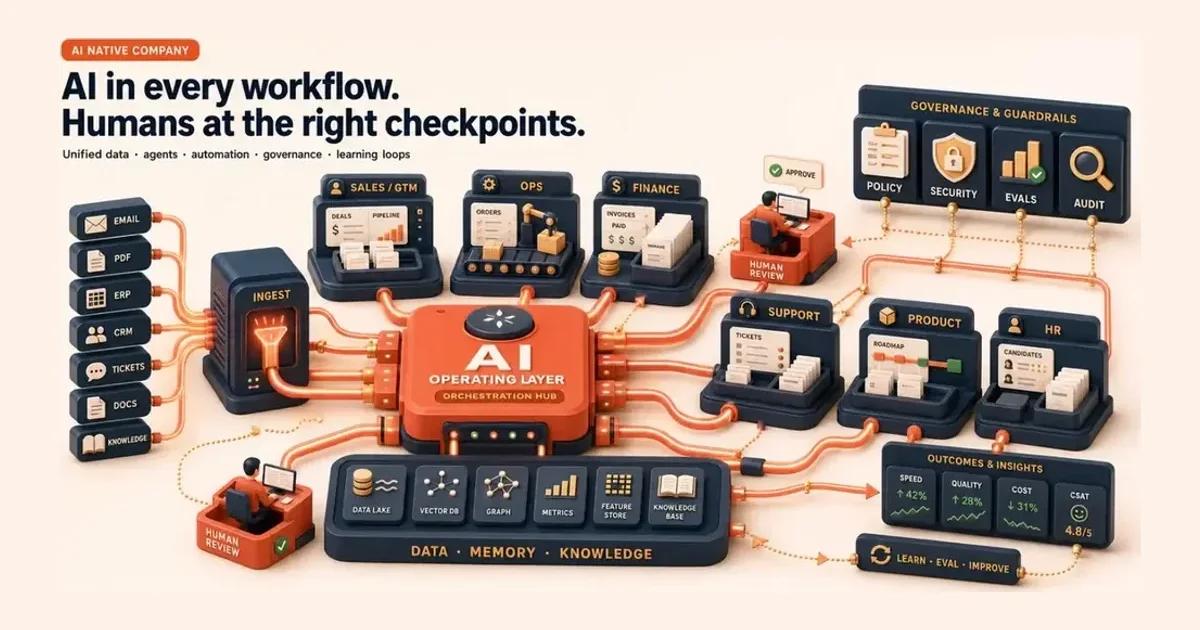
Picture the company as a single pipeline rather than a set of silos. Inputs arrive in every format an organisation actually handles: email, PDFs, records from an ERP or CRM, support tickets, documents, internal knowledge. They feed an AI operating layer, the orchestration hub where agents and automation interpret the input, decide what needs to happen, and route the work to the function that owns it. That means sales, operations, finance, support, product, people. Under it sits a shared foundation of data, memory, and knowledge that every workflow reads from and writes back to. The organisation compounds what it learns instead of relearning it in each tool.
In plain terms, the loop runs like this:
- Unified inputs from every channel land in one place rather than scattered inboxes and systems.
- The AI operating layer, agents plus deterministic automation, interprets and orchestrates the work across functions.
- Each decision either executes automatically (high-volume, rule-bounded, low-risk) or passes a human checkpoint (consequential or ambiguous).
- Everything runs under governance, meaning policy, security, evaluations and an audit trail, and produces measured outcomes that feed a learning loop back into the layer.
The mix of agents and deterministic automation matters. Agents bring judgement on messy, unstructured input, while rules-based automation gives reliable, auditable execution on the predictable parts. Choosing which is which, workflow by workflow, is most of the design work. It is the same discipline as deciding which processes to automate first and whether a step belongs to rules-based automation or an AI agent. The 2025 wave of enterprise AI has centred on exactly this shift from standalone assistants toward orchestrated, agentic workflows 2.
Humans at the right checkpoints
"AI in every workflow" is not "autonomy everywhere." The defining discipline of an AI-native company is putting people at the checkpoints that matter and letting automation own the rest. A checkpoint is a deliberate place where a human reviews, approves, or overrides before something irreversible or high-stakes happens: a payment, a customer-facing commitment, a hiring decision, anything where a silent error is expensive. Routine, reversible, high-volume steps run without a person in the loop; the judgement is spent where it changes the outcome.
This is not a soft preference. Risk frameworks and standards treat human oversight as a core control of any AI system. They define the oversight relationships, a person in the loop or on the loop or over the loop, precisely so organisations design them on purpose rather than by accident 3,5. Designed well, oversight widens what you can safely automate, because a reviewable draft-then-approve pattern lets you take on work that full hand-off would make too risky. Designed badly, or omitted, it is where AI-native ambitions quietly fail. Getting this right is its own craft, covered in the discipline of human-in-the-loop design.
The goal is leverage, not abdication. People stop doing the sorting, drafting, and re-keying, and spend their attention on the decisions, exceptions, and relationships that actually need a human.
Governance, accountability, and compliance by design
Here is the advantage that is easy to miss. An AI-native company runs every workflow through one governed layer, with policy, security, evaluations, oversight logs and an audit trail produced as a by-product of normal operation. So governance stops being a bolt-on and becomes a property of the architecture. Established frameworks give that layer its shape. The NIST AI Risk Management Framework organises it into govern, map, measure, and manage functions 5. ISO/IEC 42001 turns it into a certifiable management system with concrete controls 6. The OECD's AI Principles set the internationally agreed expectations of accountability, transparency, robustness and human-centred values that most regimes now echo 7.
The strategic payoff is scalability and flexibility to comply. The evidence of how decisions were made already exists: what data was used, what the model did, where a human signed off and how the system was evaluated. Adopting a new standard or satisfying a local regulation then becomes largely a matter of configuration, not a rebuild. Whatever applies in a given market is then a question of mapping existing evidence to a specific obligation. Regional regulation is tightening in exactly this direction. The EU's AI Act introduces risk-based obligations on AI systems 8, and data-protection law such as the EU's GDPR already requires accountability, records, and oversight of automated decisions 9. But the point for an AI-native company is structural rather than regional: build the governed layer once, and you can meet the standard or rule that applies to you far faster than a competitor retrofitting controls onto disconnected tools. Turning that operational evidence into the formal, regulator-ready documentation a specific regime expects is the natural next layer to add once the operating model is in place. The broader regulatory picture is mapped in our guide to AI governance and the rules that apply.
Audit and measurement without a manual engagement
The way you verify all this has to change too. In a traditional organisation, governance and process performance are checked by a periodic manual audit. That is a consulting engagement that interviews people, gathers documents, and samples a moment in time, then starts going stale the day it is delivered. That model fits a company where the work lives in people's heads and scattered systems. It does not fit an AI-native one.
When every workflow runs through a governed operating layer, the raw material of an audit already exists. That is what data was used, what the system decided, where a human signed off, how it was evaluated, what it cost, and what changed. Measurement and assurance become a generated, continuous artifact rather than a manual reconstruction after the fact. The question shifts from "can we pass an audit next quarter" to "what does the layer show right now." Process measurement that once took weeks of interviews is produced from the operating layer itself.
So what a company becoming AI-native, or founded that way, actually needs to adopt is not a bigger audit function but a governance layer that productizes the audit. Instead of commissioning a bespoke engagement each time, you stand up a layer that generates the analysis and the documentation as outputs. That is the role the AI Priority Map platform is built to play for AI-native companies and those mid-transition. The AI Foundation Audit productizes the opportunity side. It measures and ranks where AI pays back across your workflows from a short guided wizard rather than a multi-week study. GDPR Documentation productizes the accountability side, turning the governed layer's evidence into the formal, standards-ready documentation a given regime expects. Both replace a manual audit with a generated one, and both assume the operating model this article describes.
The foundation: data, memory, and knowledge
An AI operating layer is only ever as good as what sits beneath it. The foundation of an AI-native company is a shared data, memory and knowledge layer. That is a data lake for raw and processed records, a vector store and knowledge base for retrieval, a graph for relationships, metrics for measurement, a feature store for reuse. Its job is to let every workflow draw on the same reliable context and to accumulate what the organisation learns instead of stranding it inside individual tools.
Most ambitions actually stall here, not on model capability but on the data and integration work underneath. Research on digital transformation is consistent that the binding constraints are data quality, skills, and the capacity to integrate and operate new tools, not the technology itself 10. Two practical consequences follow. First, automating on top of unreliable data does not save work. It generates confident errors at scale. Second, the data foundation is an investment that compounds. Every workflow added to a clean, shared layer is cheaper and more reliable than the last. An AI-native company treats that foundation as core infrastructure, not a side project.
The evidence: what changes when you run this way
The case for the model is not hype. It is measurable, when you measure it honestly. In one large controlled study of customer-support agents using an AI assistant, productivity rose about 14% on average, and roughly 34% for newer and lower-skilled workers 4. The assistant effectively spread the know-how of the best performers across the team. That last mechanism is the AI-native one in miniature. Capability is captured once in the operating layer, then available everywhere.
Two cautions keep this useful. First, the size of the gain depends on the task, the data and the oversight design. The same intervention helps a structured, high-volume workflow far more than a judgement-heavy one. Second, treat any published percentage as evidence the mechanism works, not as a number you will hit. The honest practice is to measure speed, quality, cost, and satisfaction on your own workflows, against your own baseline, and prove the number in your environment before you scale it. Adoption is now mainstream 1. Advantage comes from running the model with discipline, not from having AI at all.
When "AI-native" is the wrong label
| Condition | Why AI-native is the wrong move now |
|---|---|
| Processes are broken or undocumented | An operating layer on top of them makes a poor outcome arrive faster |
| The data is unreliable | Every workflow inherits the unreliability |
| Nobody owns policy, evaluations or the audit trail | "AI in every workflow" becomes ungoverned risk in every workflow |
| The decision must stay human | Some choices carry a silent-error cost that is simply unacceptable |
AI-native is a direction, not a badge, and it is the wrong move for some companies, at least for now. If the underlying processes are broken or undocumented, building an operating layer on top of them just makes a poor outcome arrive faster. If the data is unreliable, every workflow inherits the unreliability. If there is no appetite to govern, with no one owning policy, evaluations or the audit trail, then "AI in every workflow" becomes ungoverned risk in every workflow. And some decisions should stay deliberately human, with AI nowhere near them, because the cost of a silent error is unacceptable.
There is also a sequencing trap. Trying to become AI-native everywhere at once, before the data foundation and oversight patterns exist, tends to produce a sprawl of half-governed automations that are hard to trust and harder to unwind. The companies that get there do the opposite. They earn the operating model one well-scoped, well-governed workflow at a time. Naming where the model does not yet apply is part of the discipline, not a failure of ambition.
How to become AI-native
The path is sequential, and it rewards restraint. First, rank where AI actually pays back rather than automating the loudest idea. A structured opportunity assessment scores candidate workflows on return, suitability, and risk, so the first move is made on evidence. Second, run one workflow end to end: unified data in, an agent or automation doing the work, a human checkpoint on the consequential step, an audit trail, and measurement against a baseline. Third, govern from day one, so the records and evaluations exist from the first workflow rather than being retrofitted. Fourth, close the learning loop, feeding outcomes back so the layer improves, and only then expand. A phased implementation roadmap sequences that expansion without betting the company on a single leap.
Find your first move. Before building anything, see where AI genuinely pays back. The AI Foundation Audit scores every repeatable workflow in your organisation and ranks the top opportunities by return, suitability, and risk, then ships a phased implementation roadmap. It runs from a short guided wizard, with a fast turnaround and a money-back guarantee if no opportunity with measurable savings is found. Start with the sample report, or begin the audit — on the AI Priority Map platform at aiprioritymap.com.
Becoming AI-native is less a technology project than an operating-model decision. AI in every workflow, humans at the right checkpoints, one governed layer over unified data, improving on a loop. Done with discipline, governance and the ability to meet whatever standard applies come built in. That, as much as the speed, is the advantage.
Summary
The AI-Native Company — AI in every workflow, governed
│
├─ The operating model
│   ├─ Ingest — email, PDF, ERP, CRM, tickets, docs
│   ├─ Orchestrate — agents + automation route the work
│   └─ Workflows — sales, ops, finance, support, product, HR
│
├─ Humans + guardrails
│   ├─ Checkpoints — people approve, not every step
│   ├─ Governance — policy, security, evals, audit
│   └─ Accountability — records, audit trail, sign-off
│
└─ Foundation + payoff
    ├─ Data · memory · knowledge — lake, vector, graph
    ├─ Outcomes — speed, quality, cost (measure your own)
    └─ Learning loop — learn · eval · improve
Related insights
- Which Processes to Automate First — how to choose the first workflow on evidence, not noise.
- Human-in-the-Loop Design Discipline — putting people at the right checkpoints.
- AI Governance and the Rules That Apply — turning the governed layer into compliance.
- AI Implementation Roadmap — sequencing the rollout without a single risky leap.
- AI Opportunity Assessment — the method behind ranking where AI pays back.
Last updated: June 2026. Version 1.0.
Frequently Asked Questions
What is an AI-native company?
How is an AI-native company different from a company that uses AI?
Does being AI-native mean removing humans from the work?
What does an AI-native company need in place first?
Is an AI-native operating model only for large enterprises?
How does an AI-native company stay compliant across different regions?
What outcomes should an AI-native company measure?
Where should a company start to become AI-native?
Sources
- 1.The 2026 AI Index Report — Stanford University, Institute for Human-Centered AI (HAI) · 2026
- 2.The State of AI: Agents, Innovation, and Transformation (Global Survey) — McKinsey & Company (QuantumBlack) · 2025
- 3.ISO/IEC 22989:2022 — Information technology — Artificial intelligence — Concepts and terminology — ISO/IEC (JTC 1/SC 42) · 2022
- 4.Generative AI at Work (NBER Working Paper No. 31161) — National Bureau of Economic Research; Quarterly Journal of Economics · 2023
- 5.Artificial Intelligence Risk Management Framework (AI RMF 1.0) — US National Institute of Standards and Technology (NIST) · 2023
- 6.ISO/IEC 42001:2023 — Information technology — Artificial intelligence — Management system — ISO/IEC (JTC 1/SC 42) · 2023
- 7.OECD AI Principles (Recommendation of the Council on Artificial Intelligence) — OECD · 2024
- 8.Regulation (EU) 2024/1689 (Artificial Intelligence Act) — European Union (EUR-Lex, Official Journal) · 2024
- 9.Regulation (EU) 2016/679 (General Data Protection Regulation) — European Union (EUR-Lex, Official Journal) · 2016
- 10.The Digital Transformation of SMEs — OECD · 2021
Want this run on your business?
AI Foundation Audit — a structured assessment of your AI footprint: integration risks, governance gaps, ROI opportunities. Delivered as a comprehensive report you can act on.
You receive your AI Opportunity Report and Implementation Brief — tailored to your business and delivered immediately.