AI governance software: evidence to request in 2026
Assess AI governance software by asking for system records, test evidence, production monitoring and third-party controls against NIST's current Playbook.
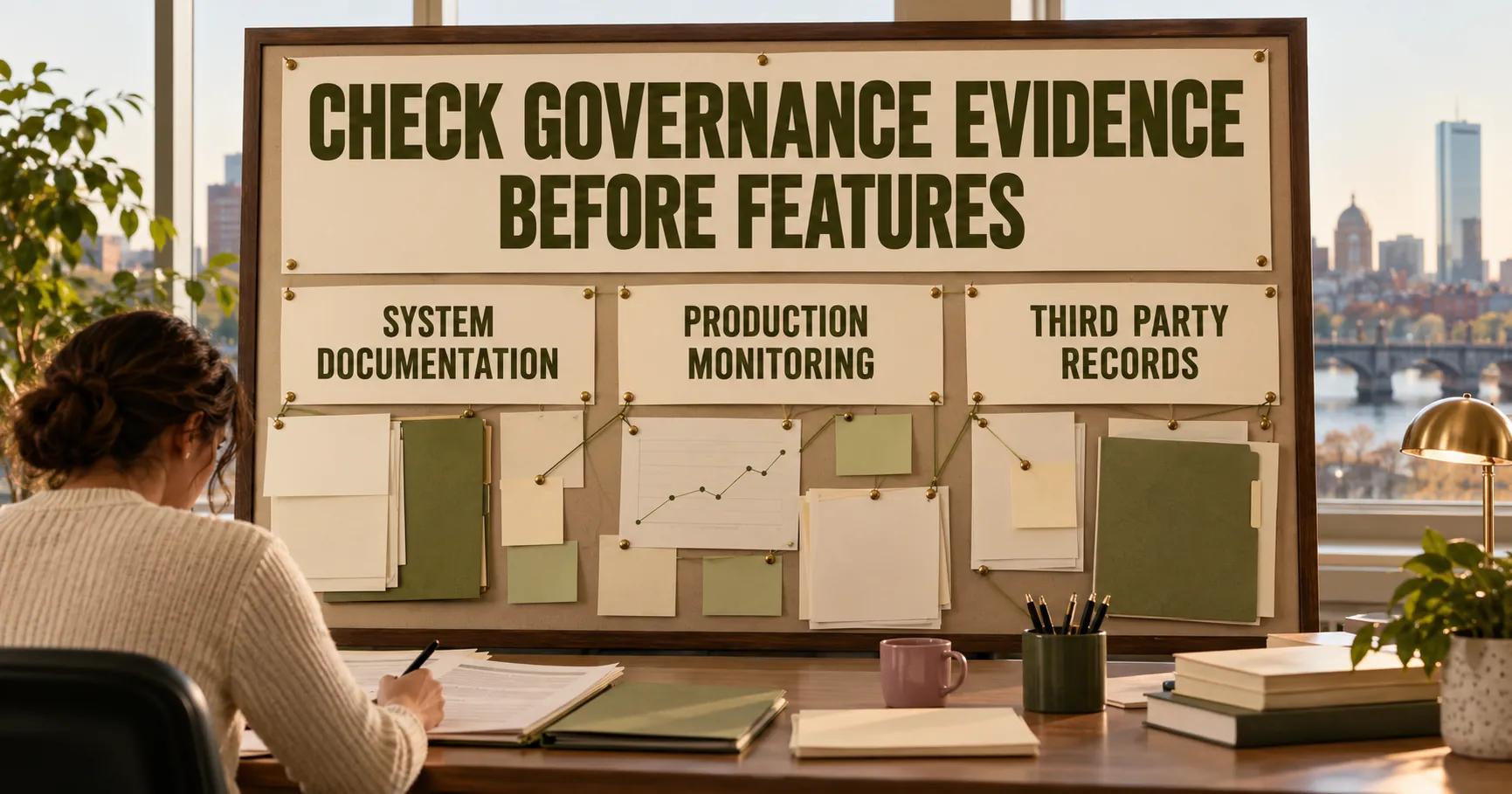
Quick Answer: AI governance software should show system documentation, test evidence, production monitoring and third-party records. NIST recommends business justification and limitations under GOVERN 1.4, production comparison under MEASURE 2.4, and third-party documentation under MANAGE 3.1 1,2,3. The assessment uses AI RMF 1.0 because NIST is revising it4.
Summary in a mind map
AI governance software: evidence to request in 2026
│
├─ Identify the system
│   ├─ Record purpose, owner and assumptions
│   └─ Link limits to test evidence
│
├─ Measure after launch
│   ├─ Keep a pre-deployment baseline
│   └─ Record production differences
│
├─ Manage dependencies
│   ├─ Name third-party technology and people
│   └─ Trace a change to its review decision
│
└─ Inspect the export
    ├─ Keep the AI RMF 1.0 reference date
    └─ Let a second reviewer follow the links
Define the governance outcome
A procurement team can spend a demonstration watching screens that never answer whether the organisation can explain one AI system. The evidence outcome comes first. The system record should show why the system exists, what assumptions and limits apply, how it was tested, and what deployment and monitoring are planned. Those are the kinds of documentation NIST recommends in GOVERN 1.4 1. One system should be traceable through those entries.
The test is deliberately concrete. In a Boston logistics firm, a team might assess an AI system used to sort incoming work requests. The example is a proposed review scenario, not an assertion that the firm uses such a system. The buyer names its purpose, owner and limitation, then asks the demonstrator to connect these to test evidence. If the fields are filled with generic placeholder text, the demonstration has not shown the organisation's actual process.
Evidence should be findable by a reviewer who did not build the record. A screen that says "tested" but cannot identify the test, result or date gives too little to assess the recommendation. Conversely, a tool with few visual features may still support the work if it reliably connects the record to the underlying decision. The outcome matters more than the number of menus.
| Outcome to test | NIST Playbook basis | Evidence to request |
|---|---|---|
| Explain one AI system | GOVERN 1.4 1 | Purpose, assumptions, limits and test reference |
| Observe it after launch | MEASURE 2.4 2 | Production observation linked to prior test |
| Manage external inputs | MANAGE 3.1 3 | Third-party technology and responsibility record |
Fix the NIST reference version
NIST says AI RMF 1.0 is being revised4. This fact should change the scorecard header. The scorecard should state "AI RMF 1.0" and the date on which the Playbook pages were checked. A buyer should not ask vendors to demonstrate a hypothetical final revision or compare products against different unstated versions. If a later version becomes available, its changes deserve a separate review.
The Playbook actions used here are GOVERN 1.4, MEASURE 2.4 and MANAGE 3.1 1,2,3. State those action identifiers beside the demonstration criteria. That makes it possible to revisit a criterion without guessing which sentence of a broad framework inspired it. The source pages are guidance, not a certification that a particular product complies with NIST.
The review date also helps with software claims. A vendor may say that a feature is "NIST aligned". The buyer should ask which current action it maps to and what actual record the organisation could export. This is a procurement question, not an accusation. A clear mapping is more useful than a badge whose scope is undefined.
Connect the system and its test
GOVERN 1.4 recommends documenting business justification, assumptions, limitations, testing results, and deployment and monitoring plans1. The buyer should make the supplier demonstrate those as one connected case. Open a sample system record. Follow its test link. Confirm the test belongs to that system version. Then return to the record and see whether its stated limitation appears in the planned monitoring.
An owner field is useful because someone must keep the record current. The cited Playbook claim does not prescribe a specific job title or software permission scheme, so those are local design choices. Ask the organisation which person can approve a record and which person can challenge it. The software should show the resulting history during the trial if the supplier says it supports that workflow.
A small test package could include the intended use, an example input, the observed output and an exception. It should also state what the trial did not cover. Without that boundary, a single successful test can be mistaken for evidence across every deployment condition. The test evidence can be modest; what matters is that it is specific and linked to the purpose it was meant to assess1.
Keep production and test results together
NIST's MEASURE 2.4 recommends monitoring system behaviour in production and documenting differences from pre-deployment testing2. An attractive activity chart alone cannot answer that request. The demonstration should take one production observation and show which earlier test it is compared with. If the measure changed, the record should identify the difference and its review status.
A practical trial can use a controlled example. Record a pre-deployment result, create a later observation and ask the supplier to show the comparison. The example must be labelled as simulated if no live system is connected. This tests the process without inventing a real incident. The organisation can then decide which observations matter for its own risk, and how frequently to review them. The cited action does not supply a universal monitoring interval2.
A difference is not automatically a failure. It is a prompt to examine what changed: the inputs, use pattern, model, environment or the measurement itself. Those are diagnostic questions for the reviewer. The essential evidence is the link between the production observation and the earlier result, plus a dated decision about what the team did next2.
Document third-party inputs
MANAGE 3.1 recommends documenting third-party AI technologies, personnel and resources to help manage risk3. A buyer should therefore ask for a dependency view that identifies what comes from outside the organisation and who is responsible for it. The record could name a model provider, a connected service and a contracted reviewer where relevant to the actual system. The cited action supports documenting these dependencies; it does not prescribe one software layout.
The supplier should demonstrate what happens when a third-party component changes. Can the system owner find the affected AI record? Can a reviewer see the earlier assessment and the new decision? These are process tests. They reveal whether dependency information is maintained or merely entered once for a sales demonstration3.
A third-party list by itself does not show control. Put the relationship beside the associated risk and the local response. The firm may choose a manual review, a restricted use or another action after considering its circumstances. This article does not claim that NIST mandates any single control for all suppliers. It asks whether the decision can be followed from the evidence.
| Demonstration prompt | What a useful answer shows | Weak answer |
|---|---|---|
| Which external component is used? | Named technology and system link 3 | Unrelated supplier list |
| Who reviews its change? | Responsible role and dated decision | No owner |
| What was tested before launch? | Result linked to system version 1 | Untitled file |
| What changed in production? | Observation compared with prior result 2 | Chart without baseline |
Export the review trail
At the end of the trial, ask for an export that another reviewer can read. It should link one AI system to its justification, assumptions, limitations, test results and deployment plan1. It should also carry a dated production observation and the comparison with the earlier test2. Finally, it should identify relevant third-party technologies and responsibility records3. The exact file format is a purchasing preference; the evidential links are the point.
Try a second person on the export. Can they locate the system, its current owner and the evidence behind the decision without the demonstrator explaining each screen? If not, write down the missing link. This simple exercise tests whether the governance process survives staff turnover or a later review. It is not a formal audit standard; it is a practical check against the Playbook's documentation themes.
A demonstration environment may contain fabricated data. That is acceptable for a trial if the supplier says so. The buyer should distinguish proof that the software can create a linked record from proof that the organisation has actually populated and used one. Only the latter supports a claim about its current governance practice.
Compare products by the same case
Give every candidate the same scenario and requests. One system, one pre-deployment test, one later observation and one third-party dependency are enough to reveal the key pathways. Score whether each tool produces a usable record, whether the links survive export and whether the team can maintain them. Do not award points for a feature that does not help answer one of those questions.
This method fits a broader AI implementation roadmap and an AI opportunity assessment, which help decide what to evaluate first. Where personal data or rights impacts are involved, a data protection impact assessment or fundamental rights impact assessment may raise separate questions. Those processes should not be collapsed into a software feature checkbox.
A buyer can keep two columns: evidence actually demonstrated and follow-up still promised. A promised export is not the same as an export examined. A promised integration is not the same as one tested against the firm's own system inventory. This distinction makes a final choice more defensible.
In words, the tree branches like this: start with the named AI system and its purpose, attach its assumptions and test result, then record a production observation against that baseline. Add the third-party dependency and owner, review any difference, and export the linked record for another person to inspect.
What the review cannot decide
The cited NIST pages do not certify a software product or decide whether a particular organisation has met every legal duty1,2,3. The framework is being revised, so a scorecard dated October 2026 should not be presented as a permanent statement about future NIST text4. The demonstration can show what a product supports and what the team observed. It cannot substitute for the organisation's own decisions and maintained records.
What to do next
Write a one-system demonstration request with the four evidence groups above. Ask each supplier to complete it under the same conditions and export the result. Keep the scorecard labelled AI RMF 1.0 and dated4. For the next internal step in choosing AI work, consider AI Foundation Audit.
Frequently Asked Questions
What evidence should AI governance software produce first?
Which NIST AI RMF version should a buyer use?
What should production monitoring show?
How should third-party AI be documented?
Does an AI governance dashboard prove compliance?
What should be exported after a demonstration?
Sources
Want this run on your business?
AI Foundation Audit — a structured assessment of your AI footprint: integration risks, governance gaps, ROI opportunities. Delivered as a comprehensive report you can act on.
You receive your AI Opportunity Report and Implementation Brief — tailored to your business and delivered immediately.