What Is a Small Language Model? Gemma 4 Memory Limits
Small language model planning: compare Gemma 4 Q4_0 weights with 16 GB, allow for runtime memory and check the current model card's Apache 2.0 licence.
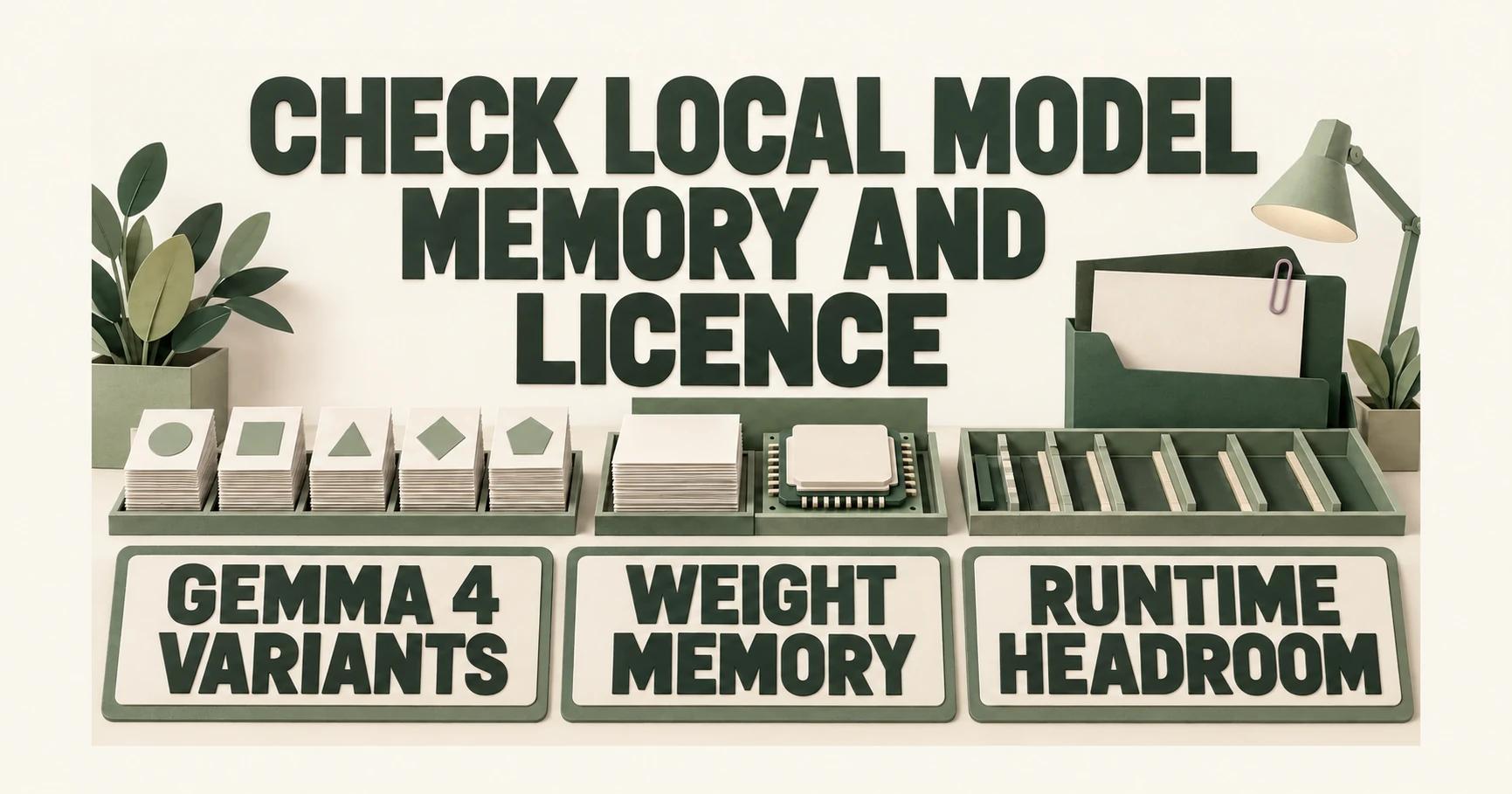
Quick Answer: Gemma 4 Q4_0 puts E2B, E4B, 12B and 26B A4B below a 16 GB weight budget; 31B exceeds it 1. Runtime software and context need extra memory 1. The model card identifies Apache 2.0 2; a small language model needs fewer computing resources 3, but test the complete deployment before choosing.
Summary in a mind map
What Is a Small Language Model? Gemma 4 Memory Limits
│
├─ Resource scale
│   ├─ Smaller models need fewer computing resources
│   └─ Test the specific business task
│
├─ 16 GB weight shortlist
│   ├─ E2B 2.9 GB; E4B 4.5 GB
│   ├─ 12B 6.7 GB; 26B A4B 14.4 GB
│   └─ 31B 17.5 GB exceeds the budget
│
├─ Complete deployment
│   ├─ Runtime software needs additional memory
│   ├─ Context cache also needs memory
│   └─ Measure the actual job on the intended computer
│
├─ Licence record
│   ├─ Gemma 4 model card: Apache 2.0
│   └─ Record the package and planned use
│
└─ Acceptance
    ├─ Weight fit is one decision
    ├─ A complete successful run is another
    └─ Check output meaning before rollout
A small language model in plain terms
A small language model is smaller in scale than a larger counterpart, with lower computing-resource needs. Eurostat's discussion uses that relative distinction 3. It does not give this business a universal boundary at which a model becomes suitable. A buyer needs to connect the resource advantage to a defined job, then test the actual output required for that job.
A language-technology conference presentation describes small models as efficient for certain tasks and suitable for smaller devices and purpose-built applications 4. OLAF also reports training on offline small language models, including privacy, prompting and optimisation 5. These are reasons to consider a local trial. Neither source establishes that the translation agency in this example will obtain a particular quality, speed or saving.
The proposed agency use case is a draft of a short client-facing summary from approved non-sensitive sample text. The agency would define what the summary must preserve and have a qualified person check omissions and meaning. A model that loads successfully but changes a key qualification would fail that content test. Resource fit and useful output are separate acceptance decisions.
For broader terminology, the existing German explanation of large language models provides related reading. The comparison of local and cloud models addresses a separate deployment decision.
Gemma 4 variants and a 16 GB weight budget
Google publishes five Gemma 4 sizes: E2B, E4B, 12B, 26B A4B and 31B 1. The table compares its Q4_0 loading estimates with the question's 16 GB allowance. The remaining amount is simple subtraction, not a measured runtime reserve. It should be labelled that way in a purchasing sheet.
| Gemma 4 variant | Published Q4_0 estimate | 16 GB minus that estimate | Weight-only shortlist |
|---|---|---|---|
| E2B | 2.9 GB | 13.1 GB | Below budget |
| E4B | 4.5 GB | 11.5 GB | Below budget |
| 12B | 6.7 GB | 9.3 GB | Below budget |
| 26B A4B | 14.4 GB | 1.6 GB | Below budget, little arithmetic margin |
| 31B | 17.5 GB | −1.5 GB | Exceeds budget |
The source values are Google's published estimates, checked against the cited overview for this October 2026 comparison 1. The shortlist answers only the weight-budget question. It does not declare any row a successful deployment on the agency's workstation. The 31B estimate exceeds the stated allowance by 1.5 GB before the agency has demonstrated an operating configuration.
The proposed decision record should keep the budget definition explicit. If the owner intended 16 GB for the entire computer rather than for model loading, that is a different constraint. The team should correct the specification before buying hardware or promising local processing. The table should not be relabelled as a list of computers on which the models are guaranteed to run.
Runtime memory and the context window
Google explains that its estimates concern static weights, while supporting software and the context-window cache consume additional memory 1. The context cache holds information associated with the material being processed and generated. The business should therefore assess the intended request, rather than a loading screenshot alone. A brief test prompt is not a substitute for the agency's document job.
A memory result should describe the complete request, including input length and requested output. If a document job fails, shortening its sample changes the question being tested. The failure point remains relevant evidence: a smaller successful task may be useful, but it establishes feasibility only for that narrower task, not for the original document workload.
The 26B A4B row deserves particular care in this budget. Subtracting 14.4 from 16 leaves 1.6 GB arithmetically 1. That remainder does not establish that the runtime and intended context fit. A trial should demonstrate the complete job under the operating conditions the team intends to use. The article supplies no invented universal allowance to add to every model.
The current Gemma 4 model licence
The Gemma 4 model card identifies Apache 2.0 and describes open-weight pretrained and instruction-tuned variants 2. The company should identify which variant and package it intends to approve. A family name in a slide deck is not an adequate record of what was downloaded and used.
For the agency's proposed trial, the approval record should keep the model identifier, package origin, licence reference and the planned use together. The responsible person can then assess the actual terms against that use. The record should not assume that an earlier model generation supplies the current answer. It also should not turn “open weights” into an unqualified statement that every possible use has been approved.
A shortlist is not a tested deployment
The weight table cannot decide output quality, runtime speed or workstation reliability for this agency. Those questions need an observed test. The agency should preserve the source sample and a checked expected result, then evaluate both technical completion and meaning. Loading is only the start. A successful launch followed by a summary that drops the client’s central qualification, reverses a comparison or loses a necessary condition is still a failed trial for the agency’s stated use case, even if the program completes without displaying a technical error.
What to do next
The agency should complete one checklist before deciding on a purchase or rollout:
- Scope: define the memory budget and one representative task, including the input sample, expected result and required output length.
- Package: record the model identifier, downloaded format, precision, package origin and licence reference so the candidate can be identified again.
- Memory: run that exact workload in the selected runtime and record peak memory, completion or the failure point, without silently shortening the sample.
- Quality: compare the output with the checked expected result, recording omissions, changed meanings and lost qualifications separately from technical completion.
- Decision: retain one deployment record stating whether the weights fit, the complete job runs and the output meets the content standard; base the next purchase or rollout on those results.
A change to the model, input size or required output calls for the corresponding checks to be repeated. A candidate that fails one check can be assessed for a different task, with that narrower scope stated in the new decision.
Frequently Asked Questions
Does a small language model automatically suit every local business task?
Are Gemma 4 1B, 2B, 4B and 16B the published variant names?
Does 16 GB of computer memory mean a 16 GB model-weight budget?
Is the 26B A4B label evidence that only 4B of weights need loading?
Does the Gemma 4 licence match a remembered Gemma 3 licence?
Sources
- 1.Gemma 4 model overview — Google · 2026
- 2.Gemma 4 model card — Google · 2026
- 3.An introduction to Large Language Models and their relevance for statistical offices — Eurostat · 2024
- 4.Large Language Models — Nimdzi Insights / European Commission conference · 2024
- 5.OLAF showcases latest tools and techniques in intelligence analysis event — European Anti-Fraud Office · 2026
Want this run on your business?
AI Foundation Audit — a structured assessment of your AI footprint: integration risks, governance gaps, ROI opportunities. Delivered as a comprehensive report you can act on.
You receive your AI Opportunity Report and Implementation Brief — tailored to your business and delivered immediately.