What Is a National Competent Authority Under the AI Act?
A plain guide to national competent authorities under the EU AI Act: who supervises, who notifies, where to find a contact and when to ask for advice.
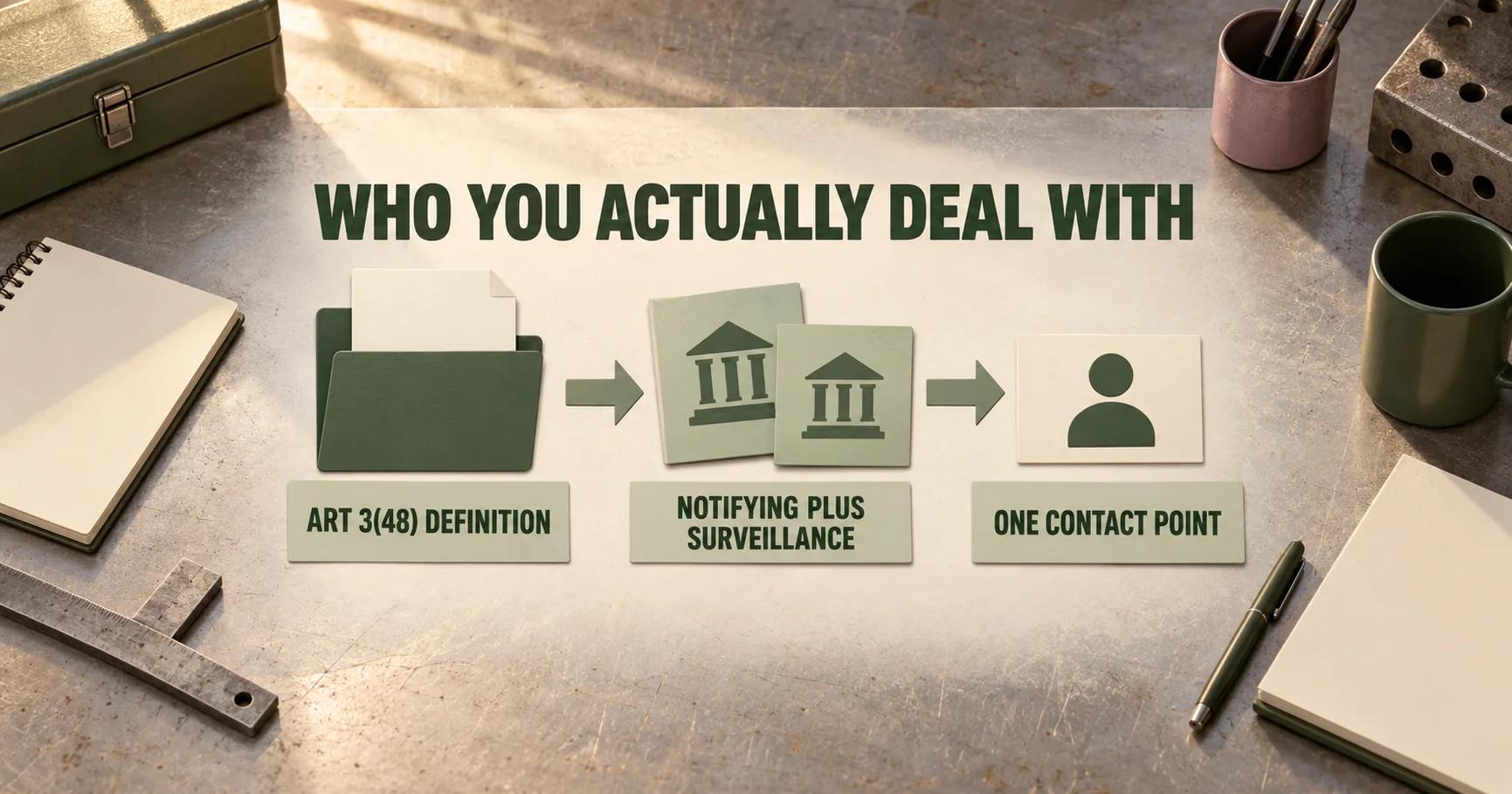
Quick Answer: A national competent authority under the EU AI Act is either a notifying authority or a market surveillance authority. For compliance questions, identify the market surveillance authority designated in its Member State and its single point of contact. The notifying authority deals with notified bodies; EU institutions have a separate supervisor.1,3
Summary in a mind map
What Is a National Competent Authority Under the AI Act?
│
├─ Start with the issue
│   ├─ AI system question — market surveillance
│   └─ Assessment body question — notifying authority
│
├─ Find the national route
│   ├─ Each State designates both authority types
│   ├─ A market authority is the single contact point
│   └─ Public electronic contacts were due 2 August 2025
│
├─ Ask with a defined case
│   ├─ SMEs may seek guidance, without guaranteed approval
│   └─ A national sandbox must operate by 2 August 2027
│
└─ Check the special case
    ├─ Union institutions use the EDPS route
    └─ A private firm uses the relevant national route
A 50-person metal workshop considering an AI system first identifies its Member State. It also records the specific question it wants answered. The relevant office depends on that question. The definition below explains the two authority functions. The contact route comes afterwards.
What does the term mean in the AI Act?
Article 3(48) defines a national competent authority as a notifying authority or a market surveillance authority. Article 70(1) requires each Member State to establish or designate at least one of each. The authorities must exercise their powers independently, impartially and without bias. This is a defined category of public body. It does not include every government office with an interest in AI.1
The definition does not name the office in a particular Member State. National designation supplies that detail. The umbrella term does not make the two functions interchangeable.1,3
Two distinct authority roles
| Role | Core function | Why a business might encounter it |
|---|---|---|
| Market surveillance authority | Supervises and enforces AI-system rules | A question about a system or its compliance |
| Notifying authority | Designates and supervises notified bodies | A question about a body that performs pre-market assessment |
| Single point of contact | Designated market surveillance contact route | Finding the right national entry point |
The single point of contact is a route into the national system. It is not a third type in the Article 3(48) definition.1,3
Which office should a company contact?
Consider the workshop buying an AI-assisted inspection system. A compliance question about that system points to market surveillance. A question about the status of a conformity assessment body points to the notifying authority. This example identifies a route. It does not classify the system or establish whether a notified body's assessment is needed.3
For a reusable enquiry, the workshop can record:
- the Member State and the published contact page;
- what the system does and where it will be used;
- whether the company supplies or uses it;
- the provision or decision causing uncertainty;
- the precise question, date sent and response received.
These fields help an authority direct the enquiry. They do not turn informal advice into approval. A company operating in several Member States checks the designation relevant to each issue. One reply may not settle every location.
EU institutions have a distinct supervisor
Article 3(48) makes a specific substitution for AI systems used by Union institutions, agencies, offices and bodies. This also covers systems they put into service. References to national competent or market surveillance authorities then mean the European Data Protection Supervisor. The rule identifies the supervisor for Union bodies. It does not redirect a private workshop's ordinary enquiry to the EDPS.1
This article cannot name a private company's particular authority without the Member State and the issue. An EU institution, by contrast, follows the supervisor named in the substitution rather than treating a Member State contact point as the default for its own system.1
Finding the single point of contact
Article 70(2) requires each Member State to designate a market surveillance authority as its single point of contact. Electronic contact information for these bodies had to be public by 2 August 2025. The Commission publishes the national list. A business can start there when a national webpage does not clarify the division of responsibilities.1
That date concerns public contact arrangements, not certification of an AI system. The national point can route a question to a more suitable unit. Article 70(3) separately requires Member States to provide adequate resources and expertise. It names AI, data protection, cybersecurity, fundamental rights, safety, standards and law. This duty does not guarantee bespoke advice on every individual project.2
Advice and sandboxes for SMEs
Article 70(8) permits national competent authorities to provide guidance on implementing the Act, particularly to SMEs and start-ups. They take account of Board and Commission guidance. An SME may ask a defined question. The provision does not promise clearance for a planned system. The checklist above ties the enquiry to the company's actual role and use.1
Under Article 57(1) of the consolidated Act, Member States must ensure that their competent authorities establish at least one national AI regulatory sandbox. It must operate by 2 August 2027. Under Article 57(6), competent authorities provide guidance, supervision and support within the sandbox, as appropriate. Its existence does not mean every business or proposed use will be admitted. An SME should check the relevant national arrangements and eligibility before planning around it.2
What to do next
List each AI system or planned use and the Member State relevant to it. For each open question, note whether it concerns the system itself, a notified body, or a Union institution. Use the Commission's public list and national contact details to locate the designated market surveillance single point of contact. Keep the enquiry, its factual description and the reply together with the project record.1,3
For wider context, read how to answer an EU AI Act vendor questionnaire and build an AI governance view. The AI literacy duty and Article 50 transparency rules address separate questions. None of these pages can name the national office until the Member State and question are known.
Frequently Asked Questions
Is a national competent authority one office?
Which authority enforces the AI Act for a company?
When was the AI Act single point of contact due?
Can a small business ask for AI Act advice?
Who supervises AI used by EU institutions?
Sources
- 1.Regulation (EU) 2024/1689 of the European Parliament and of the Council of 13 June 2024 laying down harmonised rules on artificial intelligence and amending Regulations (EC) No 300/2008, (EU) No 167/2013, (EU) No 168/2013, (EU) 2018/858, (EU) 2018/1139 and (EU) 2019/2144 and Directives 2014/90/EU, (EU) 2016/797 and (EU) 2020/1828 (Artificial Intelligence Act) — EUR-Lex · 2024
- 2.Regulation (EU) 2024/1689, consolidated 27 July 2026 — EUR-Lex · 2026
- 3.Governance and enforcement of the AI Act — European Commission · 2026
Want this run on your business?
AI Foundation Audit — a structured assessment of your AI footprint: integration risks, governance gaps, ROI opportunities. Delivered as a comprehensive report you can act on.
You receive your AI Opportunity Report and Implementation Brief — tailored to your business and delivered immediately.