Law enforcement authority in the EU AI Act: who counts?
See who qualifies as a law enforcement authority under Article 3(45) of the EU AI Act, including entrusted bodies, and where the definition affects AI duties.
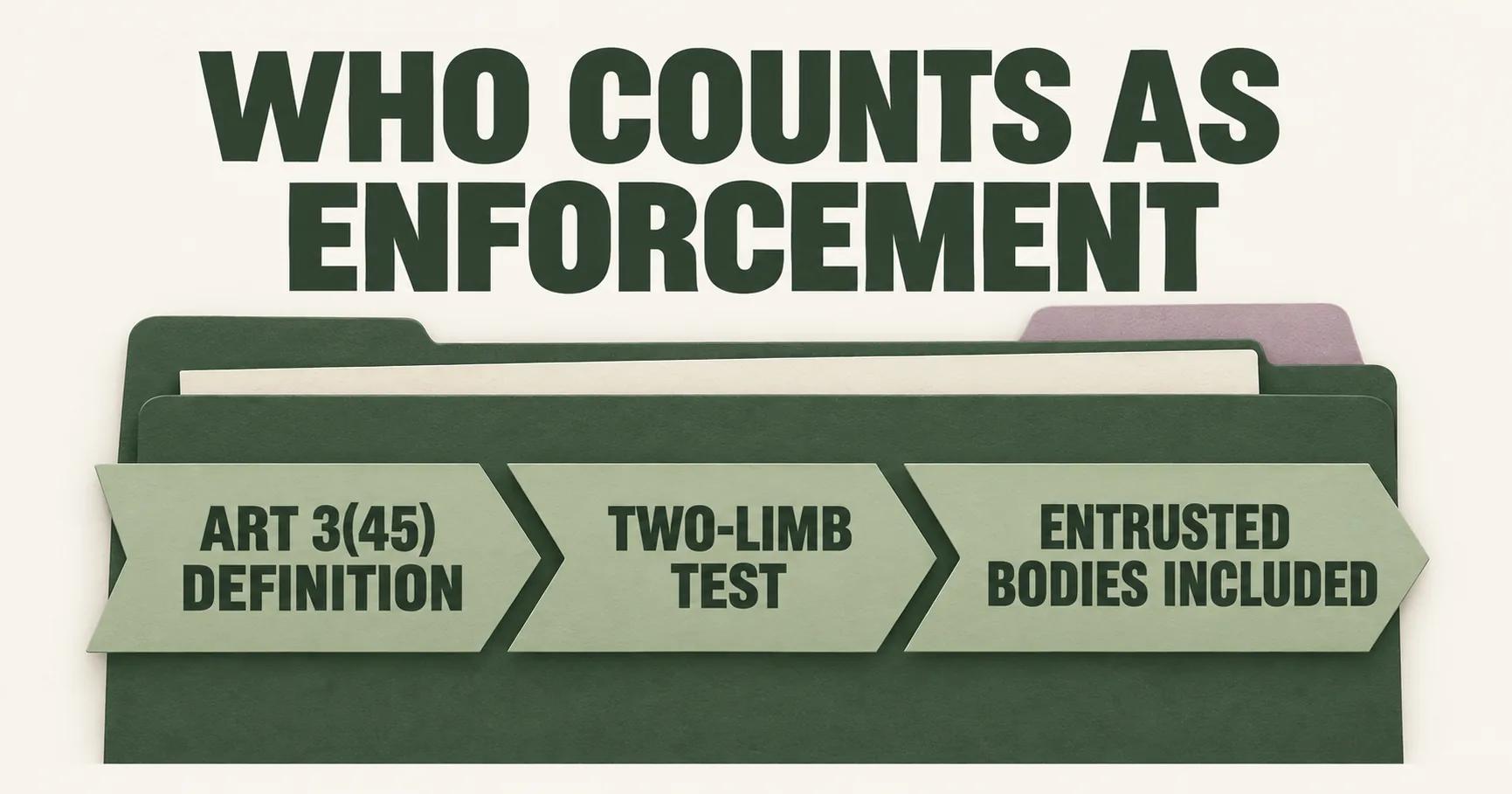
Quick Answer: Under Article 3(45), a law enforcement authority is a public authority competent to prevent, investigate, detect or prosecute crimes, execute criminal penalties or guard against public-security threats, or another body entrusted with those powers by Member State law. A supplier does not gain that status merely by selling to police 1.
Summary in a mind map
Law enforcement authority in the EU AI Act: who counts?
│
├─ Public authority limb
│   ├─ Criminal justice competence is required
│   ├─ Public security purposes can be included
│   └─ Public status alone does not settle the test
│
├─ Entrusted body limb
│   ├─ Member State law must grant public powers
│   ├─ A supplier contract is not that grant
│   └─ Check the exact purpose and legal instrument
│
├─ Use-specific rules
│   ├─ Annex III point 6 covers specified systems
│   ├─ Public biometric use has extra conditions
│   └─ Sensitive operational data has a narrow rule
│
└─ Do not overread
    ├─ The term does not authorise a system
    ├─ Sandbox data needs specific law
    └─ National entrustment remains a fact to verify
EU AI Act definition in plain terms
For a business deciding how to classify a customer, the first useful question is what legal power the customer actually exercises. Article 3(45) describes a law enforcement authority by its legally assigned purpose and powers. The label on a purchase order does not answer the question. A private vendor serving a police client and the client itself may sit on different sides of the definition 1.
The EU AI Act covers a public authority competent to prevent, investigate, detect or prosecute criminal offences, or execute criminal penalties. It also covers the safeguarding against and prevention of threats to public security within that formulation. The alternative is another body or entity entrusted by Member State law to exercise public authority and public powers for those purposes. Both the legal source of the power and its purpose matter 1.
| Question | Evidence to inspect | Why it matters |
|---|---|---|
| Is it a public authority? | Its legal mandate and competence | Public status alone is not the whole test. |
| Is it another body? | The Member State law entrusting it with powers | A services contract alone is not the named legal basis. |
| What is the purpose? | The criminal justice or public security function | An unrelated administrative use does not become law enforcement by association. |
This reading is close to the definition of a competent authority in Article 3(7) of Directive (EU) 2016/680. That directive likewise identifies public authorities with specified criminal justice functions and other bodies entrusted by Member State law with public authority and powers for those purposes. The parallel is useful when reading the terms, but the AI Act provision must still be applied to the AI system at issue 2.
The two limbs of the definition
The first limb covers a public authority that has the specified competence. The second prevents the definition from depending solely on an organisation's public or private form. Member State law may entrust another body with public authority and public powers for the same purposes. The words "entrusted by Member State law" distinguish that route from ordinary procurement 1.
Suppose a software agency builds a tool for a municipal office. The office's name, the agency's contract and the intended function are three different facts. The definition asks whether the office has criminal justice or relevant public security competence, and whether the agency itself has been legally entrusted with public powers. The agency must not claim the client's status merely because it works on the same system 1.
The two limbs also explain why an apparent enforcement task requires care. A municipal parking office may impose an administrative charge, but that description alone does not establish competence to investigate criminal offences or execute criminal penalties. The relevant Member State law and the exact task decide whether Article 3(45) applies. If that law is not known, the classification remains open 1.
Private contractors and public powers
A private contractor can fall within the second limb if Member State law entrusts it with the specified public authority and public powers. The contract for software, staffing or facilities is not itself proof of those statutory powers. A careful assessment names the provision of national law, the powers it grants and the activity for which the AI system will be used 1.
This is a narrow test. Supplying a high-risk system for a police workflow may bring the system within Annex III point 6 because that point covers specified systems intended for use by or on behalf of law enforcement authorities. It does not automatically transform the supplier into an authority. The system's classification and the operator's legal identity are separate questions 1.
Article 3(46) expressly includes activities carried out on behalf of law enforcement authorities within “law enforcement”. A contractor can therefore carry out a law enforcement activity for an authority without becoming a law enforcement authority itself. The latter status still requires the public competence or statutory entrustment in Article 3(45) 1.
Annex III point 6 gives examples such as polygraphs or similar tools and systems evaluating the reliability of evidence during investigation or prosecution. Those examples connect the intended AI use to criminal justice functions. They do not make every tool sold to a public body high-risk. A supplier should describe the intended use precisely rather than classify its entire customer list in one step 1.
How the term reaches a business
An ordinary manufacturer, agency or dental practice does not become a law enforcement authority merely because it reports an offence, receives a police request or supplies a public sector customer. Article 3(45) identifies bodies with the specified competence or statutory entrustment. A supplier that develops an Annex III point 6 system and places it on the market under its own name can instead be its provider under Article 3(3) 1.
For an AI supplier, the practical distinction is between who it is and what the system is intended to do. The supplier can document the customer role, the intended use and the legal basis claimed for any public powers. That record helps it ask a precise question about Annex III point 6. It also prevents the team from treating a general statement such as "government customer" as a substitute for a legal classification 1.
The AI governance overview addresses broader organisational roles. The AI literacy explanation concerns people who operate or use AI systems. Neither question changes the narrow Article 3(45) definition 1.
Extra steps for biometric use
Article 5(1)(h) prohibits real-time remote biometric identification in publicly accessible spaces for law enforcement except where strictly necessary to search for specified victims or missing persons, prevent an imminent threat or terrorist attack, or identify suspects of Annex II offences punishable by at least four years' imprisonment 1. The exception is narrow; completing procedural steps does not create a fourth permitted objective.
Article 5(2) requires a fundamental rights impact assessment under Article 27 and EU database registration under Article 49. In duly justified urgency, use may begin before registration, provided registration follows without undue delay 1.
Article 5(3) requires prior authorisation for each such use from a judicial authority or an independent administrative authority whose decision is binding. In duly justified urgency, use may begin without it only if authorisation is requested without undue delay, at the latest within 24 hours 1,3.
Article 5(5) leaves each Member State to decide whether to allow this use at all, so it is available only where national law provides for it 1.
The extra steps demonstrate why the definition has operational consequences. If a vendor presents an AI biometric system to a police customer, the vendor cannot answer the customer's legal-use question by pointing to the product alone. The authority's own assessment, registration and authorisation route are part of the use decision. The AI vendor questionnaire guide is a separate route for gathering supplier information 1,3.
Monitoring and incident duties
Article 26(5) tells deployers to monitor the operation of a high-risk AI system and inform the provider and relevant market surveillance authorities of a serious incident. Its qualification is specific: that obligation shall not cover sensitive operational data of deployers that are law enforcement authorities. The text does not erase monitoring or serious-incident communication in general 1.
The distinction matters when designing an incident record. A form that says "law enforcement: exempt" would suppress more than the provision says. A better legal analysis separates the existence of monitoring and notification duties from the sensitive operational data qualification. It then asks which information is sensitive in the particular context. The article cannot identify that information without the actual system and operation 1.
Personal data in AI sandboxes
Article 59(2) concerns personal data processed in AI regulatory sandboxes for the prevention, investigation, detection or prosecution of criminal offences or the execution of criminal penalties, under the control and responsibility of law enforcement authorities. Such processing must rest on a specific Union or national law and meet the same cumulative conditions referred to in paragraph 1. The definition therefore matters to who controls this narrow processing route 1.
The sandbox provision is not a general permission to place case data into an experiment. Its conditions connect the purpose, the authority's control and responsibility, the legal basis and the paragraph 1 safeguards. A business supporting a sandbox should identify who controls the activity and which specific law is relied on before describing its role. Article 59(2) does not answer those local facts for it 1.
What to do next
Record the body's legal identity, the statutory source of any criminal justice or public security powers and the AI system's intended use. If the second limb is claimed, ask for the Member State provision that entrusts the body with public authority and public powers. Then examine the relevant use-specific AI Act provision, including Annex III point 6 where appropriate 1.
For a supplier selling into this setting, separate the customer-status question from the system-classification question in the handover note. The Article 50 transparency guide addresses a different set of AI Act duties. A clear boundary between these questions helps the customer and supplier avoid applying the wrong rule to the wrong party 1.
Frequently Asked Questions
Does a private security company count as a law enforcement authority?
Does a public body automatically qualify under Article 3(45)?
Can a supplier using AI become a law enforcement authority?
What must happen before real-time biometric identification in public?
Does the term remove incident monitoring duties?
Sources
- 1.Regulation (EU) 2024/1689 of the European Parliament and of the Council of 13 June 2024 laying down harmonised rules on artificial intelligence and amending Regulations (EC) No 300/2008, (EU) No 167/2013, (EU) No 168/2013, (EU) 2018/858, (EU) 2018/1139 and (EU) 2019/2144 and Directives 2014/90/EU, (EU) 2016/797 and (EU) 2020/1828 (Artificial Intelligence Act) — EUR-Lex · 2024
- 2.Directive (EU) 2016/680 of the European Parliament and of the Council of 27 April 2016 on the protection of natural persons with regard to the processing of personal data by competent authorities for the purposes of the prevention, investigation, detection or prosecution of criminal offences or the execution of criminal penalties, and on the free movement of such data, and repealing Council Framework Decision 2008/977/JHA — EUR-Lex · 2016
- 3.Regulation (EU) 2024/1689 — consolidated text of 27 July 2026 — EUR-Lex · 2026
Want this run on your business?
AI Foundation Audit — a structured assessment of your AI footprint: integration risks, governance gaps, ROI opportunities. Delivered as a comprehensive report you can act on.
You receive your AI Opportunity Report and Implementation Brief — tailored to your business and delivered immediately.