GDPR Accountability: What EU Companies Must Document
GDPR accountability means proving compliance rather than claiming it. The records EU companies must hold — ROPA, DPIA, policies — and how to build the set.
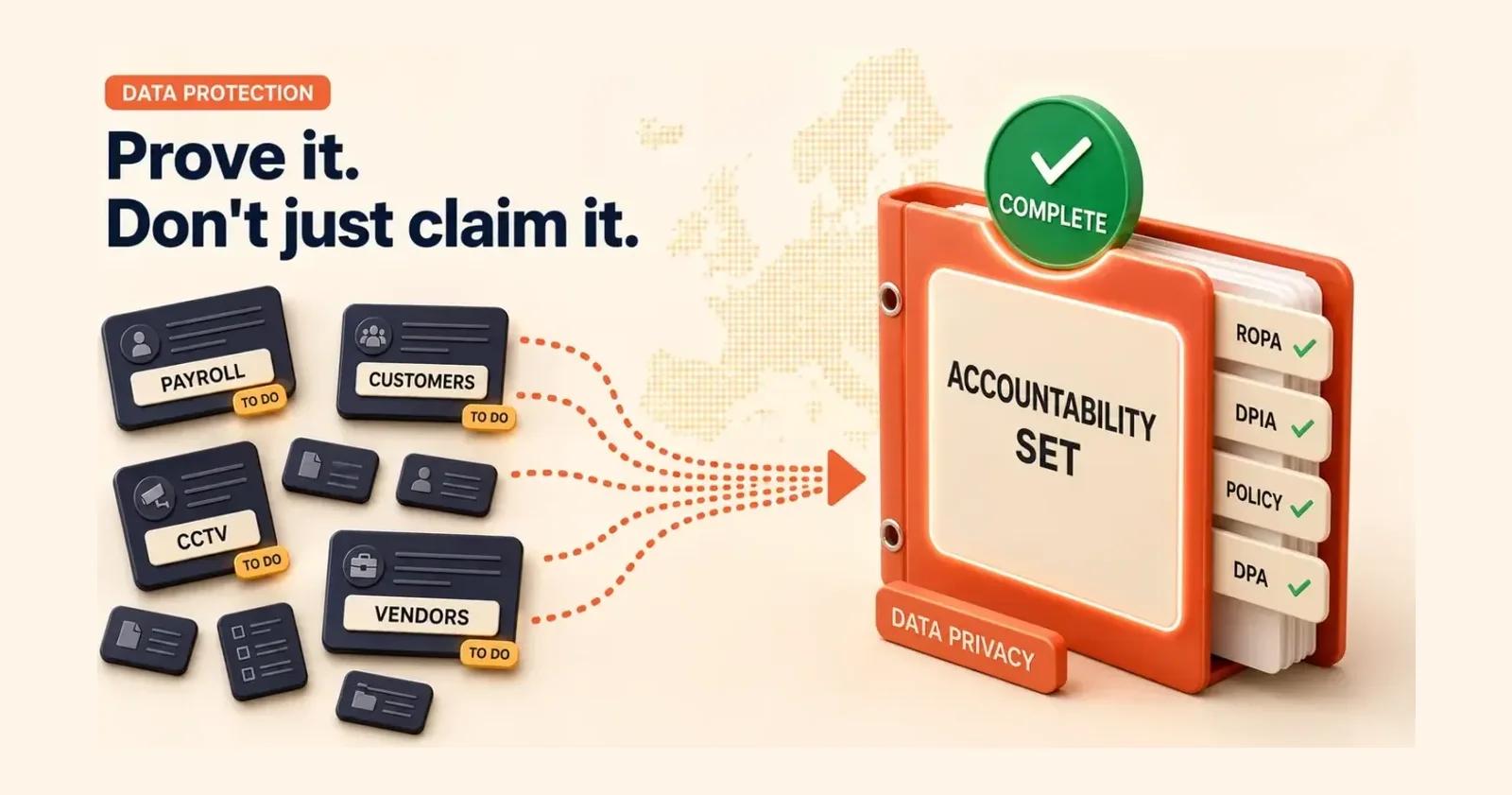
Most companies treat GDPR compliance as a state you reach: sign a policy, add a cookie banner, done. The regulation treats it as something you must be able to prove. That is the accountability principle, and it is the quiet centre of the whole law. Under Article 5(2), a company is responsible for compliance with the data-protection principles and must be able to demonstrate it 1. In practice, that demonstration is a set of documents. They are records, assessments, policies and procedures that describe, accurately and consistently, how your organisation actually handles personal data. For a European company without a legal department, building and maintaining that set is the real GDPR task. This guide lays out what the set contains, why each piece exists, and how the obligation differs across Europe, including why "European" is not the same as "UK".
Quick Answer. GDPR accountability (Article 5(2)) means a company must not only comply with data-protection law but be able to prove it, with documentation. The core set is a record of processing activities, a lawful-basis and privacy-notice layer, processor agreements, and a DPIA where risk is high, all kept accurate and internally consistent.
What accountability actually means under the GDPR
Most of the GDPR's obligations are familiar in outline. Have a lawful basis, tell people what you do with their data, keep it secure, honour their rights. Accountability is the principle that turns those obligations from intentions into something testable. Article 5(2) makes the controller "responsible for, and able to demonstrate compliance with" the data-protection principles. Article 24 requires you to implement appropriate measures and to be able to demonstrate that your processing is in line with the Regulation 1. The operative words are able to demonstrate. Compliance you cannot show, on paper, when asked, does not count.
This is a shift in where the burden of proof sits. A supervisory authority opening an enquiry, a corporate customer running vendor due diligence, or a counterparty negotiating a contract does not start by assuming you are non-compliant. But the moment they ask "show me," the responsibility to produce coherent evidence is yours, not theirs. And the test they apply is not volume. A binder of generic policies impresses no one. What regulators look for is specificity and internal consistency: documents that describe your actual processing, name your real systems and vendors, and do not contradict one another. The European Commission's own guidance for organisations frames the duty in exactly these terms. It means demonstrating compliance through records, impact assessments and breach documentation 2.
The stakes behind that word are not abstract. The GDPR backs accountability with administrative fines of up to €20 million or 4% of total worldwide annual turnover, whichever is higher, for the most serious infringements 1. But for most small and mid-sized companies the sharper, more frequent pressure is commercial rather than regulatory. A larger customer's procurement or vendor-due-diligence process asks for your ROPA, your data-processing agreement and your security documentation before it will sign. A deal stalls the week you cannot produce them. Accountability documentation has quietly become a precondition of selling into bigger organisations. The same logic extends to insurers and partners. That is why companies increasingly build the set proactively rather than waiting for a regulator to ask. The set becomes a commercial credential that lets a counterparty trust them with personal data.
So accountability reframes the whole exercise. The question is no longer "are we compliant?" in the abstract, but "what can we show, right now, about each thing we do with personal data?" Everything below is an answer to that question.
The documentation set: what European companies must show
There is no single "GDPR certificate." Instead, accountability is evidenced by a set of documents, each tied to a specific obligation. Together they cover every activity in which your organisation processes personal data. Which pieces you need depends on what you do: a sole reliance on a vendor pulls in a processor agreement, high-risk processing pulls in an impact assessment. But the spine is consistent across European companies.
In plain terms, the set is built activity by activity:
- A record of processing activities (ROPA), Article 30. The backbone document. It is an inventory of every processing activity, covering what data, whose, why, on what basis, who it is shared with, how long it is kept, and what protects it. National authorities such as France's CNIL publish templates precisely because this is the instrument they reach for first. It is, in the regulators' words, a document with inventory and analysis purposes that must reflect the reality of your processing 1,4.
- A lawful basis for each activity, Article 6, and a legitimate-interests assessment. Every activity needs one of the six lawful bases. Where you rely on legitimate interest (Article 6(1)(f)), you must document a three-part balancing test: purpose, necessity, and the balance against the individual's rights. The Court of Justice reaffirmed that discipline in its 2024 KNLTB ruling 9.
- Privacy notices, Articles 13–14. What you tell the people whose data you hold, depending on whether you collected it from them directly or not. The notice has to match the ROPA. A mismatch between what you say and what you record is the kind of contradiction an authority looks for.
- Data-processing agreements, Article 28. Whenever a vendor processes personal data on your behalf (payroll bureau, cloud host, email platform), Article 28 requires a contract with defined terms. The Commission publishes official standard contractual clauses for exactly this, which a compliant agreement can build on 5.
- Transfer safeguards, Chapter V. If personal data leaves the European Economic Area, you need a valid transfer mechanism: an adequacy decision, or the Commission's standard contractual clauses for international transfers 6.
- A data protection impact assessment (DPIA), Article 35. Required where processing is likely to result in a high risk: large-scale special-category data, systematic monitoring, extensive profiling. European guidance sets nine criteria and treats two or more as the trigger. Each national authority also publishes its own mandatory-DPIA list 3.
- Procedures as well as documents. Around the set sit the operational pieces. One is a process to handle data-subject requests within the one-month deadline (Articles 12–22). Another is a breach process able to notify the authority within 72 hours where required (Articles 33–34). The third is an internal policy describing the technical and organisational measures that keep data secure (Articles 24, 32).
That is the anatomy. The art is making it yours, every field traceable to something true about your company, rather than a folder of plausible-looking generic text.
One regulation, many regulators: the European picture
Here is where the European framing matters, and where it is easy to get wrong by reading UK-centric advice. The GDPR is a regulation, not a directive. Regulation (EU) 2016/679 is directly applicable across every EU member state and the wider European Economic Area, which includes Norway, Iceland and Liechtenstein 1,2. The load-bearing articles (accountability, lawful basis, ROPA, DPIA, data-subject rights) are identical text in Germany, France, Italy, Spain, Poland, Slovakia and everywhere else. A company operating across Europe builds the EU core once.
What changes is a national layer carried on top of that core. Each country has its own supervisory authority: the CNIL in France, the Garante in Italy, the AEPD in Spain, the BfDI and the Länder authorities in Germany, and so on. Each can issue national specifics. Those cover the age at which a child can consent to online services (set anywhere between 13 and 16 across the bloc), employment-data rules, and the authority's own list of operations that always require a DPIA. Consistency across these regulators is held together by the European Data Protection Board and the one-stop-shop mechanism, so the core does not fragment 8. For an accountability set, this means the structure is uniform and the variation is bounded. Map the EU core, then layer the handful of national specifics for each country you operate in.
And this is precisely why European is not the same as UK. Since Brexit, the United Kingdom is outside the EU GDPR. It runs its own UK GDPR alongside the Data Protection Act 2018, supervised by the ICO, and has begun to diverge from the EU text through domestic reform. Switzerland, never in the EU, has its own revised Federal Act on Data Protection. So an EU-focused company should treat the UK and Switzerland as separate, parallel regimes, distinct jurisdictions to be documented in their own right, not as local variants of the EU regulation 2. A lot of widely shared "GDPR" guidance is in fact UK guidance. For processing centred on the EU and EEA, the regulation, the regulators, and the reference texts you cite are the European ones.
Where accountability gets harder: AI and automated decisions
Adopting AI does not create a separate compliance universe, but it does add weight to the accountability set. Three points matter. First, automated decision-making and profiling that produces legal or similarly significant effects on people carries specific safeguards under Article 22. In many cases those include the right to human intervention 1. Second, AI that processes personal data at scale, or profiles individuals, frequently meets the Article 35 criteria and so triggers a DPIA 3. Third, you still need a clear, documented lawful basis for any training or inference performed on personal data.
On top of GDPR, the EU AI Act (Regulation (EU) 2024/1689) introduces a separate, risk-based layer of obligations on AI systems themselves 7. The two regimes run in parallel: the AI Act governs the system, GDPR governs the personal data it touches. GDPR accountability applies the moment an AI system processes personal data, regardless of how the AI Act classifies it. The practical consequence is that an organisation moving work into AI inherits more to document, not less. We cover the wider regulatory convergence in our guide to AI governance and the rules that apply. The operating model that keeps this evidence generated as a by-product of normal work is in the AI-native company.
The honest caveat: documentation is necessary, not sufficient
It would be convenient to say that once the set exists, you are compliant. You are not. Pretending otherwise is the classic way accountability fails. Three honest limits.
First, documents have to match reality, and you have to operate them. A policy describing access controls your systems do not enforce, or a ROPA that omits the CCTV at reception, is not neutral. It is evidence of non-compliance. The set demonstrates accountability only if it is specific, internally consistent, and actually lived. Second, a documentation set is not legal advice, and not a certification. Producing the records that the law requires is structured drafting, not a legal opinion on your particular situation. And there is no "GDPR certified" status conferred by having good paperwork. The formal certification route under Article 42 is a separate, accredited mechanism. Third, some situations need a professional. A genuinely complex DPIA, a contested cross-border structure, or a live regulatory investigation are not template territory. The right move there is to escalate to a qualified adviser, and a good accountability process tells you when.
Naming these limits is not a hedge. It is the difference between a set that survives scrutiny and a folder that collapses the first time someone reads it closely.
How to build your accountability set
There are, realistically, three ways to produce the set. A law firm or DPO consultant gives you accuracy and judgement, but slowly and at a cost that strains a smaller company. Generic templates are fast and cheap, but they fail the specificity-and-consistency test that authorities actually apply. A contradictory or hollow set is worse than an honest gap. The third route is a productized, generated set. You answer structured questions about your company and its processing activities, and a tailored, internally consistent set is assembled from a clause library built on the regulation and official guidance. It is fast, like the templates, but specific to you, like the lawyer.
Build the set without the law-firm timeline. AI Priority Map's GDPR Accountability Documentation turns a short guided questionnaire about your company and how it handles personal data into a tailored, internally consistent accountability set. That set is a record of processing activities, internal policy, privacy notices, processor agreements, a legitimate-interests assessment where you need one, and a DPIA screening. It is generated in days, in English, Slovak, German, Czech, Polish and French, at a fraction of a bespoke engagement. It is documentation support, not legal advice or certification, and it assumes you operate what it describes. If your next step is AI rather than paperwork, the AI Foundation Audit ranks where automation pays back; start with the sample report. Both products live on the AI Priority Map platform at aiprioritymap.com.
The sequence on your side is straightforward. Inventory every activity that touches personal data, fix a lawful basis for each, write the records and notices that describe them, paper the vendors, assess the high-risk cases, and stand up the rights-and-breach procedures. Then keep the whole thing current as your processing changes. Accountability is not a project you finish; it is a state you maintain. But the first, hardest 80%, a complete, consistent, company-specific set you can put in front of anyone who asks, is exactly the part that can now be generated rather than hand-built.
Summary
GDPR accountability — prove it, don't just claim it
│
├─ The principle (Art 5(2), 24)
│   ├─ Compliance must be demonstrable, not asserted
│   ├─ The burden of proof sits with you, the controller
│   └─ Authorities test specificity + consistency, not volume
│
├─ What you must be able to show
│   ├─ ROPA — every processing activity (Art 30)
│   ├─ Lawful basis + LIA for legitimate interest (Art 6)
│   ├─ Notices · vendor DPAs · transfers (Art 13/14, 28, Ch V)
│   └─ DPIA where risk is high · rights + breach procedures
│
└─ One regulation, many regulators
    ├─ EU + EEA share one core — map it once
    ├─ National DPAs add specifics — CNIL, Garante, AEPD…
    └─ Not the UK — UK GDPR + Swiss FADP are separate
Related insights
- AI Governance and the Rules That Apply — how GDPR, the EU AI Act and other regimes converge for a growing company.
- The AI-Native Company — the operating model where accountability evidence is produced as a by-product of normal work.
- How to Build an AI Register in 90 Minutes — the same documentation discipline, applied to your AI systems.
- Local LLM vs Cloud LLM: Data Security — where your data sits, and what that means for transfers and risk.
Forthcoming spokes in this cluster: how to build a record of processing activities, when and how to run a DPIA, choosing a lawful basis, data-subject-rights procedures, the Article 28 data-processing agreement, and GDPR for AI and automated decisions.
Last updated: June 2026. Version 1.0.
Frequently Asked Questions
What is the accountability principle in the GDPR?
What documents does the GDPR actually require?
Does the GDPR apply the same way across all of Europe?
Is the United Kingdom covered by the EU GDPR?
Do small companies and small businesses have to keep a record of processing activities?
When does a company need a Data Protection Impact Assessment (DPIA)?
Can we just use generic GDPR document templates?
Does using AI change our GDPR obligations?
Sources
- 1.Regulation (EU) 2016/679 (General Data Protection Regulation) — European Union (EUR-Lex, Official Journal L 119) · 2016
- 2.Rules for business and organisations (data protection) — European Commission · 2024
- 3.Guidelines, Recommendations and Best Practices (incl. DPIA WP248 rev.01; controller/processor 07/2020; consent 05/2020) — European Data Protection Board (EDPB) · 2024
- 4.Record of processing activities (Article 30 guidance and template) — CNIL (French Data Protection Authority) · 2024
- 5.Commission Implementing Decision (EU) 2021/915 — standard contractual clauses between controllers and processors (Article 28) — European Commission (EUR-Lex) · 2021
- 6.Commission Implementing Decision (EU) 2021/914 — standard contractual clauses for international data transfers — European Commission (EUR-Lex) · 2021
- 7.Regulation (EU) 2024/1689 (Artificial Intelligence Act) — European Union (EUR-Lex, Official Journal) · 2024
- 8.European Data Protection Board — role and consistency mechanism — European Data Protection Board (EDPB) · 2024
- 9.Judgment in Case C-621/22 (KNLTB) — legitimate interest as a lawful basis — Court of Justice of the European Union (EUR-Lex) · 2024
Want this run on your business?
AI Foundation Audit — a structured assessment of your AI footprint: integration risks, governance gaps, ROI opportunities. Delivered as a comprehensive report you can act on.
You receive your AI Opportunity Report and Implementation Brief — tailored to your business and delivered immediately.