What Is AI Watermarking Under the EU Act for US Firms?
AI watermarking under the EU AI Act: which existing US systems must mark synthetic output by 2 December 2026, what marking means, and which duties start sooner.
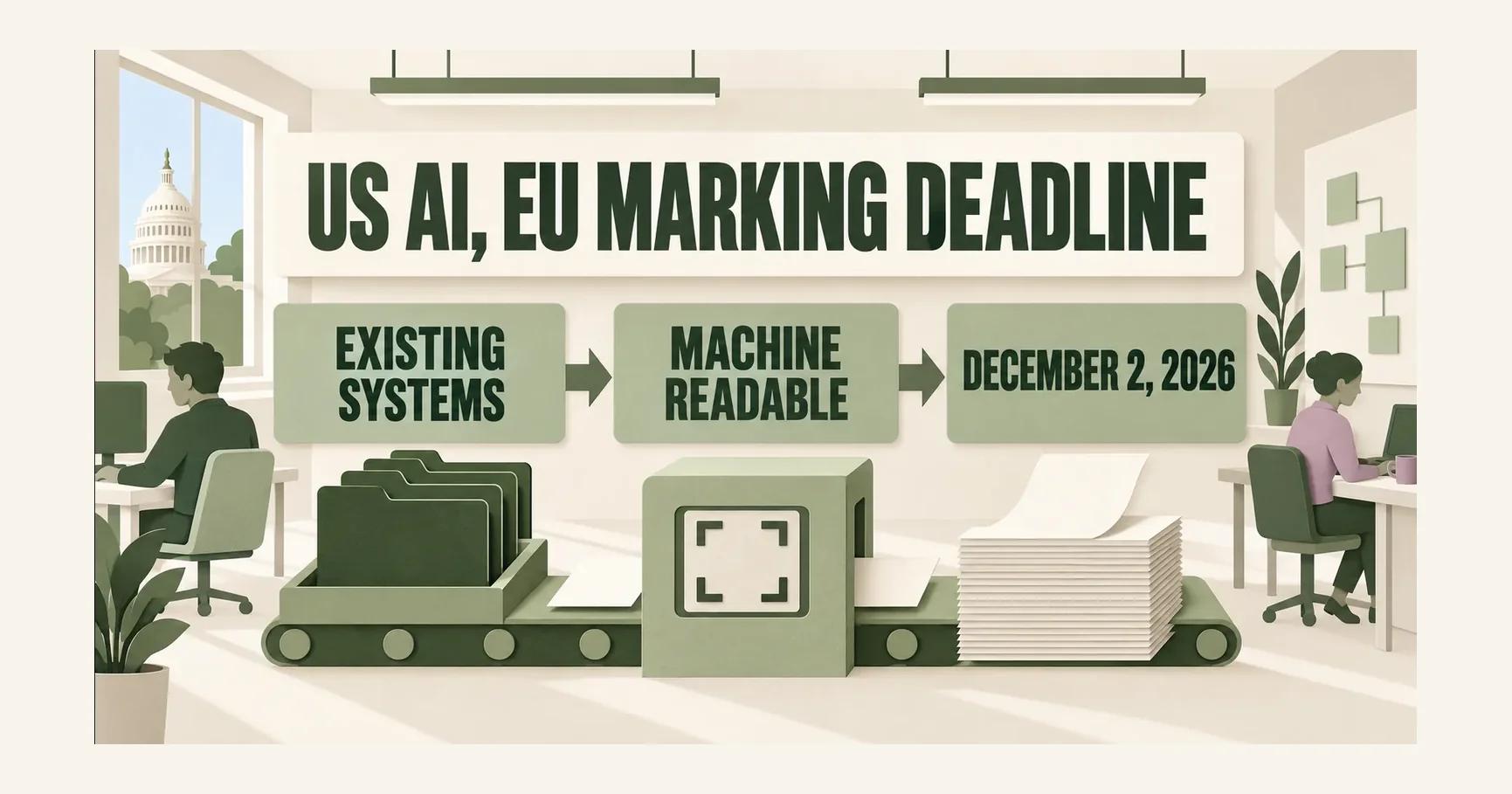
Quick Answer: AI watermarking reaches US providers of synthetic audio, image, video or text systems entering the Union market or producing output used there.1,2 Systems placed before 2 August 2026 must mark outputs in machine-readable form by 2 December 2026. Chatbot notices and deployer disclosures start on 2 August 2026.1
Summary in a mind map
What Is AI Watermarking Under the EU Act for US Firms?
│
├─ Scope and first sale
│   ├─ US establishment alone does not settle EU scope
│   └─ Record first availability on the Union market
│
├─ The marking duty
│   ├─ Synthetic audio, image, video or text
│   ├─ Machine-readable and detectable output
│   └─ Standard editing may fall outside the duty
│
└─ Two dates, distinct duties
    ├─ August: Article 50 notices and disclosures
    ├─ December: earlier systems' output marking
    └─ Voluntary code can guide implementation
EU scope for a US provider
A US company can be within the AI Act without opening an EU office. Article 2(1)(a) covers providers placing AI systems or general-purpose AI models on the Union market, irrespective of establishment. Article 2(1)(c) also covers third-country providers and deployers where the output produced by the system is used in the Union1. The practical first question is therefore where the system is made available and where its output is used, rather than the address on the provider's incorporation papers.
An internal inventory can separate three factual questions. What system does the company provide? Has it been made available on the Union market? Is its output used in the Union? This is a scope exercise, not a claim that every US AI tool needs a mark. A system outside the described territorial connection does not become subject to Article 50(2) merely because its maker is American. Conversely, a US provider should not treat a US-only contract heading as conclusive when actual availability or use points to the Union1.
For the broader compliance picture, the EU AI governance guide explains how this cross-border question sits beside other duties. That guide does not replace identifying the particular generating system and output at issue here.
First Union market placement
“Placing on the market” has a specific timing meaning: the first making available of an AI system or a general-purpose AI model on the Union market1. It is the first event that matters to this transition. The date on which the company was founded, the date of an internal prototype, and the date of a later software update are different facts. Record the evidence for the first Union availability of the relevant system rather than assuming an old codebase makes every later product an existing system.
The transition test has two limbs. First, the system must generate synthetic audio, image, video or text. Second, it must have been placed on the market before 2 August 2026. Article 111(4) then requires its provider to comply with Article 50(2) by 2 December 2026 (see 1). A new system placed on the market after the Article 50 start date cannot claim that earlier-system extension. The provider's earlier operation is irrelevant to that test.
| Question for the product record | Evidence to identify | Why it matters |
|---|---|---|
| What does the system generate? | Its actual output types | Article 50(2) concerns synthetic audio, image, video and text1. |
| When was it first made available in the Union? | The first relevant release or availability event | Article 3(9) defines the placing event1. |
| Was that before 2 August 2026? | A dated record of that event | Only qualifying earlier systems receive the December transition1. |
In words, the tree branches like this: check the Union connection, then whether the system generates synthetic content. If it does, determine whether it was first placed before 2 August 2026. Qualifying earlier systems reach the marking date on 2 December 2026; other systems have the 2 August 2026 Article 50 start date. Assess direct-interaction notices and deployer disclosures separately1.
Machine-readable output marking
Article 50(2) is about the provider's output, not simply a badge in a user interface. A provider of a system generating synthetic audio, image, video or text must ensure that generated or manipulated outputs are marked in a machine-readable format and detectable as artificially generated or manipulated1. A visible “AI” label may be useful to a reader, but visibility alone does not answer whether downstream tools can read and detect the mark.
The law describes the performance expected from technical solutions: they should be effective, interoperable, robust and reliable as far as technically feasible. It expressly calls for consideration of the limitations of different kinds of content, implementation costs and the generally acknowledged state of the art1. That wording calls for a documented engineering choice, with evidence of how a mark survives the product's relevant output path. It does not prescribe one named vendor or one universal watermarking technique in the cited provision.
This distinction helps a product team avoid an easy category error. A visible notice communicates to a person; a machine-readable mark is designed for detection in the content or its associated machine-readable form. Teams should examine their actual formats and handling paths before selecting an approach. The Article 50 transparency guide provides the wider context for notices and disclosures.
The standard editing boundary
The marking obligation has a functional boundary. Article 50(2) excludes AI systems to the extent that they perform an assistive function for standard editing, or do not substantially alter the deployer's input data or its semantics. It also contains an exception for use authorised by law for criminal offences1. “To the extent” matters: the same product may offer a modest correction function and a separate feature that substantially changes meaning.
Consider a hypothetical input: “The delivry arrived on Tuesday.” One function corrects it to “The delivery arrived on Tuesday.” The account stays the same. Another rewrites the same input as “The delivery never arrived.” That changes the meaning. Record the input, requested operation and output for each function. The first illustrates standard correction. The second illustrates a substantial semantic change. The example does not decide the legal status of either real product. It shows why the functions need separate assessment under Article 50(2).1
This article cannot determine the status of a specific product without its functions, input and output. The legal boundary above is the test to apply; it is not a list of approved editing tools. The vendor question guide may help organise questions to a supplier, while the provider remains responsible for its own applicable duty.
August notices and disclosures
Article 113 makes Article 50 applicable from 2 August 2026. Article 111(4) then creates a narrow extra period for Article 50(2) marking by providers of qualifying earlier systems, ending on 2 December 2026 (see 1). It does not move Article 50(1), which concerns informing people about direct AI interaction, or Article 50(4), which concerns specified deployer disclosures. These are distinct duties. Treating December as the date for all transparency work would miss them.
The Commission explains a second separation: a deployer who must disclose a deepfake needs an understandable visible or audible disclosure. The deployer cannot satisfy that obligation merely by relying on a provider's machine-readable marks2. The provider and deployer may both have work to do, but their messages serve different readers and legal roles. A US provider selling into the Union should describe what it supplies and what its customers must assess for their own deployment.
The AI literacy guide addresses a different obligation. It should not be used as evidence that a watermark, a chatbot notice and staff training share one deadline.
The voluntary code's role
The Commission's Code of Practice page distinguishes voluntary adherence from the legal transparency requirements. Its introductory account says the code addresses Article 50(2), (4) and (5), while participation in it is voluntary3. A product team may use it as implementation guidance, but joining it is not the act that creates the obligation, and declining it does not remove the regulation's applicable requirements.
A sensible implementation note records the applicable Article 50 duty first, then the chosen marking method, its known limits, and any code guidance used in designing it. That sequence keeps a voluntary tool in its proper place. It also avoids describing a particular vendor's watermark as automatically sufficient; the cited legal standard speaks in terms of machine readability, detectability and the stated technical qualities, not a brand name1,3.
What to do next
For each generative system, record its output types, first Union availability, whether output is used in the Union, and which Article 50 functions apply. Use those answers to distinguish the August duties from the December transition for qualifying earlier systems1. If the team needs a structured next step, use the EU AI Act Documentation Pack.
Frequently Asked Questions
Which existing AI systems must add machine-readable marking by 2 December 2026?
Does a US provider fall under the EU AI watermarking rule?
Is a visible AI label enough for Article 50(2)?
Does editing an existing file always require an AI mark?
Do chatbot notices and deepfake disclosures wait until December?
Do OpenAI, Claude, Gemini, SynthID or C2PA establish Article 50 compliance?
Sources
Want this run on your business?
AI Foundation Audit — a structured assessment of your AI footprint: integration risks, governance gaps, ROI opportunities. Delivered as a comprehensive report you can act on.
You receive your AI Opportunity Report and Implementation Brief — tailored to your business and delivered immediately.