AI visibility tool guide: what each measure really shows
Compare AI visibility tools by the event they count: Bing citations, Google AI impressions, Search clicks, ChatGPT referrals and URL inspection results.
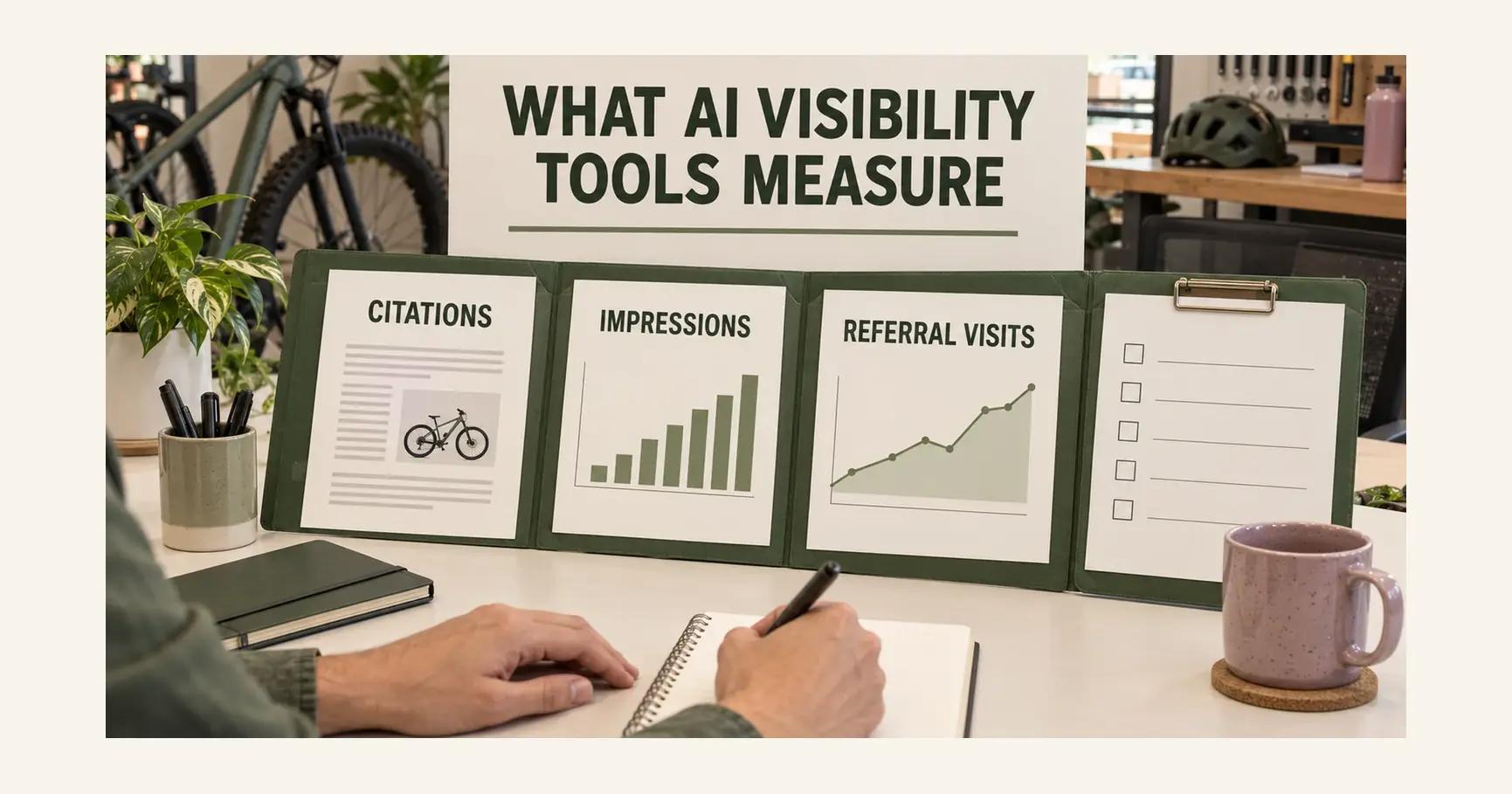
Quick Answer: An AI visibility tool measures an event: Bing counts AI citations, while Google counts AI Overview and AI Mode link impressions. Search Console reports Search clicks and impressions, which overlap the AI report. Analytics identifies ChatGPT referrals; URL Inspection diagnoses a page's index status; compare units and dates.1,2,3,4,5
Summary in a mind map
AI visibility tool guide: what each measure really shows
│
├─ Define the question
│   ├─ Name the engine, pages and dates
│   ├─ Choose one event and its unit
│   └─ Preserve the definition across periods
│
├─ Exposure measures
│   ├─ Bing: visible source appearances
│   ├─ Google AI: site link impressions
│   └─ Ordinary Search: impressions and clicks
│
├─ Arrivals and diagnosis
│   ├─ Analytics: identified ChatGPT referrals
│   ├─ URL Inspection: page status or live test
│   └─ Neither is a citation count
│
└─ Report honestly
    ├─ Keep unlike units in separate rows
    ├─ State what each view cannot prove
    └─ Investigate gaps without guessing causes
Start with the visibility question
Before selecting an AI visibility tool, write down the event that would change a decision. A business might care whether an answer names its content as a source, whether a link to its site appears in an AI feature, whether someone clicks a Search result, or whether a person arrives from ChatGPT. Those events happen at different points in the journey and have different denominators. Bing, Google and OpenAI each describe a different observation rather than a single universal visibility score 1,2,3,4.
Consider a bicycle retailer with buying guides, product pages and a booking page for repairs. If the question is whether its buying guides become sources in AI answers, a citation count is relevant. If the team wants to know whether Google displays links to those guides in AI Overviews or AI Mode, link impressions are relevant. If the commercial question is how many people reached the site, the team needs a traffic measure. The three questions cannot be answered by renaming the same chart.
A one-sentence measurement contract is useful before opening a dashboard: “For these pages, in this period, on this engine, count this event.” The page set, period and unit should remain visible beside the number. This is a recommended comparison method, not a metric supplied by a vendor. It prevents an increase in one unit being described as an increase in another unit without evidence.
| Question | Observable event | Named source |
|---|---|---|
| Was a page cited in a covered AI experience? | Visible source appearance | Bing AI Performance 1 |
| Was a site link displayed in a Google AI feature? | Link impression | Google Generative AI report 2 |
| Did someone click a Google Search result? | Search click | Search Console Performance 3 |
| Did a visitor arrive from ChatGPT search? | Analytics visit with the referral parameter | OpenAI publisher guidance 4 |
| Might a particular live URL be indexable? | Inspection or live test result | Google URL Inspection 5 |
The table deliberately leaves out a universal “AI visibility” total. Adding its rows would add unlike units: a source appearance, a shown link, a click, a visit and a diagnostic result. A useful comparison preserves the meaning of each row and relates it to the decision the retailer must make.
What Bing counts as a citation
Bing Webmaster Tools describes visible citations across Microsoft Copilot, Bing AI summaries and select partner integrations. Its Total Citations metric records source appearances during the selected period 1. A citation is therefore an appearance of a source in the experiences Bing covers, with that period as its time boundary. It is not, by definition, a person arriving at the cited site.
For the bicycle retailer, this measure can answer whether the buying guides appear as sources in the covered experiences. It does not by itself tell the retailer whether a customer read the cited passage, clicked it, bought a bicycle or booked a repair. Those would require different observations. Keep “source appearances” as the unit on the chart title and in any report shared with a manager.
Google AI link impressions
Google's Generative AI performance report measures impressions of links to a site in AI Overviews and AI Mode. In the report's description, an impression occurs when a link to the site is shown to a user in a generative AI feature on Google Search 2. That is narrower than a claim that every brand mention has been observed, and it is a different event from a visitor landing on a page.
The report addresses questions about displayed site links in those Google features. A retailer might ask whether its maintenance guide links are appearing while its product comparison links are not. The answer is about exposure of links, not an endorsement of the content or a sale 2.
The term “AI search analytics” often blurs the unit. A link impression has its own meaning even if no one follows the link. Conversely, a visit identified through another channel should not be inserted into the impression total. When a manager asks “Did we get more AI traffic?”, do not answer with a Google AI impression trend unless the question is changed to displayed links.
This difference also shapes interpretation of silence. A page without a reported AI link impression in a chosen view has no such measured event in that view; the report alone does not prove that no answer anywhere mentioned the brand. The conclusion must stay within the scope of Google's named AI Overviews and AI Mode link impressions 2.
Ordinary Search Console metrics
The standard Performance report for Google Search results reports clicks, impressions, click-through rate and average position. Google defines clicks as clicks from Google Search results, impressions as appearances in Search results, click-through rate as clicks divided by impressions, and average position as the average position of the topmost result from the site 3. Those are useful Search measurements but do not become AI citation counts because a team places them in an AI dashboard.
Google says the generative AI performance report includes data from the Web search type in the Performance report. The broader Search totals therefore can include the AI-feature observations; they are not an AI-free baseline 2. Compare the generative AI view with the broader Search view as overlapping scopes, and do not subtract one from the other without an expressly supported method.
CTR deserves particular care. It is a ratio of Search clicks to Search impressions 3. It is not the proportion of AI answers that cite the retailer, nor the proportion of AI citations that lead to a visit. If a slide uses “CTR” without its source and denominator, readers may attach the wrong meaning to the number. The caption should name the numerator and denominator.
Average position also belongs to Google Search results 3. It does not rank a citation inside a generated answer. The retailer can use it to understand a Search result trend for the selected pages, but the metric must remain labelled as a Search result measure in any combined report.
Visitors arriving from ChatGPT
OpenAI's publisher guidance describes tracking ChatGPT search traffic through analytics platforms and the referral parameter utm_source=chatgpt.com 4. This points to an arrival observation: a visitor reached the site in a way the analytics platform can identify. It does not count every answer that mentioned the retailer or every citation that may have appeared without a visit.
The retailer can filter its analytics view for that parameter to identify the landing pages of recorded visits. This is an arrival measure, subject to what that analytics view captured, rather than a census of ChatGPT answers 4.
Do not turn the referral count into a citation rate by dividing it by Bing citations or Google link impressions. The sources describe different engines, events and boundaries 1,2,4. There is no common denominator in the supplied measures. The responsible statement is more modest and more useful: “These visits arrived with the named referral parameter in this period.”
If the analytics view yields no identified visit, the result is still about that view and that identification method. It cannot settle whether someone read an answer, saw a citation or later visited by another route. The negative conclusion should be no broader than the positive measurement would have been.
Diagnose a page with URL Inspection
Google's URL Inspection tool reports information about an indexed page 5. It can also test whether a live URL might be indexable 5. It is a page diagnostic, not an exposure dashboard. Use it when a specific guide page behaves unexpectedly in a performance report and the team needs to investigate its status. A live test does not substitute for a count of impressions or citations.
Compare tools on a common sheet
The final step is to compare tools without erasing their units. Each row should identify the engines, page set, period, event and unit. For Bing, name the covered experiences and source appearances. For the Google Generative AI report, name AI Overviews and AI Mode link impressions. For ordinary Search Console, specify the Search result metric. For analytics, identify ChatGPT referral visits; for URL Inspection, label the result as a page diagnostic 1,2,3,4,5.
| Tool or view | Engine or surface | Unit to write beside the number | Decision it can support |
|---|---|---|---|
| Bing AI Performance | Covered Microsoft AI experiences | Visible source appearances | Which selected pages appear as sources? |
| Google Generative AI report | AI Overviews and AI Mode | Site link impressions | Which selected links are shown? |
| Standard Search Console Performance | Google Search results | Clicks, impressions, CTR or position | How is ordinary Search performing? |
| Analytics using OpenAI's parameter | ChatGPT search arrivals identified in analytics | Visits | Which selected pages receive identified arrivals? |
| URL Inspection | One inspected Google URL | Indexed information or live test | What page status needs investigation? |
For a hypothetical retailer comparison, use /guides/commuter-bikes and /guides/repair-basics for 1–30 September 2026. Suppose Bing reports 24 visible citations, the Google generative AI view reports 180 link impressions, the broader Search Performance view reports 1,200 impressions and 36 clicks, and analytics identifies 7 ChatGPT referral visits. Search CTR is 36 ÷ 1,200 × 100 = 3%, because Google defines CTR as clicks divided by impressions 3. These invented observations illustrate separate units, not actual retailer results. The broader Search total may include the generative AI observations 2.
What these tools cannot settle
The boundary is especially important for commercial conclusions. None of the five named sources supplies a common measure of brand share of voice across every AI engine, or a count of sales caused by an AI citation 1,2,3,4,5. A business can make a practical choice among the available observations while leaving that broader question open.
In words, the tree branches like this: if the question concerns a source appearance in Bing's covered AI experiences, read citations; if it concerns links shown in Google's AI features, read link impressions; if it concerns ordinary Search results, read Search metrics; if it concerns arriving visitors, inspect ChatGPT referrals; and if it concerns a specific page's indexed or live status, use URL Inspection 1,2,3,4,5.
What to do next
Write one measurement contract for the retailer's buying guides: exact pages, engine, event, unit and reporting dates. Pull the matching view, then repeat it for a second period without changing the definition. If another business goal needs a different event, add another row rather than relabelling the first one. The AI visibility audit, guide to checking AI mentions, ChatGPT recommendation check, generative engine optimisation explainer and competitor recommendation analysis provide related questions to investigate.
Open AI Answer Audit for the next review.
Frequently Asked Questions
Is an AI citation the same thing as a visitor?
Does Google Search Console show every AI brand mention?
Can ChatGPT referral traffic prove that ChatGPT cited a page?
What does URL Inspection add to AI visibility tracking?
Which measure should a small business compare first?
Can one tool measure AI share of voice across all engines?
Sources
- 1.AI Performance — Bing Webmaster Tools · 2026
- 2.Generative AI performance report (Search) — Google Search Console Help · 2026
- 3.Performance report (Search results): Overview and basic setup — Google Search Console Help · 2026
- 4.Publishers and developers FAQ — OpenAI Help Center · 2026
- 5.URL Inspection tool — Google Search Console Help · 2026
Want this run on your business?
AI Foundation Audit — a structured assessment of your AI footprint: integration risks, governance gaps, ROI opportunities. Delivered as a comprehensive report you can act on.
You receive your AI Opportunity Report and Implementation Brief — tailored to your business and delivered immediately.