What Is an AI Visibility Audit? Vendor Checks Explained
Learn what an AI visibility audit can verify across Google, ChatGPT and Bing: crawler access, snippet rules, citations, referrals and the limits of each metric.
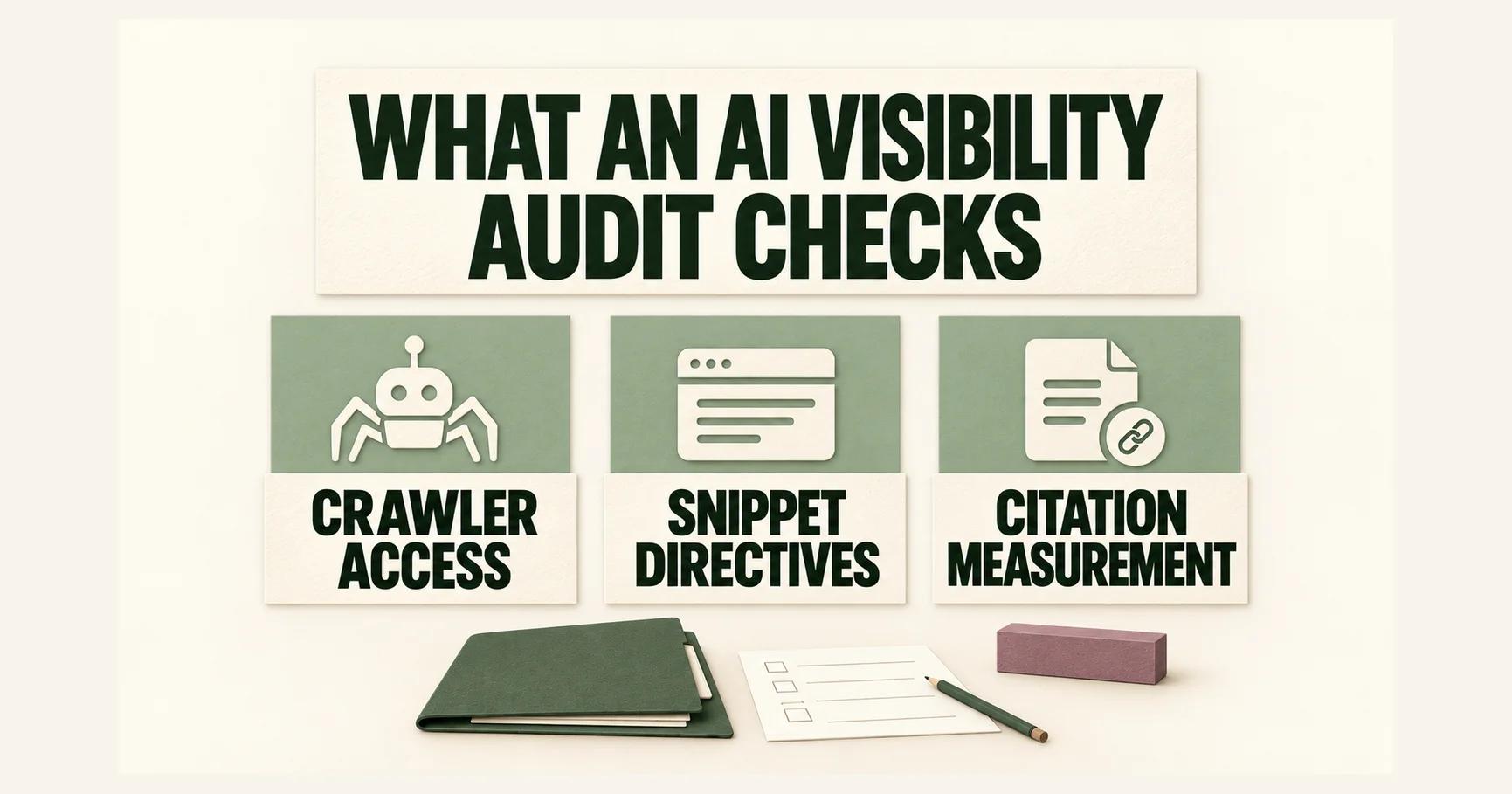
Quick Answer: An AI visibility audit checks whether answer engines can access and quote a site, then separates observed citations from visits. Verify each crawler, page-level snippet control and vendor report with saved evidence. Google, OpenAI and Bing document checks; none promises that an eligible page will appear in every AI answer 1,2,4,5.
Summary in a mind map
What Is an AI Visibility Audit? Vendor Checks Explained
│
├─ Access · the named crawler
│   ├─ OAI-SearchBot and GPTBot have distinct settings
│   └─ Save the served robots.txt rule and check time
│
├─ Eligibility · the page
│   ├─ Google needs indexing and snippet eligibility
│   ├─ Preview controls can restrict direct AI input
│   └─ Bing has separate grounding controls
│
├─ Observation · the answer
│   ├─ Bing citations are visible references
│   ├─ ChatGPT referrals are visits after a click
│   └─ Neither measure alone covers every answer
│
└─ Decision · the next check
    ├─ Fix a documented access barrier first
    └─ Record sampling limits before comparing results
AI visibility audit: the checks
A classic search audit asks whether a page can be found, indexed and visited. An AI visibility audit adds a narrower question: can a particular engine use or cite that page in a generated answer? It then asks whether the business has actually observed a citation. Those questions need separate evidence because eligibility, appearance and traffic are different events. Google describes technical eligibility for a supporting link, while Bing describes citations already observed in its AI Performance report 2,5.
For a small accountancy practice, take one service page about a client question. Note its URL, the question, the engine and the date. Test the page before judging any answer it may or may not receive. A failed access check explains why an observation is inconclusive; a passed check does not predict a citation. Google expressly says eligible pages are not guaranteed to be crawled, indexed or served 2.
| Audit finding | Vendor-documented evidence | What it cannot prove |
|---|---|---|
| Crawler access | Named robots.txt rule and served response for OAI-SearchBot, Googlebot and Bingbot 1,2,4 | That an answer will cite the page |
| Google snippet eligibility | Index status and preview controls 2,3 | That a specific prompt will produce a link |
| Bing citation | AI Performance report row 5 | A click or customer visit |
| ChatGPT referral | Analytics URL parameter 6 | Every mention without a click |
Crawler access by engine
Check Googlebot under Google’s robots.txt directives and whether Bingbot can crawl and render the page 2,4. Record each engine separately. OpenAI's crawler settings are independent. Allowing OAI-SearchBot can support search appearance while disallowing GPTBot indicates that crawled material should not be used to train OpenAI's generative foundation models. One rule cannot stand in for the other. The audit should preserve the robots.txt text, the user-agent name, the URL fetched and the observation time. For OAI-SearchBot, also save the published searchbot IP-range file and whether a request from that range reached the server 1.
An allow rule is still only one piece of the route. If the served URL, its page response or its snippet control differs from the version the owner intended, the AI visibility audit must describe that served state. A checklist saying simply “AI crawlers allowed” discards the distinction that OpenAI itself makes. The same finding should never be copied across vendors without checking their own published controls 1,2,4.
Snippet controls in AI answers
Google requires an indexed page eligible to appear with a Search snippet before it can be a supporting link in AI Mode or AI Overviews. Its nosnippet rule prevents content from being used as direct input to those features. The max-snippet directive limits how much text may be used. A page may therefore remain a conventional search result while a preview setting restricts the AI answer surface 2,3.
Bing describes different consequences for its own controls. NOARCHIVE prevents use in Copilot responses and grounding results. NOCACHE restricts Copilot to a URL, title and snippet. DATA-NOSNIPPET and NOSNIPPET can limit citation quality by preventing captions. These are vendor-specific effects; the audit records the exact directive and engine rather than giving every setting one universal meaning 4.
The useful artefact is a copy of the HTML or response header actually served for the tested page. A content-management setting in a dashboard is an intention. The served directive is the evidence the crawler can encounter. Google also notes that crawlers must be allowed to fetch a page before they can read its meta controls 3.
In words, the tree branches like this: first check access for the named engine; if access works, inspect the page's preview controls. If the page remains eligible, examine the vendor's observed report. A report row supports a citation finding; a missing row does not prove the page will never appear 1,2,5.
Measuring AI appearance
Bing Webmaster Tools shows pages cited in AI-generated answers across Microsoft Copilot and partner experiences. Bing cautions that a citation means visible reference to the content. It is not a click, traffic, user engagement, ranking, authority or importance score. Keep the report row with the page and date, then label the metric precisely. Bing says this is a sample of citation activity, refreshed daily with a short processing delay; a missing row can reflect either limit 5.
OpenAI gives publishers another observation: ChatGPT includes utm_source=chatgpt.com in referral URLs, allowing those visits to be tracked in analytics. A referral is evidence of a visit following a link. It does not count people who saw an answer without clicking. An audit that reports only referrals misses the citation surface; one that reports only citations misses the resulting visits 6.
Limits of the audit
Vendor documentation establishes controls and definitions, but it does not certify a third-party audit score. A consultant may sample prompts, compare competitors or classify answer wording. Those can be useful methods, yet a sampled answer is an observation under its stated conditions, not an engine-published ranking metric. Google says even compliant pages may not be served; Bing rejects interpreting citations as rankings or importance 2,5.
The accountancy practice should therefore retain two columns: what the vendor documents and what the auditor infers from its own sample. If a report is absent for a particular engine, do not invent a cross-engine citation count. Describe the observation method and its limits. Compare like with like before deciding whether a page improved.
Publisher audit versus model evals
An audit of AI answers can mean evaluating the answer produced by a model. That is a different question from whether a publisher's page can appear as a source. This article's six vendor documents cover crawler access, preview controls, reported citations and referrals. They do not establish a shared test for hallucination, factuality, safety or accuracy across OpenAI, Gemini, Anthropic and Copilot. Treat any such claim as a separate evaluation requiring its own documented method.
For the accountancy practice, the distinction is practical. A cited page can be accessible and visible while an answer still needs to be checked for accuracy. Conversely, a model evaluation says nothing about whether the firm's website was eligible for a supporting link. Record which surface the finding concerns before placing it in a client report.
What to do next
Start with one important service page and a customer question it answers. Save its robots.txt rule, the published searchbot IP-range check and observed access result, served snippet controls and relevant vendor report row. OpenAI says a robots.txt update can take around 24 hours to be reflected for search results, so record the time before repeating that check 1. Bing samples citation activity and refreshes it daily with a short processing delay; allow for those reporting limits when comparing dated observations 5.
For a separate measurement of answers about your business, use the 20-question, three-assistant AI Answer Audit measurement.
If the first check shows a blocked page, correct that documented barrier and verify the served result. If the page is eligible but no citation is observed, improve the answer itself and measure again without claiming a guaranteed placement. Readers comparing visibility methods can also review whether ChatGPT recommends a business, how to check AI mentions, generative engine optimisation, and why a competitor may be recommended.
Frequently Asked Questions
Does allowing GPTBot make a site appear in ChatGPT search?
Can a page rank in Google but fail an AI answer check?
Does a Bing Copilot citation mean someone visited the website?
Can an audit promise that an eligible page will be cited?
What evidence should support a crawler access finding?
Where can a business measure AI answer visibility?
Does an AI visibility audit test hallucination or model safety?
How often should the AI visibility audit be repeated?
Sources
- 1.Overview of OpenAI Crawlers — OpenAI · 2026
- 2.AI features and your website — Google Search Central · 2025
- 3.Robots meta tag, data-nosnippet, and X-Robots-Tag specifications — Google Search Central · 2026
- 4.Bing Webmaster Guidelines — Microsoft Bing · 2026
- 5.AI Performance in Bing Webmaster Tools — Microsoft Bing · 2026
- 6.Publishers and Developers FAQ — OpenAI · 2026
Want this run on your business?
AI Foundation Audit — a structured assessment of your AI footprint: integration risks, governance gaps, ROI opportunities. Delivered as a comprehensive report you can act on.
You receive your AI Opportunity Report and Implementation Brief — tailored to your business and delivered immediately.