FAQ Schema After Rich Results: What Is Worth Keeping?
Google stopped showing FAQ rich results in May 2026. Learn what FAQPage still means, why AI search needs no special schema, and when upkeep is worthwhile.
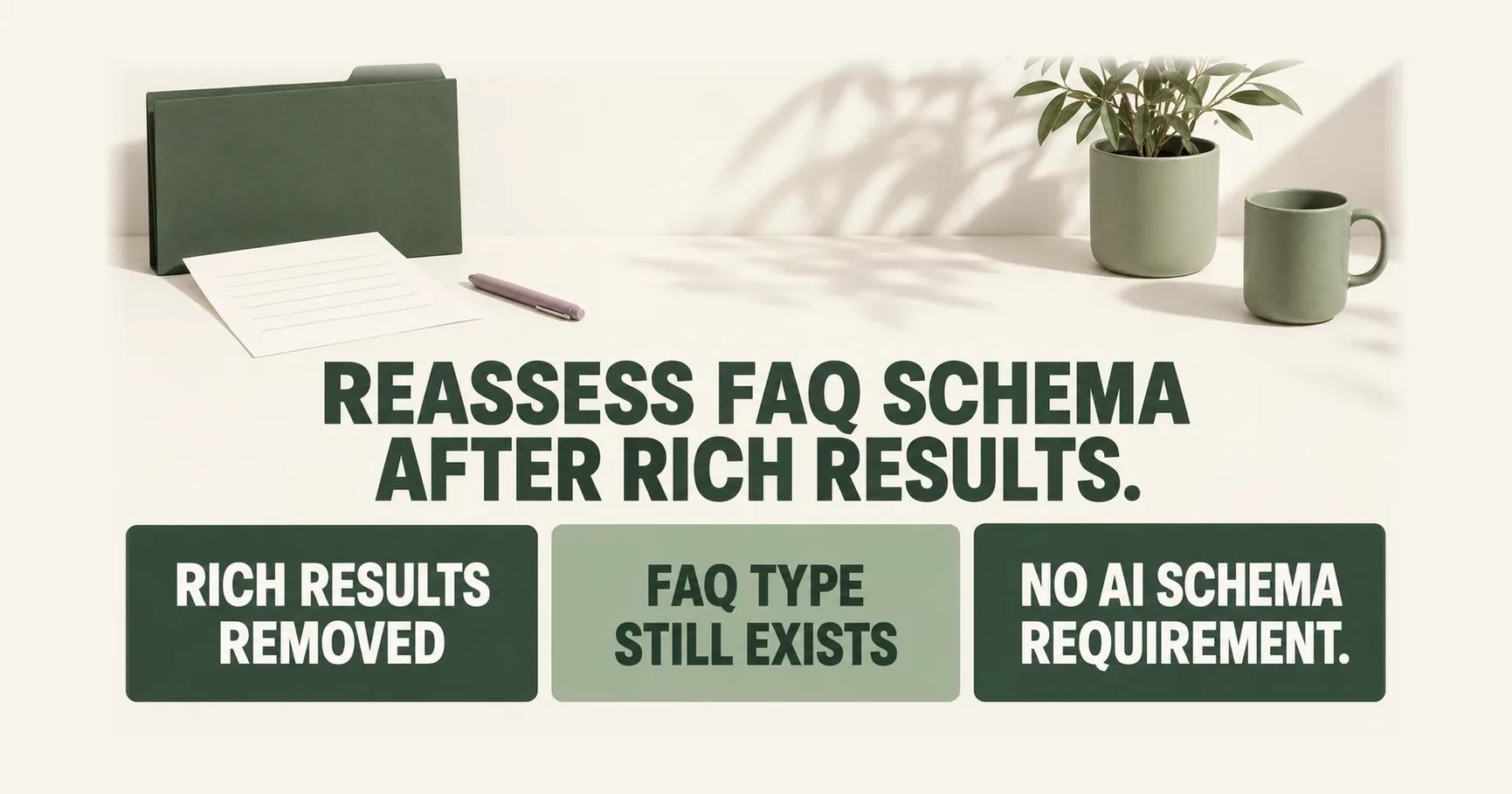
Quick Answer: Google stopped showing FAQ rich results on 7 May 2026, so valid FAQ schema cannot revive that feature1. Schema.org still defines FAQPage, while Google says structured data is unnecessary for generative AI search2,3. Keep customer questions visible; maintain markup only when you can identify and verify a useful consumer of it.
Summary in a mind map
FAQ Schema After Rich Results: What Is Worth Keeping?
│
├─ Google display ended
│   ├─ FAQ rich results stopped on 7 May 2026
│   └─ Valid markup cannot bring the feature back
│
├─ The type still exists
│   ├─ FAQPage describes a page with customer questions
│   └─ A schema type is not a Search display promise
│
├─ AI Search has no schema duty
│   ├─ Google requires no special generative AI markup
│   └─ Visible answers remain useful to customers
│
└─ Decide on evidence
    ├─ Name a documented downstream consumer
    └─ Compare upkeep with the value it actually gives
Google's rich result removal
Google's 8 May 2026 documentation update recorded that FAQ rich results would no longer appear from 7 May. In June, Google removed the feature's documentation because the result was no longer shown. These are two steps in the same change: the display ended first, and the feature guide was removed later1.
The practical test for a small business is whether its current plan depends on that display. A Minneapolis installer might still have an old FAQ plugin on a service page. The plugin's “valid markup” message says something about its output, but it does not contradict Google's announcement. A display benefit needs a current display feature; a green validation message is not one1.
This matters when a team reviews old SEO tasks. A recommendation written before May 2026 can be technically neat yet commercially obsolete. Note the date of the recommendation, the feature it expected, and the current source for that feature. If the promised outcome is a FAQ rich result in Google Search, remove that promise from the work order1.
What FAQPage still defines
Schema.org defines FAQPage as a WebPage presenting one or more frequently asked questions. It is a vocabulary for describing the content, rather than a contract for placement in a particular search interface2.
That distinction prevents two mistakes. Deleting every visible FAQ because Google retired one display feature would throw away answers customers may need. Keeping markup because the type still exists would also be an incomplete reason: a type's definition does not show who uses the data, how, or with what outcome1,2.
A page can carry an accurate customer question without carrying FAQPage markup. Conversely, markup attached to a page that does not present the questions would misdescribe the page under schema.org's definition. When assessing an existing plugin, compare its question and answer output with the page a customer actually sees2.
| Decision | What the cited sources establish | What they do not establish |
|---|---|---|
| Keep visible answers | FAQPage describes a page presenting questions2 | A required number or wording of customer questions |
| Expect Google's old FAQ display | Google ended it from 7 May 2026 1 | A route to restore it with valid markup |
| Add markup for AI Search | Google says it is unnecessary3 | How every independent answer service reads a page |
Valid markup cannot restore it
No. A format can be valid while a product feature is unavailable. Google's notice addresses whether the FAQ rich result appears in Google Search. Schema.org addresses what FAQPage means. Neither statement turns validation into eligibility for a feature Google has removed1,2.
If a vendor presents a screenshot of a structured data validator, ask what outcome it is meant to prove. It may show that the code parses. It does not show that a user saw an FAQ expansion in Search after 7 May 2026. The two observations have different owners, dates and evidence. Keep them separate in reporting1.
The same separation applies to a content management system warning. A warning that FAQPage markup is absent is a prompt to inspect the template, not evidence that the site has lost a current Google FAQ result. Record whether the website still serves the questions clearly before treating markup removal as a customer-facing loss1,2.
Google's AI Search schema rule
Google's guide says structured data is not required for generative AI search and there is no special schema.org markup to add for it. The guide still treats structured data as part of a broader SEO approach where it is relevant to other rich results. That qualification matters: “not required for AI Search” does not mean “all structured data is useless.”3
For this particular decision, the removed FAQ display weakens the old Google-specific case for maintaining FAQPage solely for rich results. Google's AI guidance supplies no replacement requirement. A business should therefore avoid buying an “AI FAQ schema” package on the assumption that such a field is mandatory for Google's generative features1,3.
A useful comparison is to check whether AI mentions your brand and observe the answer itself. Such observation is separate from the presence of schema. Our explainer on generative engine optimisation gives the broader search context; it does not turn FAQPage into a special AI instruction.
Which customer questions stay?
Keep questions that help someone decide what to do next with the business. For an insulation installer, that might mean explaining which properties it serves, how a survey is arranged, or what information a homeowner should have ready. The examples are a practical editorial choice. The cited sources prescribe no such list and confer no guaranteed search benefit on those particular questions1,2,3.
Each answer should remain understandable without the markup. A person reading the page needs the service detail in ordinary visible text. If a plugin creates a separate hidden answer that differs from the page, correcting the visible answer is the first content task. The schema definition describes a page presenting questions; it does not substitute for answering them to readers2.
For a visibility review, compare a few real customer questions with what a search or answer interface shows. Whether ChatGPT recommends your business and why it may recommend a competitor are distinct questions from whether FAQ markup validates. A change in one should not be reported as proof of a change in the other.
When is upkeep justified?
A documented downstream consumer can justify maintaining accurate markup. Name the consuming application, capture its current specification or test result, and describe the business value it provides. The three sources here do not identify one for this installer. Until such evidence exists, it would be a guess to promise a particular third-party benefit from keeping the plugin1,2,3.
The diagram below treats a Google FAQ result, Google AI requirement and a proven other consumer as separate branches. It gives the owner a decision record that can be revisited when documentation changes.
In words, the tree branches like this: keep useful answers visible; do not retain markup for Google's retired FAQ result or as a supposed AI Search requirement; retain it when a specific other system's use is verified.
What to do next
Audit the old FAQ plugin against the visible page, then write down the outcome it was meant to deliver. If it was only the retired Google FAQ rich result, update that expectation. If a downstream consumer is proposed, require evidence of its actual use. To see how AI answers currently describe and recommend your business, AI Answer Audit runs a one-time check.
Frequently Asked Questions
When did Google remove FAQ rich results from Search?
Is FAQPage still a valid schema.org type?
Does valid FAQ markup qualify for a Google rich result now?
Does generative AI search require FAQ schema?
Which FAQ questions should remain visible to customers?
When is maintaining FAQ markup still reasonable?
Sources
Want this run on your business?
AI Foundation Audit — a structured assessment of your AI footprint: integration risks, governance gaps, ROI opportunities. Delivered as a comprehensive report you can act on.
You receive your AI Opportunity Report and Implementation Brief — tailored to your business and delivered immediately.