Bing Webmaster Tools: What Do 2026 AI and Search Reports Mean?
Read Bing Webmaster Tools' AI and Search reports without treating citations as rankings. Separate search traffic, page work and IndexNow submissions.
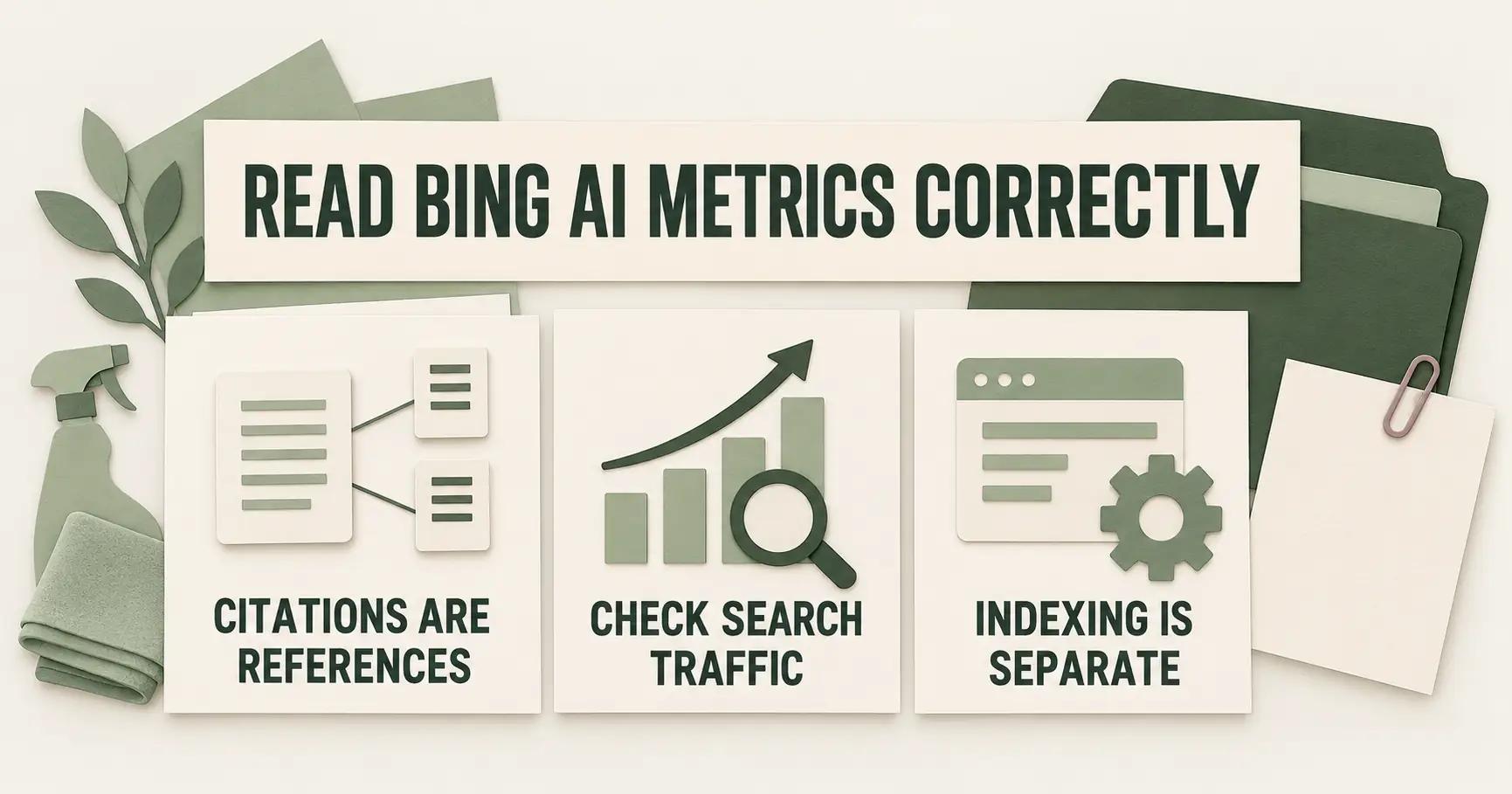
Quick Answer: In October 2026, use Bing Webmaster Tools' AI Performance to examine visible citations and Search Performance to examine impressions, clicks and click-through rate. A citation is not a ranking or authority score 1; a search click is a different event 2. IndexNow submission does not prove indexing or a later citation 3.
Summary in a mind map
Bing Webmaster Tools: What Do 2026 AI and Search Reports Mean?
├─ AI references
│   ├─ A citation names a visible source page
│   ├─ It is not a rank or authority score
│   └─ Keep the page and reporting period
├─ Report views
│   ├─ Grounding groups are not customer prompts
│   ├─ Read Topics with their filters
│   └─ Read Citation Share with its denominator
├─ Search traffic
│   ├─ Impressions and clicks have their own units
│   ├─ CTR uses search impressions
│   └─ Do not add clicks to AI citations
└─ Page action
    ├─ Inspect the live service page
    ├─ Keep IndexNow submission separate
    └─ Verify indexing with inspection tools
What AI Performance counts as a citation
A citation is a visible reference to a source page in an AI answer. The useful unit for a small business is the referenced URL with the answer context and reporting period. It is not a vote on whether the page is the best result for every customer. Bing's AI Performance help explicitly says the report does not measure rankings, authority, performance or importance 1. Those four exclusions matter whenever a dashboard number is copied into a management report.
Consider a commercial cleaning company with four staff in Columbus. Its office-cleaning service page may be cited in an answer during one reporting period. That observation tells the owner where a reference appeared. It does not tell the owner that the page ranks first in conventional search, that every prospect saw it, or that the answer led to a booking. The next useful action is to inspect the cited page and record whether the service description is accurate. An individual answer can be examined only if it was captured in a separate manual check.
A count without a page and period is weak evidence. Write down the report name, URL, date range and any displayed grouping. If a page receives several citations, keep that count within its own report. Do not combine it with visits, enquiries or sales until those events have their own evidence and definitions. This is a measurement discipline, not a promise that additional citations will follow a page edit.
Which AI experiences does the report cover?
Bing documents AI Performance citations across Microsoft Copilot, AI-generated summaries in Bing and select partner AI integrations 1. These are the covered experience types. The aggregate report does not expose each individual answer, so the cleaning company cannot use a citation count to reconstruct what a particular customer saw.
For the cleaning company, the safe comparison starts with a single observed service-page citation. Preserve the displayed source and view name. If the owner also tests a customer question manually, store that observation in another row with its date and location. The manual test and the report are different collections, so their numbers are not interchangeable. The manual test records an individual observation that the aggregate report does not show.
This distinction protects the team from an inflated conclusion. A page may appear in one answer while another answer uses a different source. Neither observation identifies the total audience without a documented denominator. Describe the surface and the period precisely. If the report provides no denominator for a claim, leave that claim out of the performance summary.
Grounding query groups versus customer prompts
A grounding-query group is a report grouping, not a transcript of an individual customer's question. The group can point the owner toward a subject that was used when generating an answer, but it cannot reveal exactly what a person typed. Treat the displayed phrase as a category for inspection rather than a quotation from a prospect. That keeps research useful without pretending to know a customer's private wording.
The cleaning team might see activity around a broad office-cleaning theme. Its page should answer what the business actually offers: service area, scope and contact path. The owner can compare that page with real enquiries already collected by the business, provided those enquiries are handled appropriately. There is no need to invent a customer's question from a broad report label.
A practical review note has three columns: the displayed group, the cited page, and the gap the reviewer actually found on that page. If no gap is found, the note should say so. The report should not force a rewrite. It is a signal about where to look, and the page itself supplies the evidence for any content change.
Topics and Citation Share in context
Topics group related grounding queries into broader thematic clusters 1. Citation Share is the site's percentage out of all citations shown for a specific grounding query 1. That denominator is citations for that query, not search impressions or all market exposure. A topic is not a verbatim customer prompt, and a share is not a ranking.
| View | What to record | What not to infer |
|---|---|---|
| Visible citations | Referenced URL and period | Ranking, authority or importance 1 |
| Grounding-query group | Displayed group and page | A verbatim customer prompt |
| Topics | Broader thematic clusters of related grounding queries 1 | Individual customer prompts |
| Citation Share | Site percentage of all citations for a specific grounding query 1 | Search click-through rate |
The review can still lead to useful work. If a cited service page omits a clear description of after-hours cleaning, and the company actually offers it, the owner can improve that page. The reason for the edit is the missing service information, not an unsupported expectation about the next citation count. Keep the edit date and page version so a later comparison has a traceable starting point.
Search Performance clicks and impressions
Search Performance counts impressions when a result or link is displayed and clicks when a person follows that link to the website 2. Its documented sources include Learn more links in the Chat response 2. Bing defines average click-through rate as the percentage of impressions that resulted in a click to any page of the website 2. That definition binds the rate to impressions and clicks. An AI citation is not an impression or a click simply because all three appear inside a search-related tool. The same word “performance” on two report names does not make their units equal.
The cleaning company should read search clicks alongside the query, page and period filters exposed in Search Performance. A page can be cited in an AI experience without a link click in the same period. Conversely, a page can receive search traffic without being visibly cited in the AI report. Both observations can be true; the reports answer different questions.
A compact review table prevents accidental arithmetic across unlike units:
| Question | Report | Unit |
|---|---|---|
| Was the page referenced in a visible AI answer? | AI Performance | Citation activity 1 |
| Did a search impression lead to a site click? | Search Performance | Click-through rate 2 |
| Was a changed URL submitted? | IndexNow record | Notification 3 |
If search impressions are present but clicks are weak, investigate the page and search presentation using that report's own definitions. If citations appear but enquiries do not rise, examine the business journey rather than calling the citation count a failure. Neither report alone attributes a sale. The owner should write the next question before opening another chart.
IndexNow is a separate signal
IndexNow notifies participating engines when a URL is added, updated or removed. Its FAQ says submission does not guarantee immediate indexing 3. The cleaning company might notify the updated office-cleaning page after a service-area revision. That is a record of a changed URL, not evidence that Bing fetched the page, placed it in the index or used it as an AI citation.
The submission date and URL belong in a record apart from the AI and search report periods. The first page check covers its content, response, crawler access and any indexing restriction. Later, use the engine's site inspection or reporting tools to check the URL's index state; the IndexNow FAQ points to those tools 3. Only then compare what the reporting screens show. If a page is not indexed, rewriting its prose alone will not resolve a technical block.
What this report cannot decide
These views cannot tell the cleaning company which single page edit will produce a future citation, search click or sale. Bing expressly excludes rankings, authority, performance and importance from AI Performance's meaning 1. IndexNow expressly stops short of guaranteeing immediate indexing 3. That leaves room for editorial judgement: a page should be changed when its information is inaccurate, incomplete or hard for a customer to use.
The owner can check whether AI mentions the brand, ask whether ChatGPT recommends the business, read about generative engine optimisation, and examine why a competitor is recommended. These are separate diagnostic questions. No one report supplies the entire answer.
What to do next
Choose one service URL, capture the AI Performance and Search Performance views with their date ranges, and inspect the live page. Record each metric in its own unit. If the page was recently changed, retain its IndexNow submission separately and verify the index state with inspection or reporting tools 3. For a separate review of the business's presence in AI answers, use AI Answer Audit.
In words, the tree branches like this: identify the question, read AI citation data for references, Search Performance for link displays and clicks, and IndexNow for submission status; then inspect the page or index state before deciding on content work.
Frequently Asked Questions
What does Bing Webmaster Tools AI Performance report show?
Does AI Performance show every prompt a customer typed?
What does Search Performance click-through rate mean?
Does an IndexNow submission prove that Bing indexed my page?
Should I rewrite every page with no AI citations?
Can I add AI citations and search clicks together?
Sources
Want this run on your business?
AI Foundation Audit — a structured assessment of your AI footprint: integration risks, governance gaps, ROI opportunities. Delivered as a comprehensive report you can act on.
You receive your AI Opportunity Report and Implementation Brief — tailored to your business and delivered immediately.